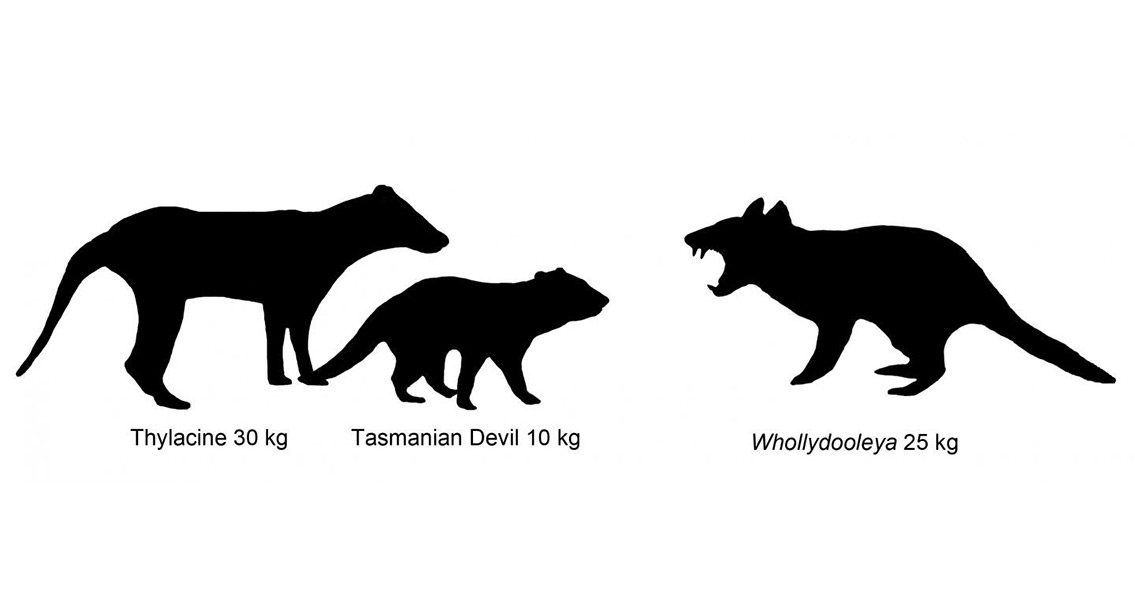
Whollydooleya tomnpatrichorum. It is believed W.tomnpatrichorum would have weighed between 20 and 25 kilograms in life. By comparison, a modern adult Tasmanian Devil weighs around just 10 kilograms. The creature marks the first formally identified discovery from New Riversleigh, a recently unearthed site in a remote part of Queensland littered with the remains of a plethora of strange, previously unidentified creatures. A description of W.tomnpatrichorum has just been published in Memoirs of Museum Victoria. W.tomnpatrichorum‘s distinct teeth are the focus of the new paper. One of the animal’s molars was excavated from an area of New Riversleigh known as Whollydooley Hill, named after Genevieve Dooley, one of the volunteers excavating the area. The tooth was found by Dooley’s partner, Phil Creaser. University of New South Wales Professor Mike Archer, the lead author of the new study, provided an insight into the just how the animal used its ferocious looking teeth. “W. tomnpatrichorum had very powerful teeth capable of killing and slicing up the largest animals of its day,” The late Miocene period in Australia, during which the newly discovered creature lived, is one of the least well understood in Australia’s history. Stretching from twelve million to five million years ago, it was characterised by drastic climate change as the continent began to dry out and megafauna there were forced to evolve and change in response. Due to the aridity of the period, precious few land animal fossils remain. That scarcity of fossils makes New Riversleigh so valuable to scientists. The site was discovered in 2012 by remote sensing using satellite data, close to the already famous fossil site of Riversleigh. “New Riversleigh is producing the remains of a bevy of strange new small to medium-sized creatures, with Whollydooleya tomnpatrichorum, the first one to be described,” explained Professor Archer. “These new discoveries are starting to fill in a large hole in our understanding about how Australia’s land animals transformed from being small denizens of its ancient wet forests to huge survivors on the second most arid continent on Earth.” Although the remains of a host of medium to large sized late Miocene animals have previously been found in fossil deposits in Australia’s Northern Territory, much less is known about the small to medium sized creatures that lived in that time “which generally provide more clues about the nature of prehistoric environments and climates”, Professor Susan Hand from UNSW, a team member on the project, explained. Dr Karen Black, post-doctoral researcher in paleontology at UNSW, added: “The small to medium-size mammals from the New Riversleigh deposits will reveal a great deal about how Australia’s inland environments and animals changed between 12 and 5 million years ago – a critical time when increasing dryness ultimately led to the Ice Ages of the Pleistocene.” According to Professor Archer, the W.tomnpatrichorum specimen discovered at New Riversleigh could have been one of the last of its species. “While it was at least distantly related to living and recently living carnivorous marsupials such as Devils, Thylacines and Quolls, it appears to have represented a distinctive subgroup of hypercarnivores that did not survive into the modern world.” “Climate change can be a merciless eliminator of the mightiest of mammals,” Archer remarked. For more information www.museumvictoria.com Illustration: Karen Black/UNSW ]]>
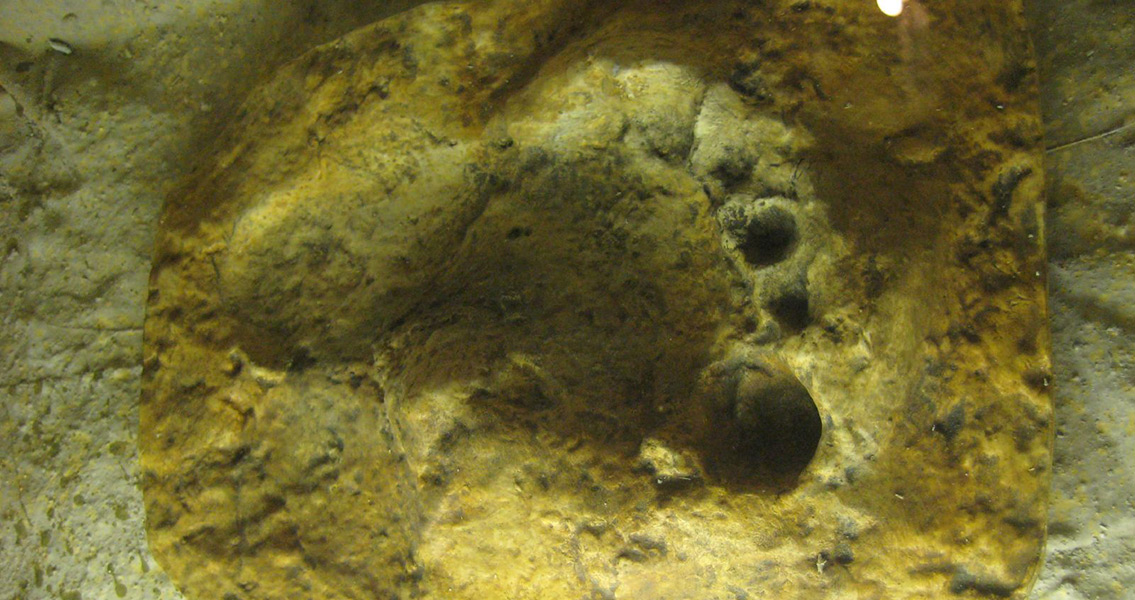
Homo neanderthalensis was the dominant human species in Europe, populating the whole of the continent. Although archaeologists have discovered numerous settlements in Germany, they have also uncovered evidence which shows that Neanderthal populations there came to an unexplained, sudden end. Based on the analysis of several archaeological sites, Jürgen Richter (Collaborative Research Center 806 — Our Way to Europe), has concluded that shortly after Neanderthals reached their peak population in Germany, their numbers rapidly declined, leading to their extinction. Neanderthals lived during the Middle Paleolithic, the time between 200,000 and 40,000 years ago. Richter’s research suggests that over 50 percent of the identified Neanderthal settlements in Germany specifically date back to between 60,000 and 43,000 years ago. Therefore, the peak Neanderthal population lies within this period. Neanderthals were an ancient human species, part of the genus Homo, that became extinct approximately 40,000 years ago. With 99.5% of the same DNA, they’re closely related to modern humans. Bone and stone tools left by Neanderthals have been found throughout Eurasia, in western to central Europe, and northern and western Asia. Their species is generally classified as Homo neanderthalensis, believed to have separated from Homo sapiens around 600,000 years ago. Some experts however, believe Neanderthals were a subspecies of Homo sapiens and therefore should be classified as Homo sapiens neanderthalensis. The number of Neanderthal sites, as well as the analysis of artifacts discovered in them, indicate the Neanderthal population in Germany were subjected to extreme demographic changes. For example, during the Middle Paleolithic there seem to have been numerous migrations, increases and declines in population, even extinctions in certain locations followed by a return of settlers. During the time period between 110,000 and 70,000 years ago there were only four identified Neanderthal settlement sites in Germany, however, during the following period between 70,000 and 43,000 years ago there were ninety-four. Less than 1,000 years later, after this peak in population, there was a rapid decrease and the Neanderthals disappeared. Why the species went extinct is still unknown. It may have been the result of decreased genetic diversity; another possibility is competition for resources with the growing number of Homo sapiens. Around 55,000 years ago, the climate began to fluctuate back and forth from extremely cold to milder cold conditions in the span of a few decades. Neanderthals had bodies that were well suited for surviving in cold climates, with stocky limbs and barrel chests that stored body heat much better than Cro-Magnons (the first early modern humans). However, these rapid climate fluctuations also caused ecological changes that the Neanderthals could not easily adapt to; familiar animals and plants would have been replaced by completely new ones within the space of a lifetime, and the Neanderthals’ ambush hunting technique wouldn’t have worked as trees replaced the grasslands. Neanderthals eventually went extinct in Europe between 41,000 and 39,000 years ago, coinciding with a period of extreme cold. This article has been published in the Quaternary International Journal. Image courtesy of Wikimedia Commons user Claire H. ]]>

Royalty, bought one such relic: blood stained tree leaves, determined to find out once and for all if they were truly covered in the monarch’s blood. In 2014, Professor Dieter Deforce from the University of Gent carried out tests confirming the blood was human. From there, Larmuseau and his team commenced DNA analysis to confirm whether the blood did indeed belong to King Albert I. “King Simeon II of Saxe-Coburg and Gotha, the last tsar and former prime minister of Bulgaria who is related to Albert I on his father’s side, and Anna Maria Freifrau von Haxthausen, a German baroness who is related to Albert I on her mother’s side, were willing to cooperate. They gave up DNA samples that we compared with the DNA of the trails of blood. We found that the blood is indeed that of Albert I.” said Larmuseau, in a press release from KU Leuven. “The authenticity of the trails of blood confirms the official account of the death of Albert I. The story that the dead body of the king has never been in Marche-les-Dames or was only placed there at night has now become very improbable. Furthermore, the results show that conducting a perfect legal investigation at the time was impossible right from the start, because souvenir hunters had disturbed the scene.” Larmuseau continued. Born in April 1875, King Albert succeeded to the throne in 1909. His popularity came from his refusal to allow German troops free passage through Belgium in 1914, and his personal leadership of the Belgian army during the First World War. Following the armistice, his reign was considered crucial in securing Belgium’s post war recovery. For more information: www.fsigenetics.com Image courtesy of © KU Leuven – Maarten Larmuseau ]]>
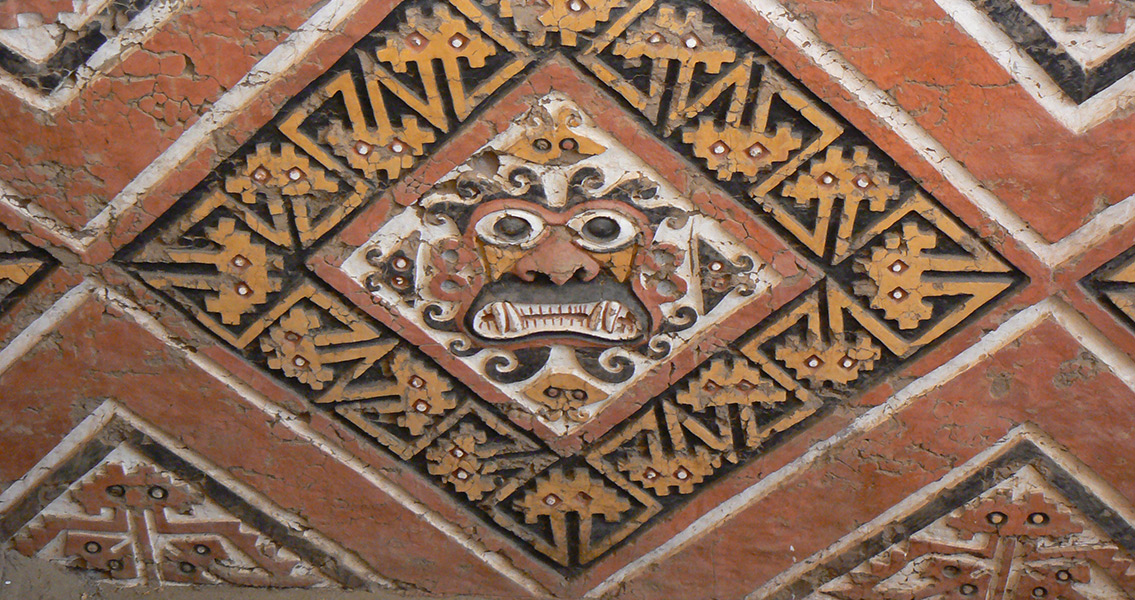
Harvard Gazette. “When I started as a young student, 25, 30 years ago, we thought the Moche was a culture led by powerful kings, warriors, or priests”, said Castillo. This is the eighth royal tomb found in the past 25 years by the San José de Moro Archaeological Program, and all eight tombs have showcased women who were found wearing beaded necklaces and intricate headdresses, surrounded by sacrificial victims. Collectively known as the priestesses of San José de Moro, they put a spotlight on the prominent role women played in Moche society. “These women were among the most important individuals in their society,” Castillo told the Harvard Gazette. “Their elaborate burials are narratives of their lives, and the ornaments they were buried with are indicators of their high status.” Another finding which supports the women’s role as priestesses are the scenes depicted in Moche art – scenes of Moche rituals include figures wearing similar headdresses and carrying silver goblets like the ones found with the remains. The Moche people didn’t have a written language, but they left thousands of ceramic pots covered with intricate drawings that portrayed their daily lives and their astral beliefs. In the scenes that depict human sacrifice, a priestess wearing a headdress holds a silver goblet full of the victims’ blood. Considered the first state-level culture in the Americas, the Moche thrived and ruled the northern coastal area of Peru from the first to eighth centuries (prior to the Incas), at the same time that the Mayans were prospering in Central America and Mexico. They conquered the desert with a complex system for irrigation, constructed adobe pyramids and used religion to unite their society like many other ancient cultures. Following the recent discoveries, another widely held belief concerning the Moche, that they lived under a single ruler, is also being reconsidered by archaeologists. “They were multiple polities, small chiefdoms that never achieved a political unification,” Castillo told the Gazette, “Some communities may have been led by women and others by men.” “They were not the sisters, the mothers, or the wives of somebody powerful,” Castillo stated in the Gazette, “In all the burials, the women had a status associated with Moche priests. They were priestesses, but they could have also been rulers. In ancient cultures, political and religious power were blended, and the rulers were often the priests.” Image courtesy of Wikimedia Commons user: Kevstan]]>

Gizmodo, Brown University’s Peter Schultz remarked that the massive asteroid was originally estimated to have been around 80 kilometers across. The lead author of the study said that this estimate has changed to at least 250 kilometers in size, and even that figure was described by Schultz as “conservative”. Imbrium Basin, the region that forms the right eye of the “Man in the Moon”, is a dark patch on the satellite’s surface that’s around 1200 kilometers wide. Both professional and amateur astronomers have studied the crater since the advent of astronomy, as it’s clearly visible with even the most basic of telescopes. Several radial gashes jut out from the surface of the basin. Clustered on the southeastern side of Imbrium, these marks were formed from ejecta as the proto-planet smashed into the Moon, likely from the northwest. The new study sought to solve some of the mysteries plaguing astronomers for decades, turning away from these well-studied gashes and instead examining scarred regions of the crater that aren’t radial. For 70 years or so, astronomers have been flummoxed as to what had caused those features, Schultz said. However, the mystery may now finally be solved thanks to a hypersonic gun range originally created by NASA during the Apollo program, which was used to simulate collisions. Firing projectiles at the Vertical Gun Range and recording the experiments with high speed cameras allowed Schultz and his team to observe pieces of material break off up-range of the primary impact site. This material preserved its momentum, leaving deep scars in the surface of the crater in a fashion that was not radial – similar to the mysterious pattern on the Imbrium Crater. Additionally, when he applied the physics to Imbrium Basin, Shultz discovered that he could extrapolate the size of the proto planet, leading him to revise the estimated size of the object. The discovery also led to an analysis of the Orientale and Moscoviense Basins on the Moon, revealing that these craters were likely caused by collisions from proto planets or objects similar in size. However, Schultz was quick to say that the Late Heavy Bombardment wasn’t from proto planets in its entirety , as there were plenty of other asteroids pelting the Earth and the Moon at the time – but he explained that the new discoveries point towards there being several proto planets within the early solar system. The research results are available online from the journal at Nature]]>