Categories
Breaking News

Site of Bear River Massacre Pinpointed by Historians

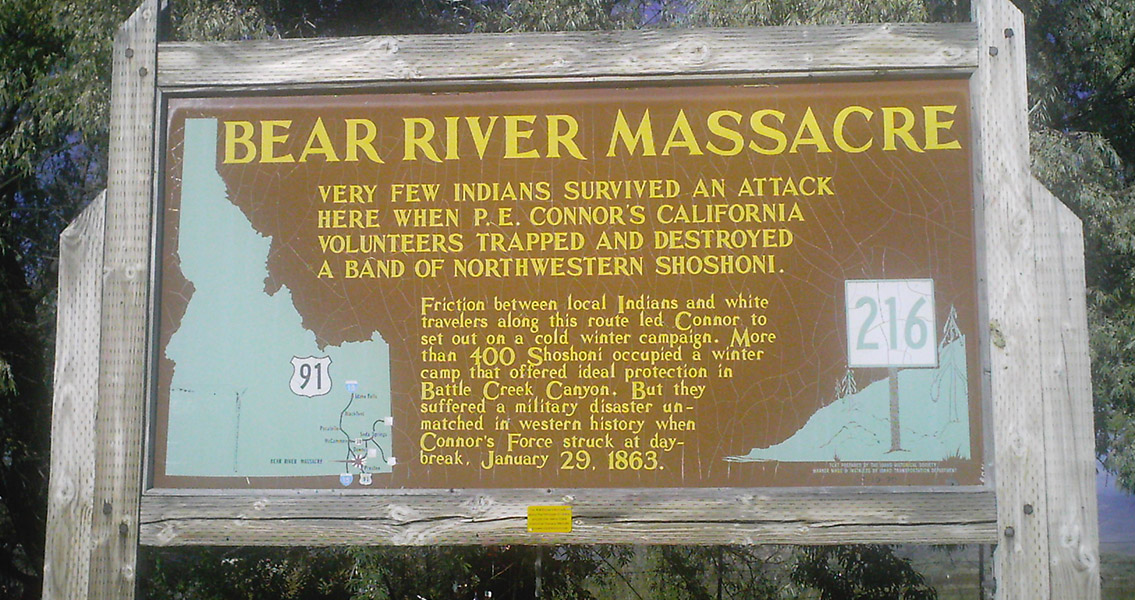
Idaho State Journal, was part of a team from Utah State University that has been investigating the Bear River Massacre site for the last three years. The archaeologist presented the team’s findings at a meeting of the Pocatello Historic Preservation Committee at Idaho State University. It has not been an easy endeavor to find the site of the massacre, thanks to the shifting riverbed of the Bear River. The path of the river has changed numerous times over the last 150 years, which required the researchers to engage in innovative approaches to find definitive answers. Starting with maps that had been penned by soldiers who were part of the massacre in 1863, the team used modern technology to make a closer determination of the location. As a result, the riverbed as it wound during the 1860s was found; the site of the camp, which had been situated at the confluence between Bear River and Battle Creek, had moved about 700 meters southward since that fateful day in early 1863. The original site, near Preston within Franklin County, is located within a 718-acre swathe of land that was set aside by the National Park Service in 1990 in order to commemorate the bloody battle. However, the exact site had been in question up until Reid and his research team pinpointed it. However, the site of the slaughter was not a mystery to everyone, according to Darren Perry, who was also at the ISU event. The vice chairman of the Northwest Band of the Shoshone Nation said that the survivors of the battle, which numbered around 160 women and children, kept the memory alive. Perry remarked that his grandmother would show him where his people’s lodges once stood, much as her grandfather had shown her. Perry’s great-grandfather was an eyewitness to the event, having been just 12 years old at the time. Despite the atrocities committed so long ago, Perry lauded Reid and his research team for their diligence in working on laying bare the history of the Bear River Massacre. “To me, the more knowledge you can get, the better off you are.” Perry remarked to the Idaho State Journal. “All they are trying to do is tell us the story.” Reid says that the impetus behind the attack by white settlers was part of a policy to deter any raids by Native Americans. The second, and perhaps more important reason, was to make it easier for Mormon farmers to settle the nearby Cache Valley. Image courtesy of Wikimedia Commons user: Robert Scott Horning]]>

Categories
News

Controversial Immigration Law Passed in the USA

Categories
Breaking News

Ancient Chinese Beer Recipe Unearthed by Archaeologists

Business Insider, the study’s co-author, Professor Li Liu, discovered that some of the pottery found on site held a striking resemblance to brewing equipment that had been found elsewhere dating back to between 3400 BCE and 2900 BCE, and might have been involved in the brewing of alcohol as well. This represents the earliest direct evidence for beer brewing within the region. The artifacts were subjected to analysis where yellowish residue was extracted and studied. This residue was found not just in pottery but in funnels and stoves inset in earthen pits discovered on site – suggesting that these stoves had been put to use during the brewing process. Additional discoveries to support the theory of on-site brewing included traces of oxalate, a substance that is a common byproduct of brewing and is formed as part of the fermentation process. The starch grains discovered within the artifacts were also subjected to analysis, revealing that they were composed of tubers, barley, broomcorn millet and a grain known as Job’s ears. The combination of grains, roughly equated to a “recipe” by the researchers, incorporates the use of Chinese grains as well as Western ones, according to lead author and Stanford University Ph.D. student Jiajing Wang in an email interview with Business Insider. All the grains save for barley are considered native to the Central Plains. Such an early appearance of barley has raised suggestions that the grain may have been introduced to the Central Plains specifically in order to brew alcohol, instead of for strict agricultural purposes. This runs in the face of earlier evidence that supported the idea that barley was introduced to China 1,000 years later exclusively for farming and not for brewing. The study’s authors say that the brewing of alcoholic beverages in the Central Plain may be associated with higher levels of social complexity during the fourth millennium BCE. Beer could have lubricated the social development of the ancient Chinese people known as the Yangshao, contributing to the rise of hierarchical societies within the region 5,000 years ago, the researchers suggest. The new research study, which was recently published in the journal the Proceedings of the National Academy of Sciences, is available online]]>

Categories
Breaking News

Black Death Wiped Out up to 45% of East England's Population

Antiquity. During the later half of the twentieth century, historians began to argue that the true devastation of the Black Death had been exaggerated. They suggested that in reality there was little evidence of ‘catastrophe cemeteries’ from the fourteenth century, while evidence of depopulation in England seemed to have occurred too late to be a direct consequence of the spread of the Plague. The new study, led by Professor Carenza Lewis from the University of Lincoln, has used discarded pottery shards as a means to measure demography. Based on extensive analysis, she has concluded that the pottery using population was 45% lower in Eastern England following the Black Death than it had been beforehand. Thousands of members of the public assisted in the study, digging 2000 test pits across six counties in search of pieces of broken pottery. As the most commonly excavated archaeological evidence domestic pottery is a valuable indicator of population size, due to its widespread daily use and the frequency with which it was discarded. By counting and comparing the number and weight of broken pottery from different date levels, patterns emerged of the historic demography of different sites. The sheer geographic scale of Lewis’ study means it has been possible to determine which towns and counties suffered, and to what extent. “As a result, we can now say with some confidence that the pottery-using population across a sixth of England was around 45% lower in the centuries after the Black Death than before.” Lewis writes in the study, due to be published in next month’s edition of Antiquity. “Furthermore, we can identify exactly where in the settlement landscape this contraction was most and least severely felt, at scales ranging from plot to region.” The results show that as extreme as the 45% reported population drop was, in some areas the consequences of the Black Death were even greater. At Great Shelford in Cambridgeshire, the weight of pottery excavated from different test pits dropped from 2kg to 200g at the levels linked to the Black Death. “Mapping these data reveals that this large village—which in the high medieval period sprawled continuously for more than 1200m from its river-side church along a high street and around two greens—was reduced to a single row running barely 200m immediately east of the church.” Shockingly, Lewis actually believes the results presented in her study could be conservative. The excavations focused on 55 currently occupied rural locations known to have been settlements in the fourteenth century. As such, any areas where the population was devastated to the extent a settlement was completely abandoned will not have been covered by the project. The Black Death was just one element of what many historians refer to as the Crisis of the Middle Ages, a period when centuries of demographic growth in Europe were abruptly reversed by a series of political, social and economic calamities on top of those caused by the great epidemic. The Great Famine of 1315-17, alongside civil and international conflicts such as the Hundred Years War and the War of the Roses, brought prosperity and population growth to a halt over the course of the thirteenth, fourteenth and fifteenth centuries. As well as providing chilling insights into the long and short term demographic effects of the Black Death in one region, Lewis’ study offers a new methodology which can be applied to a whole host of different times and scales. “Deployed sufficiently widely elsewhere in Eurasia, test-pit excavation could provide new data to inform our understanding of how the world we inhabit today came to be. Moreover, this potential extends beyond the era of the Black Death, as test-pits can produce material of any date that may illuminate demographic change in many periods.” she writes, in the conclusion to her study. More information about the study is available here Image courtesy of Wikimedia Commons user John Davey]]>

Categories
News

The Diet of Worms Leaves Luther a Wanted Man

Categories
Breaking News

Ancient Jewelry Made from Human Jawbones Found in Mexico

Live Science, the ceremonial site was first uncovered during the spring and early summer of last year in the Oaxaca Valley, situated in southern Mexico. The site, known as Dainzú-Macuilxóchitl, was once inhabited by the Zapotec people who still reside in the region today. The ceremonial site was part of a larger Zapotec residential complex. Oregon State University’s Jeremias Pink recently led a discussion on the research findings at the annual meeting of the Society for American Archaeology. The research study associated with the discovery is currently being prepared for publication. Archaeologists said that while Xipe Totec does have a reputation for being associated with human sacrifice, the painted jawbones might not have been from human sacrifices themselves. In fact, they may have been a form of ancestor worship and veneration for those Zapotec who had lived there previously. The complex had been used for human habitation for at least four centuries, researchers found upon excavating the area. Pink, who spearheaded excavations of the ceremonial site, said that the nearby residences were likely occupied by the same interrelated family groups over that span of time. Researchers say that during this long period of habitation, bones of long-dead residents were purposefully exhumed and decorated before being turned into jewelry. Pink remarked that local residents were likely delving into the tombs associated with their ancestors in order to retrieve the skeletal remains and ritualize them, demonstrating the ancestral link between their long-dead relations and themselves. It was likely a way to legitimize their position within the existing community, the grad student added. Although this might strike modern Westerners as gruesome or at the very least quite odd, ancestor rituals were widespread in ancient Mesoamerica, according to Ronald Faulseit, the excavation director at Dainzú-Macuilxóchitl. The Chicago Field Museum postdoctoral fellow said in an interview with Live Science that many instances of otherwise macabre ancestor worship are still widespread today, an example being the “Day of the Dead” celebrated in early November every year by many Mexicans. While there are no exhumations of skeletal remains as part of the celebration, Mexicans do use the day to remember their ancestors. As to why so many of the other items found at the ceremonial site, such as the whistles and the figurines, were deliberately smashed, Pink says there’s nothing but speculation. These artifacts are currently under ongoing analysis, he added. Images of the artifacts can be found here ]]>

Categories
Breaking News

Stolen Columbus Letter Makes Another Trip Across the Atlantic

Categories
News

'Angel Of Death' Josef Mengele Arrives At Auschwitz

Categories
Breaking News

We’ve Been Remembering the Alamo Incorrectly

Categories
Breaking News

Egyptian Papyri Found to Contain R-Rated Magic Spells