

Sarmientosaurus Musacchioi. Based on a partial neck fossil and a complete skull discovered in Patagonia, it’s been determined to be a new Titanosaurian dinosaur – a kind of sauropod which ranged in size from that of a cow to the size of a large sperm whale. They were plant-eaters which had long tails and necks and might have been the most common of the large herbivores that roamed the landmasses of the Southern Hemisphere in the Cretaceous period. Despite their numbers, the skulls of these dinosaurs are exceedingly rare and critical to determining specific facts related to their biology. Only four semi-complete complete skulls out of the more than 60 known Titanosaurs have been found. Researchers associated with the latest discovery utilized computerized (CT) imaging to closely examine the anatomically primitive, well-preserved neck and skull fossils from Sarmientosaurus. Researchers discovered the Sarmientosaurus brain was small compared to its huge body, a typical trait of sauropods. But they also discovered evidence of higher sensory capabilities than almost all of the other sauropods. This suggests that Sarmientosaurus had bigger eyeballs and better vision, in addition to an inner ear which might have been better tuned for hearing airborne sounds at a low-frequency compared to other Titanosaurs. Additionally, the organ in the inner ear which affects balance suggests this dinosaur might have routinely held its head in such a manner that the snout faced downward. “Discoveries like Sarmientosaurus happen once in a lifetime,” study leader Rubén Martínez told PLOS One, “That’s why we studied the fossils so thoroughly, to learn as much about this amazing animal as we could.” There have been numerous dinosaur discoveries in Argentinian Patagonia, a few of the most outstanding have been: * Giganotosaurus Carolinii, discovered in 1993 and considered to be the world’s largest carnivore (13.5 m in length, 4.6 m tall at its hip, and 9,500 kg in weight. * Argentinosaurus Huinculensisis, the biggest herbivore found to date. (larger even than Carolinii). * Andesaurus Delgadoi was found in 1987, under several meters of water in Lake Exequiel Ramos Mejía. The discovery happened when the lake fell to its lowest recorded level due to a drought. Delgadoi was named after its discoverer, Alejandro Delgado. * Rebbachisaurus Tessonei is the most complete dinosaur specimen discovered in South America, and was found in 1988. Also a sauropod, this herbivorous dinosaur weighed around 10,000 kilos and measured 17 meters long. * Gasparinisaura Cincosaltensis, a herbivorous dinosaur which stands out for its small size, 1.50 meters, as well as it’s supposed graceful quick movement. Sarmientosaurus Musacchioi was named for the town of Sarmiento which is located in Chubut Province, close to the discovery site. The study has been published in PLOS ONE, an open-access scientific journal. Rubén Martínez, with UNPSJB, is the author of the study. Image courtesy of Mark A. Klingler, Carnegie Museum of Natural History and WitmerLab, Ohio University]]>


Andina news agency that the diverse and valuable items the woman was buried with (broaches with animal carvings, a seashell necklace, and a Spondylus pendant) were indicative of her high social status. The items were also suggestive of possible trading between the coastal town of Aspero and the larger inland city of Caral. Radiocarbon analysis dated the mummy to around 2,500 BCE, the same time people of the region started building pyramids, but didn’t offer any information concerning the manner of the woman’s death. Scientists do know that human sacrifice was a rare occurrence within the Caral civilization. The location and method of her burial in addition to the objects found with her also hint at a form of gender equality that allowed both men and women to achieve a higher level of social status and leadership roles. Even though ancient Americans were raising pyramids and building cities at approximately the same time the Egyptians were building the monuments at Giza, much less is known about the ancient people of northern Peru, the Norte Chico as they’re known. Caral has a total of six huge platform mounds (also known as pyramids) as well as several sunken circular courts and giant hive-like buildings archeologists believe served as homes. All of the findings at Caral point towards a complex society capable of undertaking large city projects. The nature and origin of this region of ancient America however, has long been a point of contention between archeologists, with one camp believing that the inland cities grew out of coastal fishing settlements similar to Aspero, while the other camp theorizes that coastal societies originated from inland settlements. While there’s no evidence connecting the 30 or so smaller settlements in the region to a central power, there’s also no evidence to the contrary. Aspero and Caral, along with the region’s other settlements, are known as the Norte Chico civilization, a pre-Columbian culture dating back to between approximately 3,500 BCE and 1,800 BCE. Considered to be the oldest known civilization in the Americas, the Norte Chico civilization thrived throughout the valleys of three rivers; the Patvilca, the Fortaleza and the Supe. Archaeologists have known about the ancient sites scattered across the area since the 1940s at least; archaeological work first took place at Aspero as early as 1905. The most impressive Norte Chico achievement was its massive architecture, which included the large earthen mounds and circular plazas mentioned above. In archaeological terms Norte Chico was a pre-ceramic society during the pre-Columbian Late Archaic; it had no visual art and absolutely no ceramics, just simple carved broaches and seashell necklaces. ]]>

Science by the American Association for the Advancement of Science.]]>

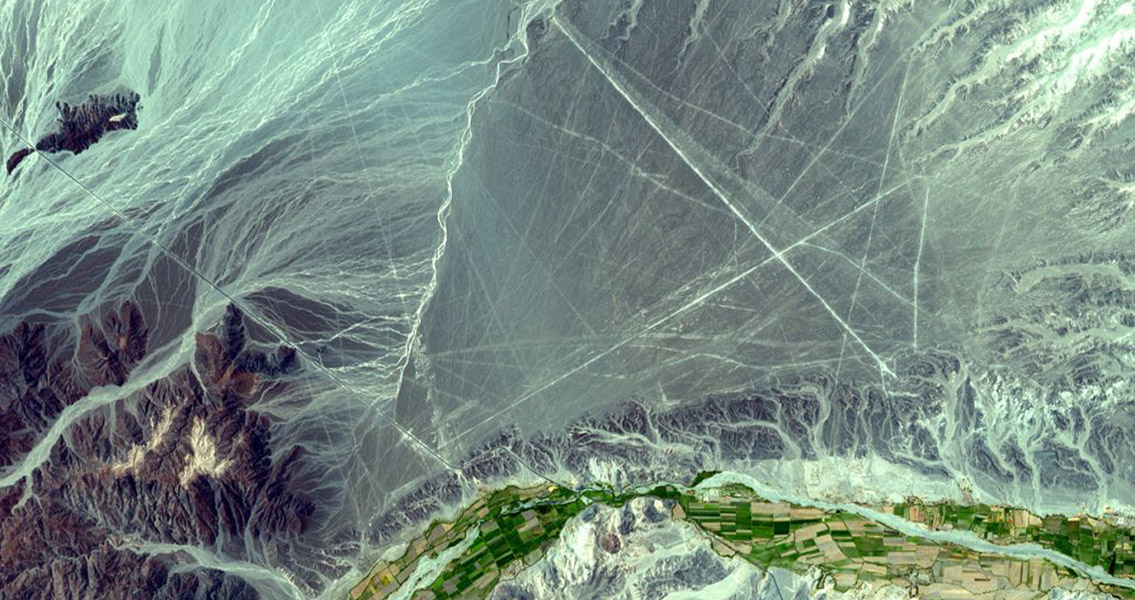
Ancient Nasca World: New Insights from Science and Archaeology. ]]>

Homo genus. “Over the last four million years, brain size and body size increased substantially in our human ancestors,” Mark Grabowski with the American Museum of Natural History and author of the paper is quoted as saying in a press release from the museum, “This observation has led to numerous hypotheses attempting to explain why observed changes occurred, but these typically make the assumption that brain and body size evolution are the products of separate natural selection forces.” That’s the very assumption now being questioned. There is significant evidence showing that the genetic variations (evolution’s kick starter) in some traits are a result of genes which are also causing simultaneous variations in other traits – leading to the conclusion that the natural selection experienced by either trait causes a correlated response in the unselected trait. For example, consider an elephant’s leg bone; as the bone grows longer, it also grows wider. If you used artificial selection to produce an elephant that was tall, it’s likely the elephant’s legs would also get wider as they get longer. This effect, in part, is because of shared genetic variations (co variations) among the traits of the leg bone. Likewise, researchers set out to investigate this type of genetic relationship between a human’s brain size and their body size and its impact, if any, on our evolution. Using the patterns of brain-size and body-size covariations from an assortment of modern humans and primates, researchers created several different models to examine exactly how these underlying genetic interactions and their associated selection pressures affected the evolution of our lineage. For the first time the findings demonstrate that the strong selection pressure to increase only brain size had a significant role in increasing body size at the same time, throughout our evolution. The phenomenon alone may also have been responsible for a major increase that occurred in both traits when our human ancestors (like Australopithecus) transitioned to Homo erectus. Selection undoubtedly played a role in fine tuning the physical changes inherent to bigger body size, this research suggests however, it was not the driving force and evolutionary models pertaining to Homo origins should be reconsidered. To put it another way, all of the scientific ideas and research done to explain why, over time, humans evolved bigger bodies may be moot; body size simply got pulled along with brain size. The work was published in the journal Current Anthropology.]]>