

www.pnas.org Image courtesy of Wikimedia Commons user: Heinrich Harder (1858-1935)]]>

Current Anthropology. The authors note that this ancient form of democracy would have been very different from what we have come to associate with the term in the more recent periods of human history, but they suggest that this early egalitarian structure gave a substantial advantage to people who were good communicators and more persuasive than the rest of their community. The presence of this advantage led to the emergence of a new idea of leadership that no longer focused on physical abilities alone but also involved cognitive ones, such as linguistic skills and the “ability to form and influence coalitions”. The second driver of socio-political development besides leaders’ ability to persuade their followers was the followers’ to partake in decision-making, making it a consensual process. The study’s conclusions could have important implications with regard to our understanding of how political systems emerged and developed throughout human history. While it’s true that more complex systems developed much later, it is fascinating to suggest that even back in the early years after hominins split from their quadruped cousins, they had the capacity to form coalitions in order to accomplish a common goal. In fact, the authors note in their paper, it was this propensity for cooperation that made hominins better equipped for the formation of large and lasting coalitions. This helped them improve their survival chances by becoming better prepared to overcome predators and supply food for the community. The study questions the ideas that have over the last seven centuries dominated political and social sciences. One of these is the theory of Homo economicus, which posits that humans are driven by self-interest and the urge to maximise the benefits they can create or receive, a theory that has dominated biology and political sciences, as well as economics, the study authors point out. The other dominant theory, which conflicts with this one, is the theory of cultural hegemony, strong in social sciences and anthropology, which suggests that culture is what dominates a community and its members are but “passive internalisers” of this culture. For more information: “The Evolutionary Origins of Human Political Systems” Image courtesy of Wikimedia Commons user: Oyoyoy ]]>

a study of beads and other items used for personal decoration. The reason remains unclear but whatever it was, it seems to have been eventually beaten by the benefits of farming and husbandry. Image courtesy of Wikimedia Commons user: Woodys ]]>

Patrouille Suisse, will celebrate the victory of the early Swiss Confederacy over the Austrian forces. Additional celebrations and commemorative events will continue up to the exact date of the anniversary in November. ]]>

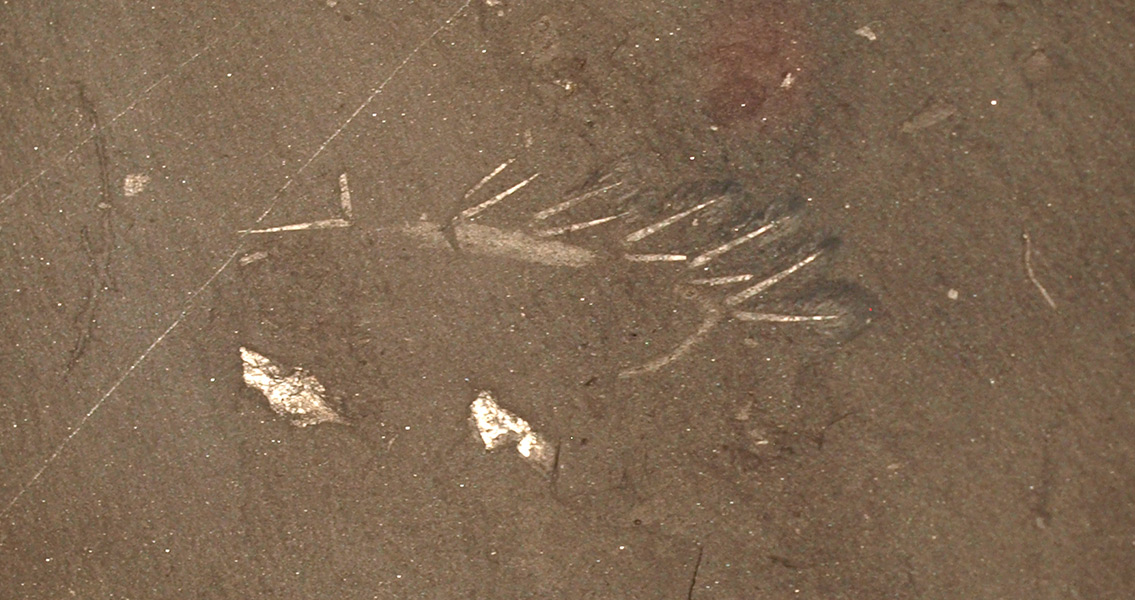
Hallucigenia sparsa, a marine worm that lived some 500 million years in the past during the Cambrian period, has proven to be a tough nut to crack based on what it left behind in the fossil record. Originally discovered in the 1970s, the spiny, 15-millimeter long worm left such strange impressions in its fossilized form that for decades researchers thought that its spines were actually its legs. While the scientific community eventually managed to figure out which side of H. sparsa was up, there was one last problem related to its study – no one could figure out which end was the front. A new research study into the diminutive, worm like marine animal has not only identified the creature’s front end from the back, it has also revealed the unique characteristics of its face. According to paleontology and evolution researcher Martin Smith from the University of Cambridge, the co-author of the study, while the research team expected to at least find a pair of eyes under the microscope they also found a “grinning” mouth lined with sharp teeth. Additional teeth were found lining the interior of H. sparsa’s mouth, angled backwards to direct food deeper into the creature to begin digestion. In an interview with Live Science, Smith said that the circular, toothy mouth of H. sparsa might end up being an evolutionary link to modern species such as nematodes, spiders and tardigrades. “You look at a spider today, and you would have no idea, but actually, its simple mouth used to be much more complicated,” Smith remarked, pointing to the more complex mouth of H. sparsa. The fossils that Smith and his colleagues used to make the discovery were sourced from Canada’s Burgess Shale, located in the mountainous terrain of British Columbia. The rock formation is noteworthy for harboring some of the most well-preserved examples of fossilized intact soft tissue and is one of the oldest fossil beds in the world where soft tissue fossils can be found. Several dozen H. sparsa specimens were examined by researchers as they carefully chipped away at the shale surrounding the ends of the fossils with the help of a micro-engraving tool. Once the specimens had been cleaned sufficiently, they were placed under a microscope for further study, which is when the eerie “smile” of the creature was revealed. While the proper end of H. sparsa has finally been revealed, there is still speculation as to what it actually ate. Smith suggests that the marine creatures could have been filter feeders, using their two long front limbs like tentacles to pluck detritus from the water. Another possibility is that H. sparsa used its legs to latch on to sponges and attach its lamprey-like mouth to feed. For more information: www.nature.com Image courtesy of Wikimedia Commons user: Captmondo]]>

Culture24. The whole settlement collapsed into the river after the fire and later it sank beneath the sediments in the river bed. Over time the artefacts sank deeper below what became fens, so today they are in a deeper palaeochannel, which has ensured their much better preservation than same-age discoveries made in shallower channels, according to the Must Farm website. This combination of circumstances has allowed researchers a glimpse into the everyday life of late Bronze Age people. Among the best preserved items are nine log boats, pots, jars, parts of clothing and personal decorations, and glass beads, Culture24 reports. The team even found footprints from the inhabitants of the settlement. There are also structural elements that have led the researchers to suggest that the settlement was protected by wooden posts. The team are now hoping to find remains from the timber structure that allowed people to go around the fens, fishing gear and more artefacts shedding light on how people in this settlement lived. However, Gdaniec added they were not looking forward to finding human remains because that would mean those people had died a violent death in the fire, a possibility which cannot be ruled out. Commenting on the latest finds, another team member, David Gibson, who is the archaeological manager of the Cambridge Archaeological Unit, told Culture 24 that the diversity of the artefacts discovered at Must Farm is pretty much unique. Usually, he said, the discoveries at late Bronze Age sites consist of pits, post holes and some metal artefacts. At Must Farm, on the other hand, a site spanning 1,100 square metres, there is evidence that can tell us a lot more about life at the time. Duncan Wilson from Historic England compared the site to the Mary Rose, the Tudor warship that contained thousands of well preserved artefacts, allowing scientists to gain vital insights into life in England under Henry VIII. The current dig season at Must Farm will take a total of nine months and is part of a four-year project. The artefacts will be put on display at the Peterborough Museum. Image courtesy of Wikimedia Commons user: Hugh Venables]]>