

Y.pestis bacteria may have persisted in Europe from the fourteenth century to the seventeenth, a period which included the notorious ‘Black Death’, according to a new study. Published in the journal Plos One, the new research has the potential to broaden our understanding of the two devastating plague pandemics that struck Europe, suggesting that the long term persistence of the disease was facilitated by an as yet unknown reservoir. DNA from victims of the second plague pandemic were recovered and analysed by Lisa Seifert from Ludwig Maximilian University of Munich, Germany, and her colleagues. The 30 victims were excavated from two different burial sites in Germany, with the sample covering a three hundred year period. Eight of the thirty skeletons tested positive for Yersinia pestis-specific nucleic acid. From these eight, the team were able to carry out single nucleotide polymorphism (SNP) analysis on five individuals, to further study the Y.pestis bacteria. Four of these individuals were excavated from a grave in Bavaria and carbon dated to the fourteenth century, while the fifth was excavated from Brandenburg in a grave for casualties of the Thirty Years War which took place in the seventeenth century. “Despite a geographical distance of 500 km and in particular a time difference of 300 years, an identical Y. pestis genotype was detected in all five human individuals.” Seifert writes in the study, a conclusion which suggests a single genotype of Y.pestis bacteria existed in Europe for hundreds of years during the second plague epidemic. Fascinatingly, the SNP data from the five individuals in Seifert’s study were fully consistent with three plague victims from the East Smithfield Cemetery in London. “In conclusion, thus far only two different genotypes of Y.pestis have been detected among plague victims of the second pandemic in Europe of which one, described in the present study, covers a time period of 300 years.” Europe was ravaged by two plague pandemics in the Middle Ages, the ‘Plague of Justinian’ which struck the continent between the sixth and eighth centuries, and a second pandemic, (which Seifert’s study focuses on), that struck between the fourteenth and seventeenth centuries and peaked between 1346 and 1353 in a period often referred to as the Black Death. Both plagues took millions of lives, with almost a third of Europe’s population being wiped out during the Black Death. The etiologies of the two plagues have long been discussed among both historians and scientists. Until recently, many scientists believed the plague was in fact a viral disease, or that the two plagues had different origins. Only in 2013 was Y.pestis proven to have unequivocally played a role in both pandemics, when its 1500 year old genome was sequenced. Two main theories exist for how the two deadly pandemics lasted for several hundred years each. One argues that the plague was continuously reintroduced into Europe along major trade routes such as the Silk Road. Another hypothesis is that the plague persisted in Europe over a long period of time in a host that has yet to be identified, for example lice. Seifert et al’s results suggest a different hypothesis to explain the deadly pandemics. “In contrast to these hypotheses, the results of the present study clearly indicate that at least one genotype, which was introduced to Europe at the beginning of the Black Death from Asia, persisted in Europe from the 14th century until the Thirty Years’ War (1618–1648). We therefore suggest a model in which Y. pestis was introduced to Europe from Asia in several waves combined with a long-time persistence of the pathogen in not yet identified reservoirs.” For more information: www.journals.plos.org Image courtesy of Seifert et al ]]>

M. rex’s body but several turtle and fish remains that have yet to be identified. The giant crocodile was likely a scavenger or an ambush predator and was most definitely capable of hunting while in the water, according to the research team. The scientists compare the large head and short teeth of M. rex to modern crocodiles, leading to the claim that the bite force of the newly-discovered specimen was likely to have been incredible. With the ability to crush nearly anything and everything its jaws wrapped around, the prehistoric monster crocodile would have found it easy to crack open turtle shells, Fanti added. However, the revelation of the newest and biggest entry into the world of prehistoric crocodiles is important on a number of levels, especially when it comes to redefining the timeline for the species and its closest cousins. The other Machimosaurus species, such as M. hugii and M. mosae, were not only smaller than M. rex but were thought to have gone extinct around 150 million years in the past as the Jurassic came to a close. However, M. rex has been dated to just 130 million years ago – which means the species either evolved after the hypothesized mass extinction at the end of the Jurassic or somehow survived it. Fanti states that this could lead paleontologists to reconsider the strongly-held mass extinction theory in an attempt to understand just what went on at the tail end of the Jurassic. The research study detailing the findings of Fanti and his team, which was published recently in the journal Cretaceous Research, can be found online here Image courtesy of Wikimedia Commons user: Nobu Tamura]]>


Protoceratops andrewsi being greater than the overall growth of the animal by demonstrating positive allometry.” As well as changing in shape, the frill also changed in size, becoming proportionately wider as the dinosaur got older. This has been taken by the QMUL team as evidence that the frills were connected to sexual selection. As they explain in the study, although there are some exceptions in the animal kingdom where positive allometric traits are not connected to sexual selection, they are incredibly rare. “If a trait is shown to be positively allometric then, in the absence of a plausible alternative regarding its evolution, we can take this as evidence supporting a hypothesis of evolution via sexual selection or socio-sexual dominance signals.” Other explanations for the horns and frills on Ceratopsian dinosaurs exist. Some palaeontolgists have argued that the horns and frills were merely a means of defence against predators, while others have suggested that the ornamental bone structures were a means for the animals to identify other members of their herd. These explanations are not mutually exclusive, and it is possible that the structures had multiple functions. Meanwhile, the authors of the study argue that the findings provide further evidence of the importance of sexual selection in shaping biodiversity. “Biologists are increasingly realising that sexual selection is a massively important force in shaping biodiversity both now and in the past. Not only does sexual selection account for most of the stranger, prettier and more impressive features that we see in the animal kingdom, it also seems to play a part in determining how new species arise, and there is increasing evidence that it also has effects on extinction rates and on the ways by which animals are able to adapt to changing environments.” said Dr Rob Knell, Reader in Evolutionary Ecology, also from QMUL’s School of Biological and Chemical Sciences. Image courtesy of Wikimedia Commons user: Luis Miguel Bugallo Sánche]]>

Kaogu, an archaeological journal. The research was only recently translated into English for publication in the journal Chinese Archaeology. ]]>
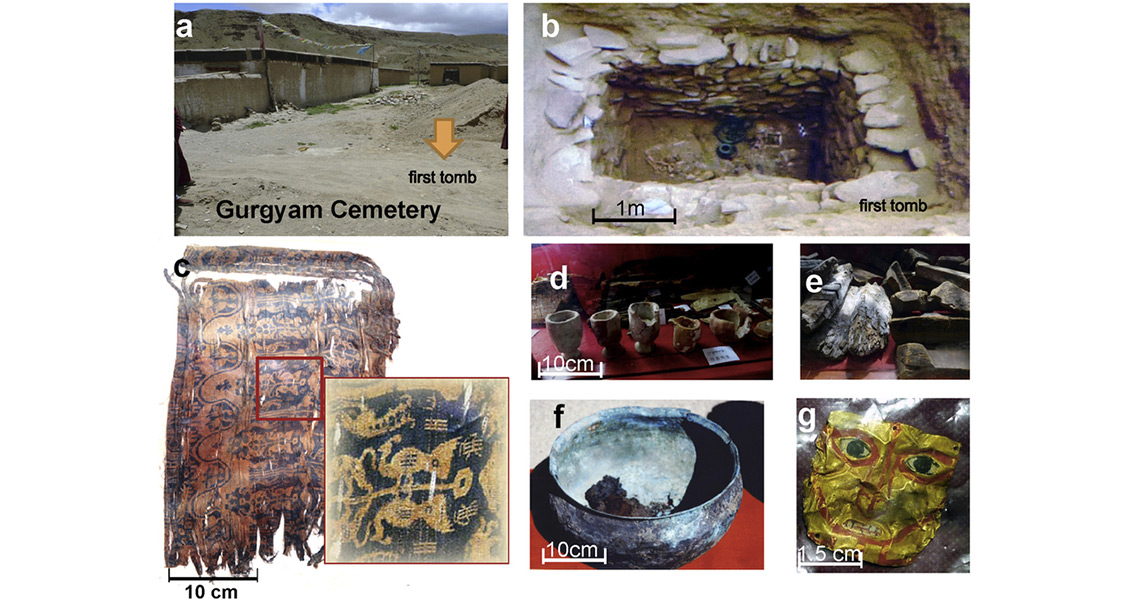
here Image courtesy of Houyuan Lu and Tao Tong]]>

here Image courtesy of Wikimedia Commons user: Cugerbrant]]>

toilets, smaller, less prominent cultures are often consigned to the dimly lit corners of history. New research from the University of Cincinnati has taken a novel approach to this problem by looking into life’s only constant – death. Through analysing ancient bereavement practices from the Central Apulian region in pre-Roman Italy, they have gained an insight into economic and social mobility, military service and even drinking customs in a region and time that had previously been invisible to history. “After going through volumes of collected material, I realized that there was so much more that could be said about what was happening in the development of this particular culture”, said University of Cincinnati Classics Doctoral student Bice Peruzzi, the leader of the research, who recently presented the findings at the 2016 Archaeological Institute of America/Society for Classical Studies Annual Meeting in San Francisco. Analysing the logistics of burials, treatment of the deceased, and contents in graves dating from roughly 525 – 200 BCE, Peruzzi discovered strong evidence of a clear social hierarchy. Men’s tombs from the same period often had metal weaponry lying close to or even across the remains. This has been interpreted as evidence of the commonality of military service in the Central Apulian region in the time period. Peruzzi placed her findings into the broader historical context of the Mediterranean, allowing her to understand the meanings of certain practices, and understand how the lives of the people in the Central Apulian region changed over time. “In spite of having no written history, I was able to distinguish three different periods and then connect them to the larger Mediterranean history to see how their society changed.” An impressive increase in the number of tombs in the region over a period of just fifty years in the fourth century BCE for instance, indicates newer social groups gaining access to ceremonial burials. Evidence suggests that these elaborate burials initially included use of the space for a period of dancing and banqueting by the attendees at the burial ceremony, a practice which had died out by the end of the period under investigation. The First Period that Peruzzi identified in the region, 525 – 350 BCE, unsurprisingly reflected the significant Greek influence over Apulia at the time. Valuable Greek vases and artefacts were found among the contents of many of the tombs. The detailed imagery on some of these artefacts focused specifically on women taking part in every day activities often thought to have been restricted to men, raising interesting questions about the role of women in the society. Along with the increase in the number of tombs in the Second Period (350 – 300 BCE) mentioned above, Peruzzi found evidence of the community’s elites starting to break away and distinguish themselves from others with their burial customs. The burial sites also revealed the onset of urbanisation in the region. “The new growth of specific burial sites to the detriment of others in addition to newly constructed walls surrounding the communities also indicates a general movement toward urbanization in Period 2.” Evidence of entering a time of great transformation can be found in what Peruzzi defines as the Third Period (300-200 BCE). A shift occurred from individual tombs to large chambers sometimes containing whole families. Weaponry was no longer put in graves, while iconography depicting female beauty had disappeared from grave goods, replaced with simple, undecorated ceramics. Meanwhile, the elites had completely abandoned elaborate ceremonial burials, further distinguishing themselves from the other elements of society. Peruzzi’s study provides insights into a period and a region historians and archaeologists have long struggled to understand. Through highlighting changing burial customs she has tracked the onset of social stratification, the emergence of an elite, and the first steps in urbanisation. “From the emergence of new social groups at the end of the 6th century BCE to the gradual urbanization and separation of “ethnic” groups during the 3rd century BCE, the evolution of funerary practices can be successfully used to highlight major transformations in the social organization of Central Apulia communities.” Image courtesy of Source/Riccardi 2003 ]]>