Categories
Editorial

Britain's Long History of Immigration

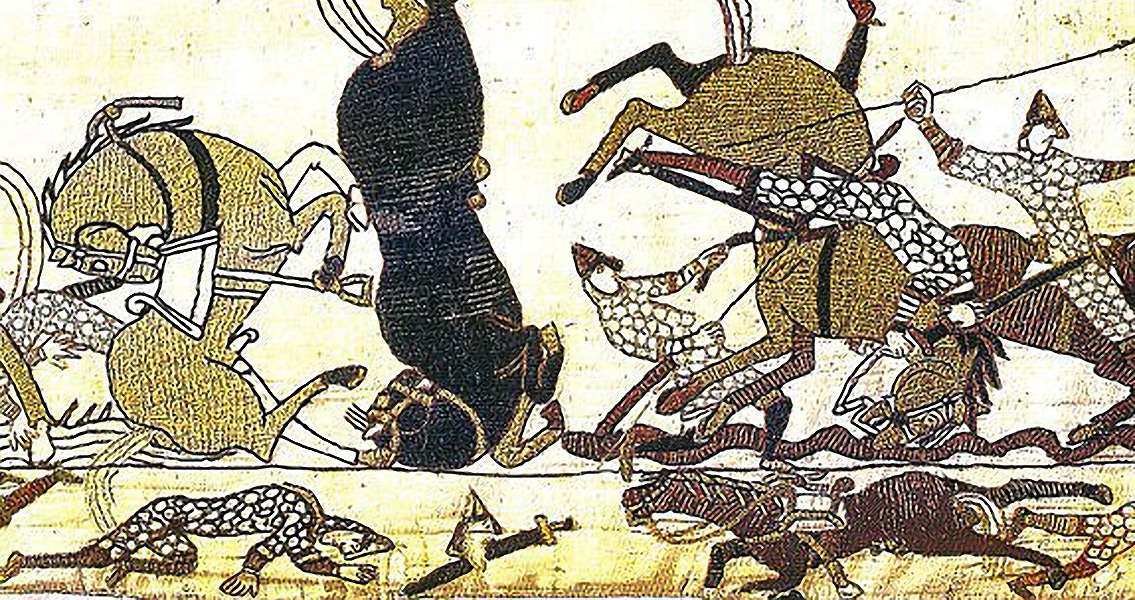
Geography providing the basis of much our knowledge. The Roman Conquest, starting from 43 CE, led to a significant increase in diversity. Traders from across the Roman Empire were drawn to the Roman colonies in England, and soldiers from as far away as Africa were deployed there. Following the Roman withdrawal many of these people left Britain, but there is little doubt that the years of Roman occupation led to a diversification of the inhabitants of the British Isles. After the Romans abandoned their colonies in Britain, several centuries of colonisation by Germanic Tribes followed. These groups, the Angles, Jutes and Saxons, settled in the south of England, and slowly became the ‘English’. This was followed by Viking influences, starting from the eighth century. Initially raiders who attacked and pillaged Anglo-Saxon communities, Norse armies began to settle in the north of England from the ninth century. Again, the Vikings ultimately left the British Isles, but they undoubtedly left a mark on the population. The final major invasion of the British Isles in the early medieval period came in 1066, with the Norman Conquest. The story of William the Conqueror is well known, but it is important to acknowledge the long term impact the Normans had on English culture. French influence permanently altered the largely Germanic language, and can still be heard in modern English. Norman traditions also filtered through into British politics and law, with traces that can still be seen to this day. The Norman, Viking and Roman immigration to Britain was largely facilitated though invasion and military expansion. In the centuries since, immigration has remained a central part of British history, one far too complex to discuss here. As politicians debate ideas of immigration and British identity, it is important to remember just intertwined foreign influence is with the country’s past.]]>

Categories
Breaking News

Climate Change Contributed Towards the Collapse of the Maya

www.pnas.org Image courtesy of Wikimedia Commons user: Kimse]]>

Categories
News

Death of Brian Boru

Categories
Breaking News

Sixth Mass Extinction Suspected

Categories
Breaking News

How Hunter-Gatherers Became Farmers, Examined

New research has, however, challenged this model. “The concept of intensification has become widely linked to hunter-gatherer research,” Christopher Morgan explains in an article published in the most recent edition of the Journal of Archaeological Research. Intensification, Morgan states, has been used to explain the evolution of human behaviour, the origin of farming, and the development of rank in complex hunter-gather societies. “This has led to diverse and even contradictory applications of the concept of intensification, to the point that a critical assessment of its current methodological and theoretical applications to the archaeology of hunter-gatherers is overdue.” One of the key problems Morgan has with the intensification model is that it does not analyse the conditions which gave rise to increased agricultural production. It is unclear, Morgan argues, whether increasing population, climate change, or changes in social behaviour drove intensification. Further, the intensification model does not examine whether abundance or scarcity drove the development of agricultural societies. Particularly in North America, it is unclear if hunter-gatherers were starving, and consequently intensified in search of a means to supplement their diet, or if they had such a surplus of food that they could explore how to increase production further. Morgan is particularly hostile to the intensification model as it is often used loosely. “One side of this divide uses intensification in a descriptive sense, where it is simply taken to mean any increase in economic productivity. The other uses intensification in an explanatory sense, where it is employed to explain how people solved population-resource imbalances,” he argues. Interesting though the intensification model is, it obviously has significant problems. How far we can apply this model to early societies is debatable. Morgan views intensification as an important consideration in the debate, but warns that over-use of the model can hamper our understanding of the past. With proper refinement and analysis, however, intensification has the potential to open the door to a much more nuanced understanding of how diversification occurred. For more information: www.link.springer.com Image courtesy of Wikimedia Commons user: Cropbot]]>

Categories
Book Reviews

Frankenstein

Related Books


Frankenstein book

Frankenstein
Or the Modern Prometheus by Mary Wollstonecraft Shelley

[gap height=”20″] ]]>

Categories
Breaking News

New Research Explores Air Raid Shelters' Social Meaning

www.juh.sagepub.com Image courtesy of Wikimedia Commons user: Ultraviolet scissor flame]]>

Categories
Breaking News

Fire Mastery May Have Given Modern Humans the Upper Hand

Homo species has just got more complex, with two scientists suggesting fire use contributed to our rise and the Neanderthals’ fall. Anna Goldfield, an archaeologist from Boston University, and Ross Booton, a mathematical biologist from Sheffield University, looked into this particular aspect of Neanderthals’ lives and discovered that even though fire was not completely unfamiliar to them, they definitely did not use it as consistently as modern humans. Although signs of fire use have been found at Neanderthal sites across Europe, they are scarce, suggesting fire was more of an occasional blessing than a fact of life. How did this impact the survival chances of the Neanderthals? By depriving them of a more wholesome calorie intake and safer food. Cooking is one of the best ways to rid food of harmful bacteria, parasites, and viruses, making it considerably safer to eat than when raw. Another major advantage of cooking is that it increases the amount of “processable” protein, and protein is indispensable for survival. So, according to Goldfield and Booton, who used mathematical models to try and detect a link between frequency of fire use and survival rates among both Neanderthals and modern humans, the former lived for hundreds of thousands of years in Europe without resorting to the use of fire on a regular basis. Modern humans, however, had mastered the element and made good use of it for warmth and cooking. The models revealed that this had a significant impact on survival chances. A mathematical model stipulating that modern humans used fire consistently while Neanderthals did not, yielded a gradual rise in the modern human population and a decline in Neanderthal numbers. A model which stipulated that the two species used fire with a similar frequency yielded no significant difference in their survival chances. Since we already know for a fact that the Neanderthals went extinct relatively soon after modern humans came on the European scene, the first model seems to be a more accurate reflection of reality. Further support for the “fire mastery hypothesis” comes in the different nutritional needs of Neanderthals and modern humans. Neanderthals were bulkier than us and needed a higher calorie intake to survive. Modern humans could survive with less. So, by mastering fire and cooking, the human populations expanded and, according to the mathematical models, consumed a larger share of the reindeer population (a crucial source of calories for both humans and Neanderthals, 40,000 years ago). Neanderthals were therefore left with scarcer access to a food source that they needed in larger quantities than humans. This latest research is further support of a more general theory that it was shrinking resources that spelled doom for the Neanderthals. This shrinking was not just due to the appearance of modern humans, however. Earlier studies have suggested that climatic factors reduced the amount of available sustenance. These, coupled with the mastery of fire characteristic of modern humans, may well have contributed to the demise of the Neanderthals, by restricting their access to the resources they needed to survive. Image courtesy of Wikimedia Commons user: Dirk Beyer]]>

Categories
News

The Start of the Tiananmen Square Protest

Categories
Breaking News

Evidence of Cannibalism Found in Britain

www.sciencedirect.com Image courtesy of Wikimedia Commons user: Nachosan]]>