Categories
Breaking News

T-Rex Bone Speaks of Cannibalism

a study of Tyrannousaurus fossils in museums in North America revealed four specimens which had bite marks on them, made by a large animal. Since the largest carnivore in the region at the time was the T-Rex, the researchers concluded that the eater must have been another T-Rex, suggesting cannibalism was a common behaviour among Tyrannosauri. Earlier this year, British researchers studied in Alberta, Canada, the remains of a Daspletosaurus, another species from the Tyrannosaurus family, which bore traces of multiple fights and cannibalism. The Daspletosaurus was smaller than the T-Rex and had apparently become a victim of a bigger genetic cousin, who also snacked on it after its death. The evidence pointing in that direction included bite marks and even one puncture wound to the back of the head, which was the result of a particularly hard bite, according to the researchers who studied the skull. The cousin in question, however, was not T-Rex because the Daspletosaurus lived 75 million years ago, the BBC writes, before that most famous of the Tyrannosaurids came onto the scene. For more information: TYRANNOSAUR CANNIBALISM: A CASE OF A TOOTH-TRACED TYRANNOSAUR BONE IN THE LANCE FORMATION OF EASTERN WYOMING Image courtesy of Wikimedia Commons user: David Monniaux]]>

Categories
Breaking News

New Polar Dinosaur Species Discovered

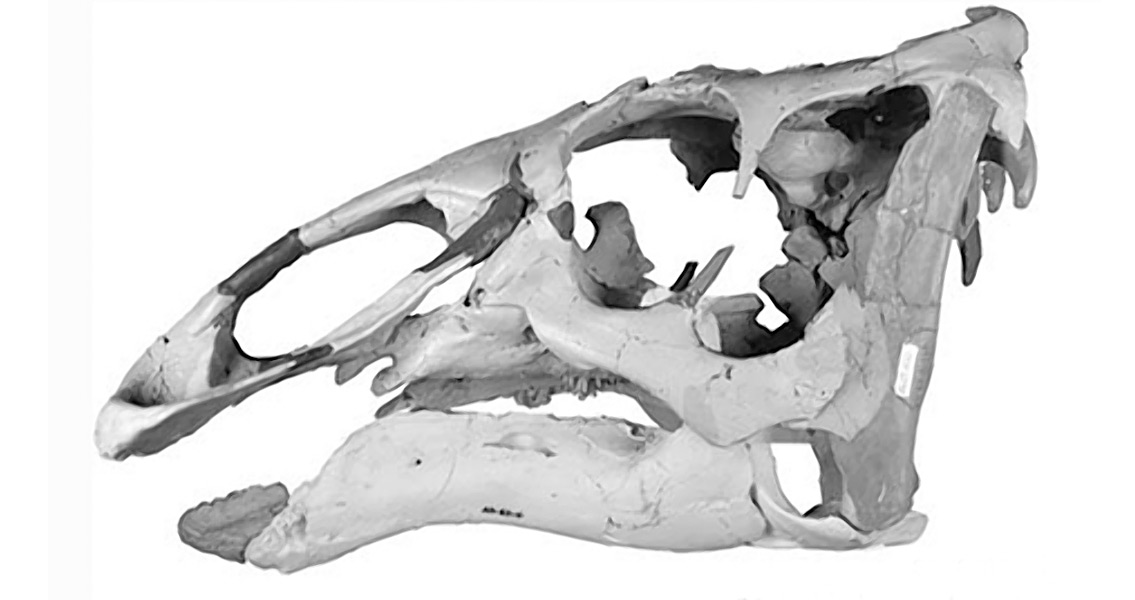
Ugrunaaluk kuukpikensis, a hadrosaur, or duck-billed dinosaur, probably lived around 69 million years ago and spent four months every year in darkness, surviving on tree bark, ferns, and whatever other vegetation was left when the sun went down for the winter. The hadrosaur fossils were discovered in the Liscomb Bone Bed, a geological layer rich in ancient fossils along Colville River, in the Prince Creek formation, the University of Alaska Fairbanks said in a press release. Pat Druckenmiller, one of the authors of the new study and the earth science curator at the University of Alaska Museum of the North, said the animal stood between six and seven feet tall and was up to 30 feet long. The creature’s hind legs were much longer that its front legs but it could walk on all fours, the authors also report. Another one of the authors, biologist Gregory M. Erickson from Florida State University, told the New York Times that the “ancient grazer” had crests along its back, like Godzilla, and a mouth full of as many as 1,000 sharp teeth. Although Ugrunaaluk kuukpikensis had to survive snowfalls and a long period of darkness, the authors note that temperatures above the Arctic Circle during the Cretaceous were warmer than they are now, with the average standing around 4 degrees Celsius above zero. Still, if that was the average, then there were certainly prolonged periods when temperatures dipped below zero, which suggests the hadrosaur was a uniquely hardy creature. Druckenmiller told the New York Times that the species is completely new to science, distinctly different from other dinosaur species discovered earlier at lower latitudes in Alaska, a “truly polar” dinosaur. The authors of this new paper, which was published in the journal Acta Palaeontologica Polonica, had earlier published work suggesting that there were animals living in northern Alaska 69 million years ago, when there were forests in the area because of the more temperate climate, the press release notes. Erickson says that the discovery of the Ugrunaaluk kuukpikensis fossils “challenges everything we thought about a dinosaur’s physiology.” he added that the discovery prompts the question of how the duck-billed herbivores survived the harsh Arctic winter. Since 1961, when palaeontologist Robert Liscombe, after whom the area is named, discovered the first dinosaur fossils in the Northern Slope of Alaska, a total of 6,000 dinosaur bones have been unearthed there. Most of them belong to young, smaller, animals, probably a herd that was suddenly killed, Druckenmiller says in the press release. As for species, three distinct ones have been named and catalogued, all of them unique to northern Alaska. This latest one, “the ancient grazer” as its name translates from the language of the local indigenous community, is by far the most complete ever discovered in a polar region, Druckenmiller says. For more information: “A new Arctic hadrosaurid from the Prince Creek Formation (lower Maastrichtian) of lower Alaska” Image courtesy of Wikimedia Commons user: Hirotsugu Mori, Patrick S. Druckenmiller, and Gregory M. Erickson]]>

Categories
Breaking News

Largest Feathered Dinosaur Found in China

Zhenyuanlong by the researchers who examined it, the dinosaur was a close relative of the Velociraptor and lived around 125 million years ago. The fossil was discovered accidentally by a farmer in northeastern China, just like another recent discovery, this time of a bat-like dinosaur, in the same part of the country. In a paper published in Nature, researchers Steve Brusatte from the University of Edinburgh and Junchang Lu from the Chinese Academy of Geological Sciences detail the find, explaining it belonged to the dromaeosaurids, a clave of very close bird relatives including the Velociraptor – a species that gained notoriety with the Jurassic Park film series. All the specimens belonging to that clave have been found in northeastern China, in Liaoning province. So far they have been classified into five species groups, some of them containing just one species. Most of the dromaeosaurids were very small, the authors say in the paper, close in size to a modern cat or a medium-sized dog, and they all had long arms. The only exclusion from these characteristics was a fossil of a species named Tianyuraptor, which was close to two metres long and whose arms were around half the length of its legs. However, no evidence of feathers was found on that fossil. The newly discovered fossil, slightly smaller than a Tianyuraptor, was covered in feathers. This was a stroke of luck for the researchers as they had previously believed these larger bird ancestors were not very good at flying, if they could fly at all. The Zhenyuanlong, on the other hand, almost certainly could and did fly. The dinosaur had large wings and on them, as well as on its tail, the researchers found pennaceous feathers, also called quill feathers, which are essential for flying and are present in all modern flying birds. This led the team to suggest that the non-flying and flying dinosaurs were contemporaries during the early Cretaceous. As regards the individual characteristics of the fossil, examination revealed it was a young specimen based on the extent of fusion between different bones, including the vertebrae. The last year and a half has been very productive for palaeontologists who focus on the evolution of birds. In addition to the many discoveries of feathered dinosaurs, last year a team of scientists also linked dinosaur bones with bird bones, something that had not previously been possible because of the hard line distinguishing developmental biology from palaeontology. That team, however, was interdisciplinary and looked both at dinosaur fossil bones from the wrist and the wrist bones of modern bird embryos, identifying at least one bone that was present both in dinosaurs and in birds. For more information: “A large, short-armed, winged dromaeosaurid (Dinosauria: Theropoda) from the Early Cretaceous of China and its implications for feather evolution” Image courtesy of Wikimedia Commons user: David W. E. Hone, Helmut Tischlinger, Xing Xu, Fucheng Zhang]]>

Categories
Breaking News

Extreme Weather Swings Kept Dinosaurs Away From Tropics

www.pnas.org Image courtesy of Wikimedia Commons user: Heinrich Harder (1858-1935)]]>

Categories
Breaking News

Modern Birds 6 Million Years Older than Thought

Archaeornithura meemannae. The remains have been dated to 130.7 million years ago, around 30 million years after the first birdlike dinosaurs appeared on the scene and set off bird evolution. To compare, what was believed to be the oldest representative of the bird family lived 125 million years ago. Both belong to the Ornithuromorpha clade (a group encompassing all representatives of a life form, from the first one to all their descendants), which also includes all modern birds. The fossils were unearthed in 2013, but only now have analyses been completed that date them and classify them as being from a new species. An artist’s recreation of the ancient bird’s appearance shows that it was remarkably similar to many modern birds. In fact, the only feature out of place was the pair of small claws at the central joints of its wings. Otherwise it was covered in feathers, apart from the legs, which suggests it was a wading bird, and had a beautiful purple plumage on its head, while the rest of it was mostly gray. The bird was a small one, just 15 cm, and it is unclear whether it had teeth – a common feature of early Cretaceous birds – or not. Among the suggestions the researchers were able to make based on the fossil evidence, is that it was probably a herbivore and that it used gastroliths (stomach stones) to help digestion, study co-author Wang Min from the Chinese Academy of Sciences said. This discovery adds to a growing, though still scarce, body of evidence about the early stages of birds’ evolution. Just recently, again in China, scientists discovered an ancestor of the avian class with bat-like, skin-covered wings. This pigeon-sized dinosaur represents a stage in bird evolution before the Archaeopteryx, so far considered the earliest known example of a creature between a dinosaur and a bird. The Archaeopteryx was a feathered dinosaur that had bird-like characteristics, such as skeletal structure and possibly the ability to fly. The bat-winged dinosaur, on the other hand, most probably comes from an earlier time, before some reptiles started growing feathers and became warm-blooded, effectively ceasing to be reptiles. Early birds, however, were not the only masters of the air during the Mesozoic era, which spanned a huge period, from 252 to 66 million years ago. This other group of flying animals were called Enantiornithes. Although these apparently looked very similar to birds, they had teeth and claws, like dinosaurs. More than 50 separate species have been identified, with some only represented by a single bone, but they all died out during the latest mass extinction on the planet, around 66 million years ago, at the boundary between the Cretaceous and the Paleogenic eras. Enantiornithes are believed to have left no currently surviving descendants. Image courtesy of Wikimedia Commons user: Acabashi]]>

Categories
Breaking News

Unique Bat-Like Dinosaur Found in China

scansoriopterygids, characterised by their long hands, that lived 160 million years ago. All fossilised remains from this group come from China and none of them have such a bone connected to their wrists. This, coupled with the fact that bats and flying squirrels have similar bones on their hands, led the scientists to the suggestion that the dinosaur had wings made from skin, not feathers. The team, including Xu Xing and Corwin Sullivan from the Chinese Institute of Vertebrate Paleontology and Paleoanthropology, and Zheng Xiaoting from Linyi University, named the creature Yi qi, meaning “strange wing”. They explained that at this stage it is impossible to determine whether the wings were used for flapping or gliding but in any case no other dinosaurs that have been discovered in this group of species had anything like them. Zheng said that Yi qi must have been a flight pioneer, given that it lived in the Jurassic era, long before feathered dinosaurs took to the air. However, the evidence is scarce, so it is likely that the publication detailing the find and the scientists’ conclusions will cause controversy. Although it has been long suspected that modern birds evolved from dinosaurs, until recently there was no hard evidence proving the link. Just last year, paleontologists completed a comprehensive family tree of a group of carnivorous dinosaurs from which birds are thought to have evolved. The tree reveals that, unlike with humans, this evolutionary process was gradual, with no “missing links”. Simply put, 150 million years ago a group of small dinosaurs started changing, acquiring bird-like skeletons, beaks and feathers. This process took tens of millions of years, accelerating over time. This, paleontologists explain, is because once the bird skeleton was in place, it greatly increased the potential for further evolution and diversity. For the sceptics, bird DNA has also been linked to dinosaur DNA, including that of the Tyrannosaurus Rex. In 2007, US researchers managed to extract collagen, a protein from the soft tissue of a bone, from the remains of a Tyrannosaurus that had lived 68 million years ago. The closest collagen type found in a modern animal was that in chicken bones. This discovery helped add more weight to the hypothesis that birds evolved from dinosaurs. Image courtesy of Wikimedia Commons user: H. Raab]]>

Categories
Breaking News

Late Miocene Caiman Had Strongest Jaws in History

Categories
Breaking News

New Dinosaur Discovered

Image courtesy of Wikimedia commons user: Steveoc 86 ]]>

Categories
Breaking News

Ancient Marine Predator Discovered in Scotland

Categories
Breaking News

Remains of New Species of Two-Footed Dinosaur Unearthed In Venezuela