
Science Advances has used DNA evidence to argue that the Ice Age megafauna were in fact the victims of a ‘perfect storm’ of both. The study, led by the Australian Centre for Ancient DNA (ACAD) at the University of Adelaide, argues that it was only as the climate started to warm, around 12,300 years ago and long after the first humans had arrived in the region, that the megafauna in Patagonia started to die out. Researchers from University of Colorado Boulder, University of New South Wales and University of Magallanes in Patagonia, were involved in the study. For a thousand years humans lived in Patagonia alongside the megafauna. Seemingly, while the region stayed cold, the populations of megafauna remained constant. When the climate started to warm however, the impact was startlingly quick. “Patagonia turns out to be the Rosetta Stone – it shows that human colonisation didn’t immediately result in extinctions, but only as long as it stayed cold,” said study leader Professor Alan Cooper, ACAD Director, in a press release. “Instead, more than 1000 years of human occupation passed before a rapid warming event occurred, and then the megafauna were extinct within a hundred years.” DNA analysis was at the heart of the study. Researchers traced the genetic history of megafauna populations by studying DNA extracted from radio carbon dated teeth and bones excavated from caves in Patagonia and Tierra del Fuego. The pattern of human colonisation of the Americas was rapid, and coincided with contrasting temperature trends on each continent. Using the genetic histories of populations of sabre-toothed cats, giant jaguars, the South American horse and the short faced bear, the team managed to distinguish the impacts of humans and climate change on the mega fauna populations. “The America’s are unique in that humans moved through two continents, from Alaska to Patagonia, in just 1500 years,” said Professor Chris Turney from the University of New South Wales. “As they did so, they passed through distinctly different climate states – warm in the north, and cold in the south. As a result, we can contrast human impacts under the different climatic conditions.” Not all large species in Patagonia went extinct, the guanaco and vicuna – ancestors of modern day llamas and alpacas, survived, although their numbers reduced drastically in the period. “The ancient genetic data show that only the late arrival in Patagonia of a population of guanacos from the north saved the species, all other populations became extinct,” said Dr. Jessica Metcalf from the University of Colorado Boulder, the lead author of the study. The sites used in the study have long provided insights into the demise of Ice Age megafauna. “In 1936 Fell’s cave, a small rock shelter in Patagonia, was the first site in the world to show that humans had hunted Ice Age megafauna. So it seems appropriate that we’re now using the bones from the area to reveal the key role of climate warming, and humans, in the megafaunal extinctions,” said Dr. Fabian Martin, from the University of Magallanes. ]]>

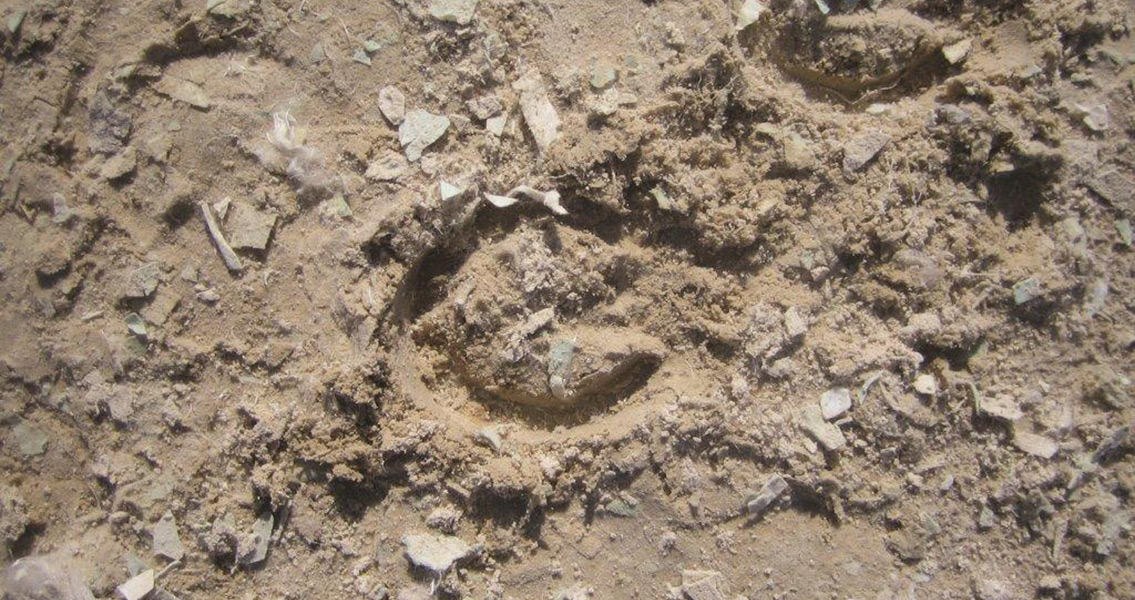
Homo erectus, in the desert of the East African country of Eritrea. It’s believed the prints date back approximately 800,000 years, and although their age has yet to be verified, it’s anticipated they will provide a wealth of information about the movements and gait of this extinct species of hominid. Alfredo Coppa, an archaeologist with Sapienza University in Rome, along with his Italian research team and researchers with Eritrea’s National Museum discovered the 26 square meter stone slab that contained the footprints. Today, the region where they were found is in the middle of a desert, but 800,000 years ago the environment was very different. The fossilized footprints, which are practically indistinguishable from our own, were left in the sandy sediments on the shore of a lake, which archaeologists believe was part of the landscape at the time. The shapes of the footprints indicate they filled with water directly after they were formed and before they dried out and were eventually buried. The footprints suggest movement from the north to the south, and amazingly, there were also tracks from an animal similar to a gazelle around them, suggesting perhaps our early ancestors were on a hunting expedition. “Fossilized footprints are extremely rare,” Coppa explained to the Italian publication, The Local, “We need to carry out more digs in the area, which has so far turned up the fossilized remains of five or six different Homo erectus specimens.” Homo erectus (which means “upright man”) lived through most of the Pleistocene epoch which lasted from about 2,588,000 years ago up to 11,700 years ago. The earliest Homo erectus fossils date back 1.9 million years, and there are two schools of thought on how and where they evolved. The first theory has Homo erectus evolving from the Australopithecina, in East Africa, and migrating (around 2 million years ago) as a result of the desertifying conditions which were developing in northern and eastern Africa at the time. H.erectus joined other migrations travelling through the “Saharan Pump” and spread throughout much of Eurasia, getting as far as India, Georgia, Sri Lanka, Indonesia, and China. The second theory is that H.erectus evolved in Eurasia and then migrated to Africa, based largely on evidence which has been discovered at the Dmanisi site in Georgia which shows they inhabited the area around the same time or even slightly before the earliest evidence of H.erectus in Africa. What has been decided is that we, Homo sapiens, evolved from African Homo erectus approximately 200,000 years ago. Even if the footprints are found to be the oldest left by Homo erectus, they aren’t even close to being the oldest prints left by a hominid species; a team of researchers in Tanzania discovered the tracks of our first upright ancestor, Australopithecus, which were 3.8 million years old. ]]>



Football hooliganism has been around, in one form or another, as long as football itself. Recent events at the European Football Championship, particularly the running street battles and stadium fights between British, French and Russian supporters, have brought football hooliganism back into the media limelight however, providing a reminder of the most provocative element of one of the world’s most popular sports. A hooligan is defined as “a violent young troublemaker, typically one of a gang”. The etymology of the word is far from clear, but it is generally believed to have originated at some point late in the nineteenth century. When used in connection to football, the term is deeply evocative, bringing to mind the violent, sometimes tragic clashes between rival supporters in the later decades of the twentieth century. Significantly, these clashes were not simply random acts of violence, but organised confrontations between massive gangs of fans, referred to as ‘firms’ in the UK.