Categories
Breaking News

Grave of Axe-Wielding Viking Berserker Found in Denmark

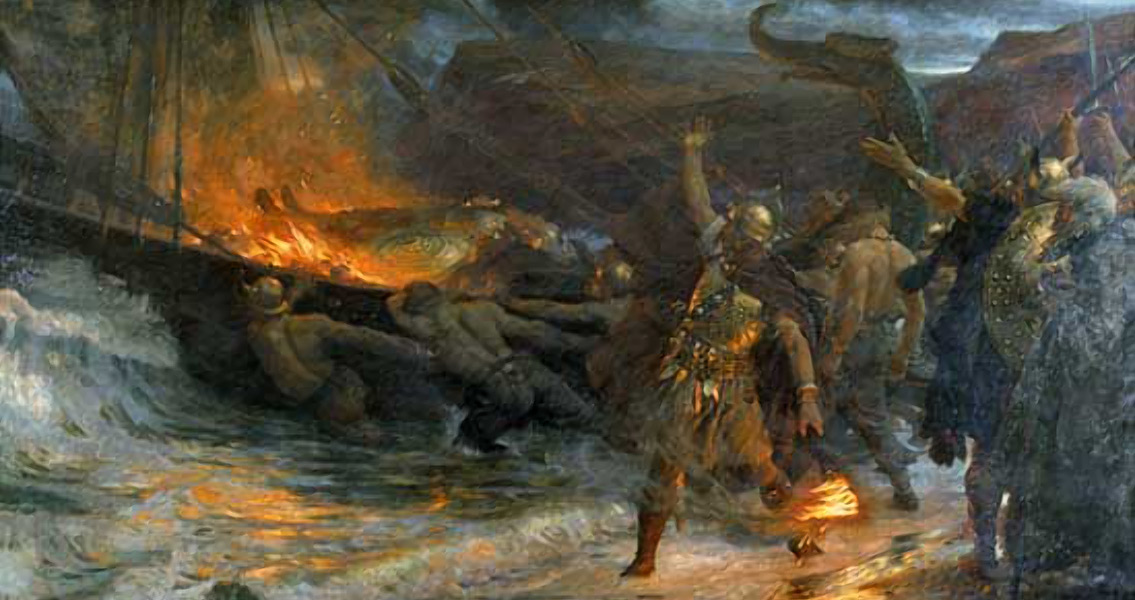
News Corp Australia, Kirsten Nelleman Nielsen, the leader of the excavation, says that the axe is exceedingly large, and would have been the kind of weapon that would have struck fear into the hearts of the wielder’s enemies. Known as the “Dane Axe”, the weapon would have been analogous in the Viking Age to the machine gun of the modern era, the researcher added. The weapon was likely not a ceremonial one, as it is simple and without adornment. Additionally, as it was the only object buried with the man, it is likely to have been a prized possession in life, leading Nielsen and his team to surmise that the tomb contains the remains of a warrior. Nielsen said the find was more than a little extraordinary, as this particular axe is much larger and heavier than other axes found in similar graves. The handle of the weapon would have been very long, requiring the use of both hands to wield effectively. Originally discovered in 2012, the multi-roomed dødehuse was stumbled upon during the construction of a highway in the district of Harup; the timber structure measures 13 meters by 4 meters and is part of an extensive burial ground. Within were found a trio of graves, which have all been dated to 950 CE. The front of the tomb held a man and a woman, seemingly buried together, while the back was the final resting place of the axe-wielding warrior. The couple seem to have been highborn or otherwise people of import, as their grave goods were sourced from across Europe. According to University of Copenhagen, Denmark archaeologist Henriette Lyngstrøm, silver coins originating from ancient Afghanistan and ceramics from the Baltic point to an international reach. Additionally, the female was found with a set of keys, thought to have been symbolic of her power, and the two were found within a wagon that is thought to have been used by Danes of noble birth during the time they were alive. The man, perhaps her husband, was found with a more modestly-sized battle axe. Nielsen remarked that finding a male and a female buried together in such pomp and circumstance is noteworthy, as it explodes the myth of the male-dominated nature of Viking society by affording equal status between the two. ]]>
Categories
Breaking News

Archaeologists Discover the Eighth Priestess of San José de Moro

Harvard Gazette. “When I started as a young student, 25, 30 years ago, we thought the Moche was a culture led by powerful kings, warriors, or priests”, said Castillo. This is the eighth royal tomb found in the past 25 years by the San José de Moro Archaeological Program, and all eight tombs have showcased women who were found wearing beaded necklaces and intricate headdresses, surrounded by sacrificial victims. Collectively known as the priestesses of San José de Moro, they put a spotlight on the prominent role women played in Moche society. “These women were among the most important individuals in their society,” Castillo told the Harvard Gazette. “Their elaborate burials are narratives of their lives, and the ornaments they were buried with are indicators of their high status.” Another finding which supports the women’s role as priestesses are the scenes depicted in Moche art – scenes of Moche rituals include figures wearing similar headdresses and carrying silver goblets like the ones found with the remains. The Moche people didn’t have a written language, but they left thousands of ceramic pots covered with intricate drawings that portrayed their daily lives and their astral beliefs. In the scenes that depict human sacrifice, a priestess wearing a headdress holds a silver goblet full of the victims’ blood. Considered the first state-level culture in the Americas, the Moche thrived and ruled the northern coastal area of Peru from the first to eighth centuries (prior to the Incas), at the same time that the Mayans were prospering in Central America and Mexico. They conquered the desert with a complex system for irrigation, constructed adobe pyramids and used religion to unite their society like many other ancient cultures. Following the recent discoveries, another widely held belief concerning the Moche, that they lived under a single ruler, is also being reconsidered by archaeologists. “They were multiple polities, small chiefdoms that never achieved a political unification,” Castillo told the Gazette, “Some communities may have been led by women and others by men.” “They were not the sisters, the mothers, or the wives of somebody powerful,” Castillo stated in the Gazette, “In all the burials, the women had a status associated with Moche priests. They were priestesses, but they could have also been rulers. In ancient cultures, political and religious power were blended, and the rulers were often the priests.” Image courtesy of Wikimedia Commons user: Kevstan]]>

Categories
Breaking News

5,000-Year-Old Kurgan-Style Tumulus Discovered in Istanbul

Categories
Breaking News

Home Is Where the Bones Are – UAE Find Deemed House of the Dead

Categories
Breaking News

Court Rules Siberian Ice Princess Will Stay With Researchers

The Siberian Times as the White Lady, a priestess who guarded “the umbilical cord of the Earth.” He went on to say, “She stood as a guard at the gates of the underworld, preventing the penetration of evil from the lower worlds. However, after archaeologists removed the mummy, it has lost its strength and can no longer perform its protective function. So evil started to penetrate, natural disasters and human conflicts began.” In a region where the influence of shamans still exists, many of the local residents in Altai were nervous when these remains and others were removed from the sacred burial mounds (kurgans), despite their scientific value. In Altai, her removal has been blamed for most misfortunes, natural and otherwise; high winds, forest fires, suicides and illnesses, even an increase in the number of earthquakes in the region. One local was quoted as saying, “There are places here that it is considered a great sin to visit, even for our holy men. The energy and the spirits there are too dangerous. Every kurgan has its own spirit – there is both good and bad in them – and people here have suffered much misfortune since the Ice Princess was disturbed. It is nothing short of sacrilege to pour hot water on the remains of ancients who have survived in the permafrost for thousands of years,” he said. The move to rebury the princess is opposed by both state officials and the academics who have been involved in researching the remains. Developments in technology continue to divulge new information about the mummy. In 2014 for example, an MRI scan revealed the woman had breast cancer and that she had used marijuana to help ease the suffering. Additionally, the mummified woman has helped researchers make great advances in understanding the Pazyryk culture. Her tattoos show extraordinary artistry and skill and the items found with her in the burial chamber, including beauty products found in a “cosmetic bag”, help to recreate the life of a woman dead for two millennia.]]>

Categories
Breaking News

Seeing Life in Death: Understanding a Pre-Roman Culture

toilets, smaller, less prominent cultures are often consigned to the dimly lit corners of history. New research from the University of Cincinnati has taken a novel approach to this problem by looking into life’s only constant – death. Through analysing ancient bereavement practices from the Central Apulian region in pre-Roman Italy, they have gained an insight into economic and social mobility, military service and even drinking customs in a region and time that had previously been invisible to history. “After going through volumes of collected material, I realized that there was so much more that could be said about what was happening in the development of this particular culture”, said University of Cincinnati Classics Doctoral student Bice Peruzzi, the leader of the research, who recently presented the findings at the 2016 Archaeological Institute of America/Society for Classical Studies Annual Meeting in San Francisco. Analysing the logistics of burials, treatment of the deceased, and contents in graves dating from roughly 525 – 200 BCE, Peruzzi discovered strong evidence of a clear social hierarchy. Men’s tombs from the same period often had metal weaponry lying close to or even across the remains. This has been interpreted as evidence of the commonality of military service in the Central Apulian region in the time period. Peruzzi placed her findings into the broader historical context of the Mediterranean, allowing her to understand the meanings of certain practices, and understand how the lives of the people in the Central Apulian region changed over time. “In spite of having no written history, I was able to distinguish three different periods and then connect them to the larger Mediterranean history to see how their society changed.” An impressive increase in the number of tombs in the region over a period of just fifty years in the fourth century BCE for instance, indicates newer social groups gaining access to ceremonial burials. Evidence suggests that these elaborate burials initially included use of the space for a period of dancing and banqueting by the attendees at the burial ceremony, a practice which had died out by the end of the period under investigation. The First Period that Peruzzi identified in the region, 525 – 350 BCE, unsurprisingly reflected the significant Greek influence over Apulia at the time. Valuable Greek vases and artefacts were found among the contents of many of the tombs. The detailed imagery on some of these artefacts focused specifically on women taking part in every day activities often thought to have been restricted to men, raising interesting questions about the role of women in the society. Along with the increase in the number of tombs in the Second Period (350 – 300 BCE) mentioned above, Peruzzi found evidence of the community’s elites starting to break away and distinguish themselves from others with their burial customs. The burial sites also revealed the onset of urbanisation in the region. “The new growth of specific burial sites to the detriment of others in addition to newly constructed walls surrounding the communities also indicates a general movement toward urbanization in Period 2.” Evidence of entering a time of great transformation can be found in what Peruzzi defines as the Third Period (300-200 BCE). A shift occurred from individual tombs to large chambers sometimes containing whole families. Weaponry was no longer put in graves, while iconography depicting female beauty had disappeared from grave goods, replaced with simple, undecorated ceramics. Meanwhile, the elites had completely abandoned elaborate ceremonial burials, further distinguishing themselves from the other elements of society. Peruzzi’s study provides insights into a period and a region historians and archaeologists have long struggled to understand. Through highlighting changing burial customs she has tracked the onset of social stratification, the emergence of an elite, and the first steps in urbanisation. “From the emergence of new social groups at the end of the 6th century BCE to the gradual urbanization and separation of “ethnic” groups during the 3rd century BCE, the evolution of funerary practices can be successfully used to highlight major transformations in the social organization of Central Apulia communities.” Image courtesy of Source/Riccardi 2003 ]]>

Categories
Breaking News

Newly Discovered Sarcophagus Highlights Tomb Recycling

Categories
Breaking News

Second “Witch Girl” Discovered Burnt and Buried

Categories
Breaking News

Infant Fossils Shed Light on Native American Lineages

Categories
Breaking News

New Hunt for Alaric’s Treasure Starts in Italy

The Origin and Deeds of the Goths. Then the slaves returned the river to its original course and were killed in order to keep the location of the grave a secret. The famed treasure that went into the tomb with the Visigoth king is believed to be a few tonnes of gold and silver as well as the Menorah from the Second Temple, looted by the Romans from Jerusalem in 70 CE, the Telegraph reports. Given the size of the treasure it’s hardly surprising that many have tried to find it, including Hitler, who tasked Heinrich Himmler with the discovery. Given the supposed location, it’s also hardly surprising that nobody has found the treasure yet. No search until now, however, has had the support of the local authorities or the technical means to examine the riverbed. Commenting on the project in a statement quoted by the Telegraph, Cosenza’ mayor Mario Occhiuto said that there are clues and historical records that confirm the location of the treasure in the tomb of Alaric. The team of archaeologists assigned to the project will have “the latest technical and scientific innovations” at their disposal to find the gold and silver. If the search is successful, it will greatly increase the tourist attractiveness of Cosenza, which, like many other cities in southern Italy, is experiencing serious economic troubles, the Telegraph notes. Yet, the enthusiasm is not unanimous and there are some more cautious voices. One such voice is that of a Mediaeval historian from Calabria University, Pietro De Leo, who told Corierre della Sera that although there can be little doubt as to the location of Alaric’s grave, it is unlikely that the tomb contains any precious metals or artefacts from Roman times. In addition to the excavation works, the project, which aims to commemorate the Goth chieftain, also involves the construction of a museum, something that has sparked opposition from some local historians who claim this would be a humiliation because of Alaric’s record in Italy. The Visigoths overran Rome within three days and then moved south with the ultimate aim of reaching Africa. Their king, however, died in Calabria later the same year and the conquest plans fell through. Cosenza’s mayor dismissed the negative remarks with the argument that Alaric was an important historical figure that played a part in the demise of the Roman empire and as such deserved the attention he is getting with this project. Image courtesy of Wikimedia Commons user: Maitre Francois ]]>