Categories
Breaking News

Dinosaurs Were an Important Resource for Dung Beetles

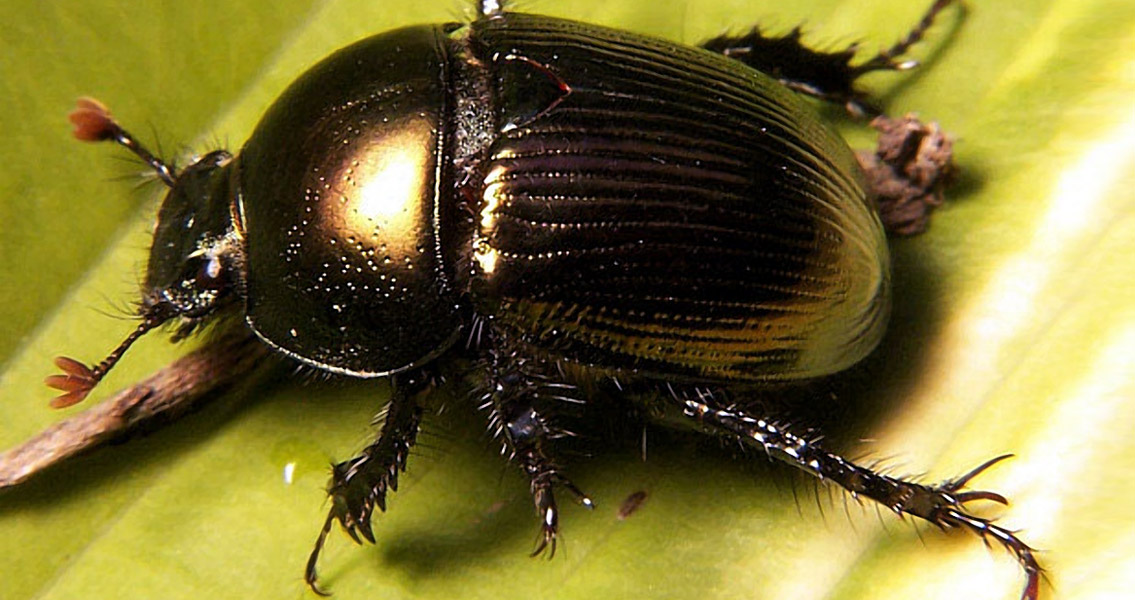
PLOS ONE, co-author Dr. Stephen Cameron with the Queensland University of Technology in Australia explained that fossilized dinosaur feces (70 and 80 million years old) supports the hypothesis the study outlines because it shows signs of tunneling that has been attributed to dung beetle feeding. The study is the first to show how the specialization of one group was related to using dinosaurs, the dominant species for 135 million years, as a resource. Of course, the flip side of this connection is that the mass extinction of dinosaurs during the Cretaceous-Paleogene period would have also impacted the dung beetle. Fortunately for the beetle, the impact of the dinosaur extinction occurred during the beetle diversification and they survived the event. The study concludes that the modern dung beetle is descended from a species which either fed on the dung of dinosaurs and other early mammals, or from a species which had already adapted to eating the dung of the Cretaceous mammals. Although the findings may challenge prior research associating mammals and the origin of dung feeding, the study also shows that the greatest rate of diversification the beetle experienced was during the Paleogene period, which is in line with the timing of major diversification of most mammals. Additional research will be needed to untangle the cause of the latest diversification and provide more detail on the dung beetle’s survival through the Cretaceous-Paleogene mass extinction. This story of flowering plants, beetles, and dinosaurs, demonstrates the relationships and complex interactions between evolving ecosystems, and the possibility of discovering what drives diversification – even for insects like the dung beetle for which very limited fossil records exist. The study was published this week, in the open-access journal PLOS ONE.]]>
Categories
Breaking News

New Research Suggests Humans Drove Hobbits to Extinction

Homo floresiensis, aka the ‘Hobbit’ people, were first discovered on the island of Flores in Indonesia and ever since researchers have wondered how they were able to co-exist with early humans when no other group had. The answer? They didn’t. New excavations and dating have concluded that the Hobbit people died away 50,000 years ago, tens of thousands of years earlier than previous testing indicated. In fact, the new data suggests that instead of living alongside them, modern humans may have driven H.floresiensis to extinction. In hindsight though, the error is clear to see. The first Hobbit fossils were considered too precious and fragile to undergo radiocarbon analysis. In lieu of testing the bones, researchers gathered charcoal found nearby under the assumption it had accumulated at the same time as the fossils. The charcoal was tested and dated to 11,000 years old. Modern humans spread throughout Australia and Asia around 50,000 years ago. “Somehow these tiny people had survived on this island 30,000 years after modern humans arrived”, Richard Roberts, with the University of Wollongong, told Nature “We were scratching our heads. It couldn’t add up.” Previous research shows the Neanderthals disappeared shortly after the arrival of modern humans in Africa and Europe. So the team continued excavations in Liang Bua (the limestone cave where the original fossils were found), primarily to search for more remains, and to gain a better understanding of the enormous cave and its geology. Freshly excavated rock and dirt (removed from the same layer of sediment as the Hobbit bones) was tested using several different methods and the results showed the samples were 100,000 to 60,000 years old. Tom Higham, with the University of Oxford, UK, considers the recent dating results compelling, telling Nature “These results are tantalizingly close to the earliest evidence for modern humans in the region, which might suggest a causal link to the subsequent disappearance of H. floresiensis.” Homo floresiensis (which translates as Flores Man) would have been around 3.5 feet (1.1 meters) tall. A total of nine partial skeletons were recovered in 2003, and included one with a complete skull, which is referred to as “LB1”. It’s been determined that LB1 is the skeleton of a 30-year-old female (nicknamed the Little Lady of Flores or “Flo”). Her height has been estimated to be 3 feet and 6 inches (1.06 meters). There has been intense and continuous research since their first discovery just to determine whether or not the Hobbit people represent a species separate from modern humans. Some experts have posited that the historical H. floresiensis could be connected to the Ebu Gogo myths which were prevalent on the island of Flores. Although the new research answers the co-existence question, others remain. For example; what is the Hobbit people’s evolutionary connection to other primitive humans and did they mate with modern humans? It’s also been noted that Liang Bua’s unusual geology would have made it easy for researchers to make the mistake of connecting the charcoal remains to the Hobbit remains over ten years ago. Image courtesy of Wikimedia Commons user Avandergeer]]>

Categories
Breaking News

Malaria Was Around With The Dinosaurs

P. falciparum parasite. The first recorded instances of the disease in humans took place in China in 2,700 BCE. It has since had a constant, and dramatic effect on history, with some historians arguing that it played a leading role in the fall of the Roman Empire. Now, a new study argues that the origins of malaria go back much further than ancient China, to the time of the dinosaurs. Typically, malaria is thought to be of a reasonably modern origin, with estimates placing its beginnings to between 15,000 and 8 million years ago. The new study, published in the journal American Entomologist, argues that malaria evolved in insects at least 100 million years ago. George Poinar, a researcher from Oregon State University, claims that the disease may have begun in an insect such as the biting midge. His conclusions have been reached through careful analysis of the fossil record, including a one hundred million-year-old Protoculicoides biting midge preserved in Myanmar Amber, which contained numerous oocysts of the malarial parasite Paleohaemoproteus burmacis in its body cavity. “Scientists have argued and disagreed for a long time about how malaria evolved and how old it is,” Poinar explained in a press release from OSU. “I think the fossil evidence shows that modern malaria vectored by mosquitoes is at least 20 million years old, and earlier forms of the disease, carried by biting midges, are at least 100 million years old and probably much older.” Poinar and his wife Roberta garnered attention in 2007 with their book ‘What Bugged the Dinosaurs?’, in which they suggest that the evolution and development of blood sucking, disease spreading insects could have played a pivotal role in wiping out the dinosaurs. They argue that a single global event, such as a meteor strike, failed to explain dinosaur extinction. “There were catastrophic events known to have happened around that time, such as asteroid impacts and lava flows,” Poinar said in the OSU press release. “But it’s still clear that dinosaurs declined and slowly became extinct over thousands of years, which suggests other issues must also have been at work. Insects, microbial pathogens and vertebrate diseases were just emerging around that same time, including malaria.” In the new study, Poinar argues that insects must be considered the primary hosts of malaria, since the sexual reproduction stage of the parasites does not occur in the vertebrate animals they infect. In particular, he highlights Gregarinida as the parasite group which could have been the progenitor of the disease. “Based on the host range and life cycle of representatives of the Coccidia and Gregarinida, the progenitor for malarial organisms (Haemosporidia) is considered to have evolved from gregarine protozoa.” he writes in the newly published journal article. Based on the fossil evidence, he concludes that reptiles may have been the first vertebrate hosts of malaria, “Fossil evidence and molecular studies indicate that the original vertebrate hosts of malarial or plasmodid organisms were reptiles; thus, the mid-Cretaceous biting midge infected with P. burmitis could well represent an early prototype of a malarial vector–vertebrate association.” He writes in the study. Poinar’s research suggests that malaria is millions of years older than traditionally believed. By charting its ancient history, new insights could be gleaned into its effects on vertebrate survival millions of years ago, as well as providing new insights into its deadly modern day life-cycle. For more information: oxfordjournals.org Image by George Poinar, Jr., courtesy of Oregon State University]]>

Categories
Breaking News

Zanzibar’s Extinct Animals and the Island's Formation

Categories
Breaking News

Survival of the Fittest: Neanderthals Unable to Compete

here. ]]>

Categories
Breaking News

Adapt or Die: Origins of Giant Gorilla Species' Extinction

here. Image courtesy of Wikimedia Commons user: Daderot]]>

Categories
Breaking News

Rare Hawaiian Birds Face Extinction Without Immediate Action

Categories
Breaking News

Hunting Contributed to Mammoth Demise

with giant reptiles. Another one, from this month, suggested that humans change the habitats they enter much more quickly than previously thought, at least in some ecosystems. For more information: Test of Martin’s overkill hypothesis using radiocarbon dates on extinct megafauna ]]>

Categories
Breaking News

Humans Change Habitats More Quickly Than Thought

Categories
Breaking News

Humans and Giant Lizards Co-Existed in Australia

factsheet on the Capricorn Caves website. The manager of the cave complex commented in the UQ press release that “This study also begs the question — what else is entombed in our caves and what else can we learn?” For more information: Temporal overlap of humans and giant lizards (Varanidae; Squamata) in Pleistocene Australia ]]>