Categories
Breaking News

Did the Romans hunt whales?

A gray area Due to centuries of whaling, the North Atlantic right whale (Eubalaena glacialis) is currently a threatened species, congregating off eastern North America. The Atlantic gray whale (Eschrichtius robustus) has completely disappeared from the North Atlantic and can only be found in the North Pacific. Neither is found in the Mediterranean today. In fact, it has long been assumed that the Mediterranean was outside the historical range for both species. You can read more about the history of whaling here. [caption id="attachment_8733" align="aligncenter" width="536"] Atlantic Northern Right Whale mother and calf. Credit: Wikimedia Commons[/caption]

Calving season in the Med

Due to the migratory nature of both species of whale, their presence east of Gibraltar means that they would have entered calving season in the Mediterranean Sea. Co-author of the study Dr Camilla Speller, from the University of York, says: “Our study shows that these two species were once part of the Mediterranean marine ecosystem and probably used the sheltered basin as a calving ground. “The findings contribute to the debate on whether, alongside catching large fish such as tuna, the Romans had a form of whaling industry.”

Roman scandal

The paper speculates that small rowing boats and hand harpoons could have been used to capture the creatures; similar to the medieval Basque whaling methods used in the following centuries. Lead author of the study Dr Ana Rodrigues, from the French National Centre for Scientific Research, adds: “[The] Romans did not have the necessary technology to capture the types of large whales currently found in the Mediterranean, which are high-seas species. But right and gray whales and their calves would have come very close to shore, making them tempting targets for local fishermen.”

The ripple effect: what this means for other research

If coastal whales were in fact present in the Mediterranean, some previously perplexing sources suddenly make a lot more sense. Anne Charpentier, lecturer at the University of Montpellier and co-author in the study, said: “We can finally understand a 1st-Century description by the famous Roman naturalist Pliny the Elder, of killer whales attacking whales and their new-born calves in the Cadiz bay. “It doesn’t match anything that can be seen there today, but it fits perfectly with the ecology if right and gray whales used to be present.” As a result, the authors of the study are urging historians and archaeologists to re-examine their material in light of the knowledge that coastal whales were once part of the Mediterranean marine ecosystem. [caption id="attachment_8812" align="aligncenter" width="500"] A Roman mosaic with fishing scene, found in Hippolytus House in greater Madrid, Spain. Credit: Alberto Paredes/Alamy Stock Photo[/caption]

The forgotten calving grounds

“It seems incredible that we could have lost and then forgotten two large whale species in a region as well-studied as the Mediterranean. It makes you wonder what else we have forgotten,” concludes Dr Rodriguez.]]>

Categories
Breaking News

17th century barracks discovered at Elizabeth Castle, Jersey

University of York has discovered new evidence confirming that there was an Army Barracks at Jersey’s Elizabeth Castle during the late 17th Century. The excavation also led the team to uncover a rare brass button, which is thought to have been part of an Army officer’s uniform.

The first major excavation of Elizabeth Castle, Jersey

Built on a rocky islet in St Aubin’s Bay, Elizabeth Castle has defended the shores of Jersey for more than 300 years. Archaeologically speaking, it is a complex site, and has never been excavated in this manner before. It was originally a defensive island fortress during the 16th Century, before falling to occupation by German soldiers during the Second World War. The dig has been conducted alongside Jersey Heritage and originally aimed to discover the location of barracks blocks, allowing historians to learn more about the people that used the building. An archives team from the University of York has worked closely with Jersey Archive to use data for the benefit of the archaeologists. They have since been able to identify four key areas where trenches could be created, which has not only framed the search for artefacts, but also detailed potential evidence of the original structure of the site. The excavation has lasted a week so far, with structural evidence of the barracks, including walls, a cobbled floor and a curious door key, coming to light. [caption id="attachment_8808" align="aligncenter" width="505"] The team also found a key at the site, thought to be contemporary to the site. Credit: University of York[/caption]  

A rare Tudor find: the brass Board of Ordnance button

The brass button comes from the uniform of an officer of the Board of Ordnance, dating to the 18th Century. As there would only have been one Board of Ordnance Officer based at the castle, this is a rare find. Dr Catriona Cooper, from the University of York’s Department of Archaeology, said: “The Board of Ordnance was a government body established in the Tudor period to act primarily as custodians to the areas required in defence of the country. “It is exciting to find this button, because there would have only been one officer that wore this uniform at Elizabeth Castle.  He would have had oversight of the castle’s defences and its army supplies, such as weaponry.” [caption id="attachment_8809" align="aligncenter" width="505"] The brass button is from the uniform of an officer of the Board of Ordnance. Credit: University of York[/caption]

Giant haul of findings from nearby hospital block

Archaeologists are also investigating an early 19th Century hospital block, utilising digital visualisation techniques, to produce a better understanding of the make-up of the building.  It is hoped that the completed work will assist Jersey Heritage to enhance the visitor experience to the site. As part of an ongoing partnership between Jersey Heritage and the University of York, the dig has been much more fruitful than the team had first imagined: “We have also uncovered a comb, tokens and coins, as well as lots of clay pipes ceramics and building materials.  The aim will be to open these finds up to the public and reveal more about the life at the hospital and barracks sites to allow for a clearer window into the past of this fascinating castle site.”]]>

Categories
Book Reviews

For Whom the Bell Tolls by Ernest Hemingway

For Whom the Bell Tolls is a book with important themes that still hold relevance today. The book is semi-biographical as Hemingway took inspiration for some of the characters and events from his own experiences in the Spanish Civil War. Brief Synopsis of the Plot The story is centered around American-born Robert Jordan, a dynamiter, who is tasked with blowing up a bridge near the Sierra de Guadarrama mountain range that is located between Segovia and Madrid. The plot is tight as the action occurs over the course of just four tense days and three sleepless nights. Wrought with the brutality of war, For Whom the Bell Tolls contains imagery and themes that reveal the even deeper meanings of an already complex and rich story: Relevant Themes in the Text Like any great work, For Whom the Bell Tolls has been analyzed by literary scholars. Most agree on central themes to the story. As a reader, you can look for each theme in your own reading of the text, seek out your own as well, and take personal lessons from the messages Hemingway intended. Camaraderie based on loyalty A key theme in the text is friendship and love or more broadly camaraderie based around shared ideals, shared loyalty to those ideals, and ultimately shared loyalty to one another due to common goals. In the brief span of the time depicted in the text, Robert Jordan experiences intense friendship with his comrades and an intense relationship with his newfound love, Maria. On the one hand, this theme can all read as romanticized. After all, it seems lovely to think of a group of people quickly banding together over a shared mission. It might be easy to scoff at the way things play out. However, research does show that when placed in life and death situations, brain chemistry does allow for these fast and furious bonds. It aids survival after all. Sacrifice for the greater good of all If a main theme of For Whom the Bell Tolls is the coming together of different peoples over a common goal to promote the survival of each, it may be surprising to learn that another theme of the text is personal sacrifice. Indeed, the characters of the book are putting themselves at risk not just for their own personal survival but to promote greater ideals and a greater good. The goal for Robert Jordan and his comrades is not just their own survival but the survival of something much greater than themselves. That is war. No person ever went to war just hoping to make it out alive. They knew they risked their life, but they did it with the hopes of making the world a better place. Hemingway illustrates this perfectly through the plot of the text. Defeat and death of one’s ideals Sadly, camaraderie and personal sacrifice do not always mean success. Throughout the text, Hemingway also weaves a theme of defeat, which is illustrated with repeated instances of hopelessness and inevitability for a less desired future. This is first illustrated when Robert Jordan visits the palm reader, whose prophecies serve to foreshadow the rest of the book. Death in a literal sense is also a key theme in the book. This is to be expected based on the title alone. Being set in a period of messy war tactics only increases the odds. The characters each know the risks they face in their situation, with death by enemy or self being the ultimate one. There is no skirting around it and Hemingway does not even try to. In fact, he highlights it. Analysis of Writing Style For Whom the Bell Tolls was lauded during its initial publishing. Today, however, there are millions of books to choose from and it might not be the first option you would turn towards. The book does contain some antiquated stylings that might make it seem less relevant and accessible to today’s reader. In writing the book, Hemingway nearly treated it as though it was a true account of the war, even “translating” the content from Spanish into English. As such, there are some phrasings that might make little sense to the common reader. Although, that can also reasonably happen with any aged book, wherein some phrases have simply been lost to changing styles that occur over time. Further, despite depicting the brutalities of war, Hemingway was simultaneously mindful of the sensibilities of the time-period he was writing in. As such, he modified “foul” language, often replacing those words with the terms “obscenity” or “unprintable.”  This makes reading the book akin to watching a show with words ‘bleeped’ out but the reader can still discern meanings from context clues. Relevant Themes for Today Despite its somewhat antiquated language and styling, For Whom the Bell Tolls still has great relevance to today. The text is considered a classic after all because the themes that Hemingway included and highlighted are ones that every generation will face in some form. Any person who has been in school, a club, a job, or some other setting will know the force that can come along with camaraderie and allegiance to others. It can make people do amazing things they could not have done on their own or engage in unspeakable acts under the guise of anonymity. When you watch the news and see that an innocent person has stepped in front of a gun to protect another innocent person, you know that personal sacrifice still abounds. Yet, when you watch the news too much, seeing death and destruction, you may also be met with the same feelings of hopelessness and inevitability about a dismal future that the characters in For Whom the Bell Tolls faced. Final Recommendations Ultimately, the question is whether you should take the time to read Hemingway’s classic novel For Whom the Bell Tolls. The answer is yes, you absolutely should. This book is a classic for a reason. It contains a piece of history not often depicted in books and movies. It also contains timeless themes. At the least you will be a more learned person for adding this classic to the bookshelf of your mind. You may also learn some valuable lessons about the human spirit. You may even learn more about what people (including yourself) are willing to do to protect the people they love and their shared ideals.

 ]]>

Categories
Breaking News

How European colonisation completely wiped out dogs in America

Canines and colonisers: an unhappy tale Colonial devastation bestowed upon native humans of the Americas is well-documented; but evidence about dogs’ lives is less known. However, an international team has started to ask – and answer – those questions. Fifty researchers collaborated on the investigation and together, they conducted the most detailed and thorough study of ancient and modern dog DNA to date. Through biological and archaeological evidence, they examined the remains of 71 ancient dogs from the Americas and Siberia; and put their findings alongside the genomes of modern dogs. [caption id="attachment_8797" align="aligncenter" width="720"] A ritual burial of two dogs at a site in Illinois near St. Louis suggests a special relationship between humans and dogs at this location and time (660 to 1350 years ago).
Credit: Photo courtesy Illinois State Archaeological Survey[/caption]

Lineage losses for man’s best friend

Published in the journal Science, the new evidence gives us reason to conclude that ‘pre-contact’ dogs disappeared to a similar extent to the Neanderthals. One of the authors was Greger Larson from the University of Oxford, who is leading an international effort to investigate how dogs have been domesticated. He says the study solidifies our understanding of the fates of humans and their animals: “The Europeans come through. They knock out the humans. They knock out the dogs… It’s a complete disappearance.” Leading the research was Laurent Frantz, an expert on ancient DNA at the Queen Mary University of London. Until now, there hadn’t been sufficient evidence to tell the story of what happened to dogs after the arrival of European colonists. However, his research proves that pre-contact dogs were identifiable as a group separate to any other, and that their disappearance came about from a combination of disease and European persecution.

Dogs in America: a history

America’s earliest dogs were not domesticated North American wolves, as has been speculated. It’s much more likely that they followed humans over a land bridge that once connected North Asia and the Americas, the study found. You can read more about recent research on human migration into the Americas here. The earliest archaeological evidence for dogs living in North America comes from 10,000 years ago. As humans entered the region 14,000 years ago, it looks like the first wave didn’t bring dogs with them. The first canines to arrive in America were of East Asian descent, but soon evolved into their own group, distinct from both their ancestors and modern dogs. The animals in question are loosely related to Arctic breeds, such as huskies and malamutes, which arrived with later human migrations into North America. [caption id="attachment_8798" align="aligncenter" width="640"] A modern Malamute.[/caption]

“Forced cultural changes”

Humans and dogs coexisted relatively peacefully in both continents for over 9,000 years. But when European colonists arrived, they were gone. “This suggests something catastrophic must have happened, and it’s likely associated with European colonisation,” says Frantz. Clearly, early humans and dogs in the Americas faced many of the same challenges after European contact. University of Illinois Professor of Anthropology, Ripan Malhi, explains: “It is known how Indigenous peoples of the Americas suffered from the genocidal practices of European colonists after contact… What we found is that the dogs of Indigenous peoples experienced an even more devastating history and a near-total loss, possibly as a result of forced cultural changes and disease.”]]>

Categories
Breaking News

3-million-year-old skeleton reveals the story of ancient toddlers’ lifestyles

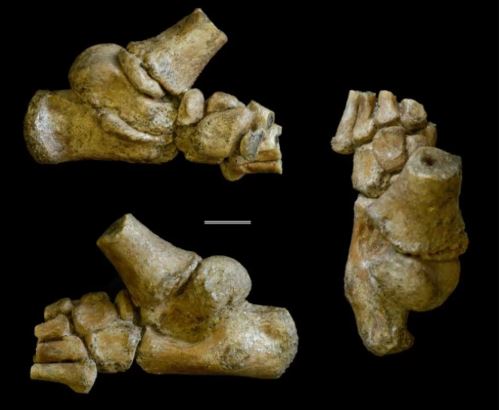
The 3.32 million-year-old foot from an Australopithecus afarensis toddler shown in different angles. Credit: Jeremy DeSilva & Cody Prang[/caption]

A complete 3-million-year-old skeleton

Discovered in 2002 by Zeresenay Alemseged, a professor of organismal biology and anatomy at the University of Chicago, the foot is about the size of a modern human’s thumb. Astonishingly, it is part of an almost complete skeleton of a young female Australopithecus afarensis living 3.32 million years ago in the Dikika region of Ethiopia. “This is the most complete foot of an ancient juvenile ever discovered,” Desilva says. “For the first time, we have an amazing window into what walking was like for a two-and-a-half-year-old, more than 3 million years ago.”

 “On the cusp of being human”

Alemseged is a world leader in palaeontology, specialising in the study of human origins and our evolution. He contributed to the study as a senior author. “Placed at a critical time and the cusp of being human, Australopithecus afarensis was more derived than Ardipithecus (a facultative biped) but not yet an obligate strider like Homo erectus. The Dikika foot adds to the wealth of knowledge on the mosaic nature of hominin skeletal evolution” explains Alemseged. The fossil record shows that these ancient ancestors were adept at walking upright. Desilva adds: “Walking on two legs is a hallmark of being human. But, walking poorly in a landscape full of predators is a recipe for extinction.” [caption id="attachment_8792" align="aligncenter" width="230"] The child’s foot (bottom) compared with the fossil remains of an adult Australopithecus foot (top). Credit: Jeremy DeSilva & Cody Prang[/caption]

A relative of the Lucy fossil?

The fossil of the toddler’s foot is not only the same species as the famous Lucy fossil, but was also found in the same vicinity in Ethiopia. Unsurprisingly, this led to it being erroneously called ‘Lucy’s baby’ by the popular press – despite this toddler having been around 200,000 years before Lucy.

What we know about the toddler’s lifestyle

With a remarkably preserved anatomy, the fossil foot has given the research time invaluable insight into the daily lifestyle of this toddler. After an examination into how the foot developed and what this tells us about human evolution, it can even start to tell the story of how our ancestors survived. At just two and a half years of age, this Dikika child was already walking on two legs. However, findings also suggest that she was still spending time in the trees, foraging for food while clinging to her mother. “If you were living in Africa 3 million years ago without fire, without structures, and without any means of defence, you’d better be able get up in a tree when the sun goes down,” adds DeSilva. Accordingly, the base of the big toe and the skeletal structure surrounding it suggests that vulnerable children spent more time in the trees than their adult carers. “These findings are critical for understanding the dietary and ecological adaptation of these species and are consistent with our previous research on other parts of the skeleton especially, the shoulder blade,” Alemseged notes.]]>

Categories
Editorial

How did 'dazzle painting' affect World War One military tactics?

German U-boats: A looming challenge As a Royal Navy volunteer, Norman Wilkinson was all too aware of the threat from Germany’s U-boats. The Kaiser had declared a no-holds-barred approach to submarine warfare on January 31st 1917 and, desperate to bring an end to such a costly and gruesome war, he ordered torpedoes on any ship entering the warzone. Unbridled horror ensued: on April 17th 1917, the HMHS Lanfranc, a hospital ship with wounded German soldiers, was torpedoed by Imperial U-boats. 40 died, including 18 Germans. Maritime camouflage became one of the big questions being passed around the British Royal Navy offices. On a ship’s journey, it moves through changing light and visibility. If a camouflage was to work, it would need to evolve every second. What worked on land simply wouldn’t work at sea. As imaginative ideas from artists and inventors arose, they were discussed, trialled and ultimately vetoed. Thomas Edison’s idea, to adorn a vessel with trees to make it look like an island, was actually put into practice on the S.S. Ockenfels. It made it to New York harbour before the winds got the better of the disguise.

Hidden in plain sight

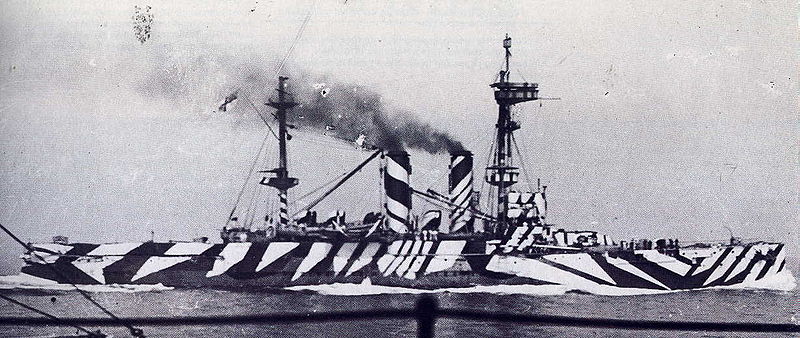
Artist-turned-Royal-Navy-volunteer Wilkinson took a different approach. Rather than hide the boat, he’d distort it. Reflecting on his idea, he said: “Since it was impossible to paint a ship so that she could not be seen by a submarine, the extreme opposite was the answer – in other words, to paint her, not for low visibility, but in such a way as to break up her form and thus confuse a submarine officer as to the course on which she was heading.” A U-boat gunner would need to hit the target from between 300 and 1900 metres away. He had under 30 seconds to pick out the ship through his periscope before he would be spotted, thus revealing the submarine’s location. Terribly expensive and often slow, torpedoes were in limited supply: a typical U-boat would only carry 12. For the gunner, getting it right first time was imperative. The visibility of a British ship may have been its vulnerability; but the gunner’s weakness was his reliance on his own guesswork during that 30-second window. Spotting this, Wilkinson realised that ‘dazzling’ the gunner was the only way to compromise his estimation. In that split moment, he’d have to decide: should he risk shooting a precious torpedo when he couldn’t be certain where the ship was heading? With this theory in place, Wilkinson started to design. He used broad strokes of intense colours in geometric shapes to blur the vessel’s shape, size and direction. For example, a curve on the side of the ship could conjure up a phantom wave; making the ship seem smaller. Bold patterns on the stern or bow could create an optical illusion, turning the ship around in the eye of the gunner and his low-down viewpoint. [caption id="attachment_8786" align="aligncenter" width="500"] HMS London in May 1918. Credit: British Royal Navy[/caption] Consciously or not, Wilkinson’s newly militarised creativity reflected the overwhelming strides being made in contemporary art.

What was happening in the art world?

As an artist, Wilkinson would have been aware of the truly ground-breaking movements occurring in art during the First World War. Consumed by nihilism, many international artists had begun to express their anguish at a humanity hell-bent on tearing itself apart. In 1915, one artist, the Russian Kazimir Malevich, painted a simple black square on a canvas. Representing the end of everything, the omnipresence of death, and a bleak hopelessness, Black Square remains one of the most influential artworks of the 20th Century. Malevich’s Black Square was part of the artist’s Suprematist movement: a bold visual language of abstract geometric shapes and stark colours. The first ever Suprematist exhibition was held in 1915, showing 35 of Malevich’s seemingly random arrangements of shapes and colours. Despite the sparse conversation around the relationship between Suprematism and dazzle painting, the influence is clear. [caption id="attachment_8785" align="aligncenter" width="500"] Supremus 58 by Kazimir Malevich. Credit: Russian Museum[/caption] More frequently discussed is the impact Cubism may have had on dazzle painting. Picasso, a leading artist of the Cubist movement that first gained traction in 1907, claimed inspiration for the new military technique. Whether Cubism, Suprematism or something else, Wilkinson was functioning in an art world obsessed with randomised geometric shapes and a gripping use of colour. His subconscious would have been overflowing with an aesthetic intended to confuse.

Dazzle painting gets the royal approval

By late October, Wilkinson’s idea had come to fruition. King George V was sent to inspect the ‘Dazzle Section,’ a new division of the British merchant naval service. At first, the King was presented with a small model of a ship. Rather than the classic battleship grey, it had been painted with a joyous palette of contrasting colours. Looking through a periscope about 10 feet from the tiny model, he was asked to guess the ship’s course. As an ex-Naval officer, he knew what he was doing. “South by west,” he answered. Had he been a gunner, he’d have wasted one of 12 precious torpedoes on that guess. The dazzle-painted ship had actually been heading east by southeast. The king was first confounded, and then convinced.

Dazzle artists at work

The Royal Academy of Arts offered four unused studios as dazzle-painting headquarters. Wilkinson’s team of 19 was made up of 5 artists, 3 model makers and 11 female art students who hand-painted the technical plans. To become predictable was to become defunct; so each design was unique and tailored to individual ships. Within a year, 2,300 British ships were painted with dazzle. By the end of the war, that number would grow to 4,000. [caption id="attachment_8787" align="aligncenter" width="500"] A Dazzled Merchantman by Charles Pears. A Merchant vessel at sea during choppy weather conditions. The ship is painted in a dazzle camouflage scheme, which incoporates shades of blue, pale green, mauve and also black and white. Credit: Imperial War Museum[/caption]

Did dazzle painting work?

Whether or not dazzle painting worked is up for debate. In the first three months of 1918, 72% of dazzled British ships that were attacked were sunk or damaged. In the second quarter, though, this dropped to 60%; compared to the 68% of non-dazzled ships. Dazzled ships in America fared better: of 1,256, only 18 were sunk. The conversation continues to this day. In 2011, the University of Bristol released research concluding that dazzle painting can certainly disrupt a person’s perception of the speed of a moving target. In truth, though, it didn’t matter whether dazzle painting worked. Insurance companies thought it did, so they lowered the premiums on painted boats. Morale on dazzled ships was higher, making deployment of the strategy a no-brainer. Despite being met with general derision in the press, dazzle ended up having a distinct effect on the identity of wartime Britons. Its distinctive visuals appeared on fashion items, cars and even high street windows. People attended ‘dazzle balls,’ where they would dress up in dazzle-inspired costumes and raise money for the war effort. Its military effect may be debatable but one thing is certain: a creative injection into a flailing war can have a morale boost at sea and at home.]]>

Categories
Breaking News

Not Western after all: veterinary science originates from Mongolia

Max Planck Institute for the Science of Human History. A team of scholars, led by William Taylor of the Institute, have analysed ancient horse remains from a Mongolian pastoral culture called the Deer Stone-Khirigsuur Culture. Crucially. their findings challenge the traditional view that veterinary care is a Western science.

Who were the people of the Deer Stone-Khirigsuur Culture?

This pastoral culture roamed the steppes of Mongolia and the eastern parts of Eurasia between 1300 and 700 BC. The nomadic tribe carved beautiful standing stones, known as deer stones, and created burial mounds, or khirigsuurs, across the Mongolian Steppe. As peaceful horsemen, they have been linked to some of the oldest evidence for nomadic herding and the keeping of domestic livestock in that part of the world. [caption id="attachment_8781" align="aligncenter" width="500"] Horses congregate near a deer stone site in Bayankhongor, in central Mongolia’s Khangai mountains.
Credit: William Taylor[/caption] They were the first peoples in eastern Eurasia to utilise horses as livestock, and it has been suggested that they were among the first to ride the animals. At roughly the same time as their inhabitancy, bronze and metal mouthpieces for riding spread throughout the region. These would have given riders more nuanced control over the animals, enabling them to use them for new purposes – including warfare. However, using metal to control horses also saw the rise of new oral issues, including painful interactions with a vestigial tooth that develops in some animals, known as a ‘wolf tooth’. A common problem among the horses, ‘wolf tooth’ would have been alleviated by the use of blunt metal instruments. The practice remains in a similar form today. This dentistry care would have allowed the early riders to control their horses, and further use them to advance their own society. Near each deer stone and khirigsuur, stone mounds symbolise the ritual burials of domestic horses. To contextualise the scale of this culture, the number of horses buried can run up into the hundreds, or even thousands. [caption id="attachment_8782" align="aligncenter" width="500"] A depiction of the classic Mongolian style of deer stone. Credit: Kyarrakun, via Wikimedia Commons[/caption]

“Oldest known practitioners of vet care”

A careful study of the skeletal remains found in these burials has exposed never-before-known information about early veterinary dental procedures. The Deer-Stone Khirigsuur people would have removed any baby teeth causing pain in young horses – making them the world’s oldest known practitioners of veterinary dental care. Throughout the study, Taylor worked closely with colleagues from the National Museum of Mongolia. Jamsranjav Bayarsaikhan and Tumurbaatar Tuvshinjargal were able to provide him with deeper insight about the development of horseback riding and how a horse-based pastoral economy facilitates scientific advancement. “We may think of veterinary care as kind of a Western science,” Taylor comments. “But herders in Mongolia today practice relatively sophisticated procedures using very simple equipment. This results of our study show that a careful understanding of horse anatomy and a tradition of care was first developed, not in the sedentary civilizations of China or the Mediterranean, but centuries earlier, among the nomadic people whose livelihood depended on the well-being of their horses.”

Connecting East and West

Nicole Boivin, Director of the Department of Archaeology at the Max Planck Institute for the Science of Human History, concludes: “In many ways, the movements of horses and horse-mounted peoples during the first millennium BCE reshaped the cultural and biological landscapes of Eurasia. “Dr. Taylor’s study shows that veterinary dentistry – developed by Inner Asian herders – may have been a key factor that helped to stimulate the spread of people, ideas, and organisms between East and West.” The research has been published in full here.]]>