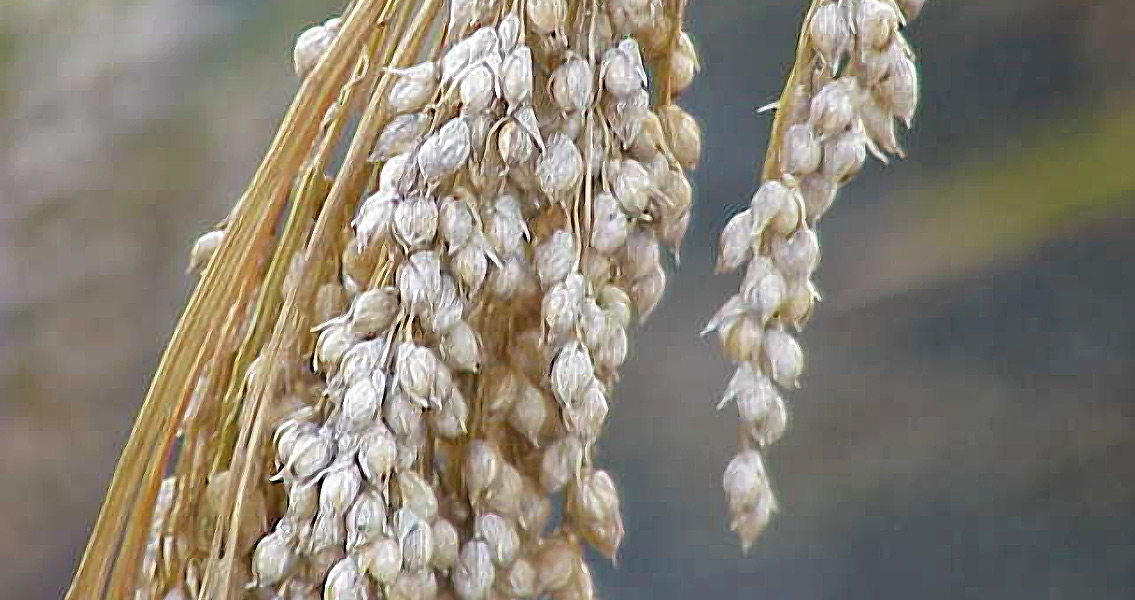
Panicum miliaceum and Setaria italica),” the team wrote in their report, published in the upcoming edition of the Journal of Archaeological Science. Intriguingly, there was very little evidence of C4 plants in the diets of individuals from Bronze Age northern Kazakhstan. In later periods, C4 plants were a major component in human diets across the region, but at this early stage – around 1,800 BCE – it appears that southern Kazakhstan was populated by agricultural societies. “The wide variety of stable isotope results, both within and between contemporary sites from the southern regions of Kazakhstan, indicates a diversity of food choice,” the team explained. The team’s research presents the earliest directly dated isotopic analysis of millet consumption outside of China. Their research suggests that millet was a significant dietary component for a substantial number of individuals in Bronze Age southern Kazakhstan, indeed, millet made up such a large proportion of their diet that it was detectable in analysis of human bone collagen. The evidence for substantial millet consumption in southern Kazakhstan – particularly when taken with the absence of the crop in the north during the same period – suggests that this region may have been the route for the spread of millet crops from China. This hypothesis, the team notes, warrants further archaeobotanical research. What the team have revealed conclusively is the great variation in human diet. Southern Kazakhstan during the Bronze Age had a great many different sources of food which has left an indelible mark in the bones of people who inhabited the area. The evidence of millet also implies that Bronze Age southern Kazakhstan could have been a very important area between China and further West, meaning that the region could have been the first area to properly cultivate the crop outside of China. For more information: www.sciencedirect.com Image courtesy of Wikimedia Commons user: Kurt Stüber]]>

GSA Today, the authors argue that pre-Republican Rome was a smart city. During this period, Rome’s expansion did not substantially alter the geological features of the area. Natural resources around Rome were managed in order to minimise the environmental damage from over-exploitation. During the pre-Republican era, Rome was an agricultural economy. The small hilltops around the river Tiber’s alluvial plain created remarkably fertile soils, suitable for farming. Access to the river meant that trading of agricultural products was remarkably easy for Romans. Farms were numerous and the city of Rome was self-sufficient. In the same period, Naples had fewer natural resources and was also exposed to more geological vulnerabilities than Rome. As it was based within a naturally-defensible bay, Naples had an economy dependent on sea trade. Naples is also surrounded by very rugged geomorphologic terrain, meaning that the potential for agricultural expansion and economic diversification was limited. Naples, unable to expand outwardly, grew in a vertical manner. The natural marine terraces which bordered the coast became the foundations for Naples’ expansion. Geomorphology, de Rita and Häuber argue, played a key role in constraining Naples’ importance for the Roman Empire. “Geology was a major contributor to the fortune of Rome, which had more resources and reduced risks relative to Naples”, the pair wrote. “Rome could also safely expand toward the Alban Hills area because of the plateau geomorphology, which further provided an easy path for the construction of the aqueducts. The city could also develop agricultural practices that, until Republican times, ensured its self-sustenance.” As time passed, however, rapid urban expansion and population growth led to the over-exploitation of resources. Both cities became unstable and disasters occurred as a result of natural processes, such as flooding and earthquakes. “…many past examples have shown how the indiscriminate use of technology in response to a natural hazard–induced risk, instead of generating security, can lead to higher risk and danger,” the article explains. Häuber and de Rita’s work offers a stark warning for modern cities. Expansion must be managed carefully, allowing for urban growth without out-stripping resources. If we do not heed these warnings, we risk our cities being increasingly vulnerable to natural disasters. For more information: www.geosociety.org Image courtesy of Wikimedia Commons user: Markus Bernet]]>


www.saa.publisher.ingentaconnect.com Image courtesy of Wikimedia Commons user: Rotatebot]]>

Live Science that the ancient city was marked by a so-called ceremonial route, running from west to east, with only a 3-degree deviation from true east, a remarkable accuracy. This ceremonial route, a perfectly straight line, was lined by as many as 15 flat-topped pyramids which would have stood as tall as 100 feet. Each had a temple on top, which people reached by steps in the pyramids. At the easternmost end of the route there was a structure including three main pyramids along with some other buildings, arranged to face each other. Such triadic structures have been found in other Maya cities as well. In the northern and southern parts of the city were residential areas, again conforming to the overall grid design, Pugh said, and the whole area was encircled by a stone wall for protection. Apparently, Nixtun-Ch’ich was a beautiful, “shiny” city at its height, based on evidence of white plaster that may have been used for the buildings. However, for the people living in it, this design may not have been the most pleasant one due to its strictness, imposing a sense of constant control. This conclusion is based on the atmosphere of early European grid-design cities that started being built during the early Renaissance. Compared to Nixtun-Ch’ich, other ancient Maya cities were more “relaxed” in terms of design, with more open spaces. There is one other city on the land of the former Maya empire, Teotihuacan, which was also built according to a grid design but that city was inhabited by another civilisation about which little is known. Pugh’s research was actually focused on a community building and artefacts dating to a much later period, about the fourteenth century CE. The building was probably the place where the local Maya heirs, the Chakan Itza, held meetings, performed religious ceremonies, and generally conducted matters of state. There were two altars with turtle sculptures in the building, as well as figures of parrots and snakes along the walls. The building, Pugh says, was probably used for about two centuries. The Maya civilisation has been the subject of extensive study since the nineteenth century but the reasons for its decline, which occurred sometime around 900 CE, are still unclear. This was the first geographically focused empire in the region, which at its height spanned the Yucatan Peninsula, Tabasco and Chiapas in what is today Mexico, as well as Guatemala, Belize, western Honduras and El Salvador. The first evidence of Maya culture dates back to 1800 BCE but the golden age, the Classic Period of the civilisation, is considered to have lasted from 250 to 900 CE. Among its hallmarks are the stone pyramids where the Maya worshiped their gods, and the Maya calendar, whose accuracy is still a mystery for modern science. Image courtesy of Wikimedia Commons user: joiseyshowaa]]>

scansoriopterygids, characterised by their long hands, that lived 160 million years ago. All fossilised remains from this group come from China and none of them have such a bone connected to their wrists. This, coupled with the fact that bats and flying squirrels have similar bones on their hands, led the scientists to the suggestion that the dinosaur had wings made from skin, not feathers. The team, including Xu Xing and Corwin Sullivan from the Chinese Institute of Vertebrate Paleontology and Paleoanthropology, and Zheng Xiaoting from Linyi University, named the creature Yi qi, meaning “strange wing”. They explained that at this stage it is impossible to determine whether the wings were used for flapping or gliding but in any case no other dinosaurs that have been discovered in this group of species had anything like them. Zheng said that Yi qi must have been a flight pioneer, given that it lived in the Jurassic era, long before feathered dinosaurs took to the air. However, the evidence is scarce, so it is likely that the publication detailing the find and the scientists’ conclusions will cause controversy. Although it has been long suspected that modern birds evolved from dinosaurs, until recently there was no hard evidence proving the link. Just last year, paleontologists completed a comprehensive family tree of a group of carnivorous dinosaurs from which birds are thought to have evolved. The tree reveals that, unlike with humans, this evolutionary process was gradual, with no “missing links”. Simply put, 150 million years ago a group of small dinosaurs started changing, acquiring bird-like skeletons, beaks and feathers. This process took tens of millions of years, accelerating over time. This, paleontologists explain, is because once the bird skeleton was in place, it greatly increased the potential for further evolution and diversity. For the sceptics, bird DNA has also been linked to dinosaur DNA, including that of the Tyrannosaurus Rex. In 2007, US researchers managed to extract collagen, a protein from the soft tissue of a bone, from the remains of a Tyrannosaurus that had lived 68 million years ago. The closest collagen type found in a modern animal was that in chicken bones. This discovery helped add more weight to the hypothesis that birds evolved from dinosaurs. Image courtesy of Wikimedia Commons user: H. Raab]]>
www.sciencedirect.com Image courtesy of Wikimedia Commons user: OgreBot]]>
