Nature, can be found online here]]>
Nature, can be found online here]]>
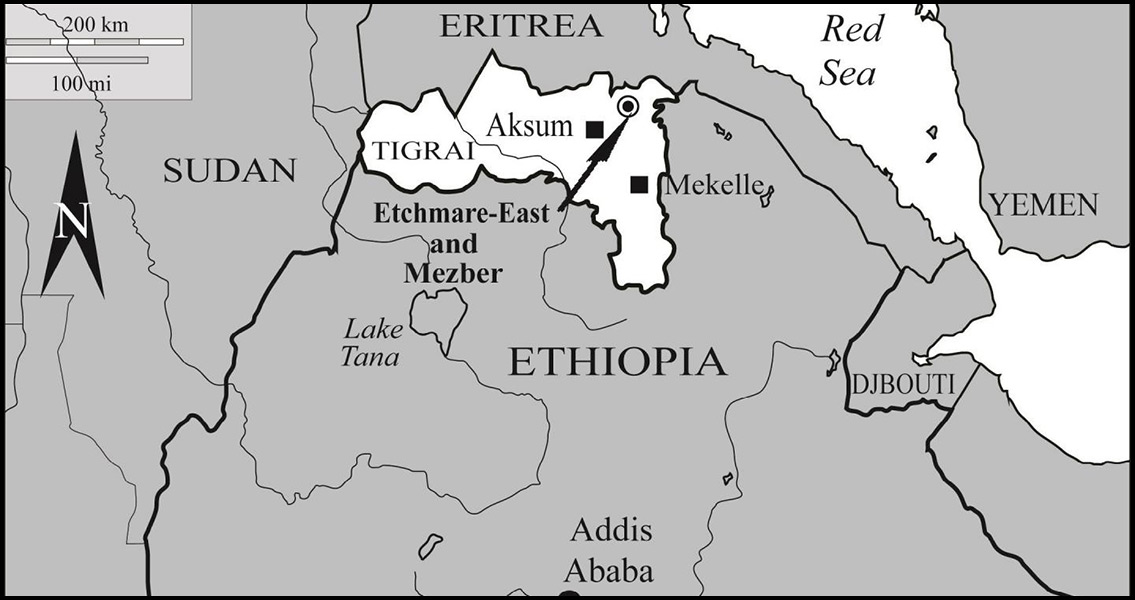
Gallus gallus, a species endemic to sub-Himalayan northern India, southern China and south-east China. First domesticated in the region between 6,000 and 8,000 years ago, the offspring of these chickens have spread across the globe. A team from Washington University in St. Louis radio carbon dated around 30 chicken bones unearthed from the site of an ancient farming village in what is today Ethiopia. Among them was a discarded chicken leg, etched with teeth marks from thousands of years ago. The bones provide physical evidence of the introduction of chickens to Africa. “Our study provides the earliest directly dated evidence for the presence of chickens in Africa and points to the significance of Red Sea and East African trade routes in the introduction of the chicken,” said Helina Woldekiros, lead author of the study and a postdoctoral anthropology researcher in Arts & Sciences at Washington University, in a press release. How the domesticated chicken arrived and then dispersed through Africa has long remained a mystery. Earlier research relied on depictions of chickens in ceramics and paintings, along with bones from other archaeological sites, to conclude that chickens were introduced to Africa through North Africa, Egypt and the Nile Valley about 2,500 years ago. Until now, the earliest actual bone based evidence of chickens in Africa was from the Saite levels at Buto, Egypt, and was dated to between 685 and 525 BCE. The new study, published in the International Journal of Osteoarchaeology, both pushes that date back by centuries and also suggests that the initial introduction could have happened on the east rather than north coast of Africa. “Some of these bones were directly radiocarbon dated to 819-755 B.C., and with charcoal dates of 919-801 B.C. make these the earliest chickens in Africa,” explained Woldekiros. “They predate the earliest known Egyptian chickens by at least 300 years and highlight early exotic faunal exchanges in the Horn of Africa during the early first millennium B.C.” Co-author of the study Catherine D’Andrea, professor of archaeology at Simon Fraser University in Canada, led the excavation team in Ethiopia. The bones used in the study were recovered from the kitchen and living room floors of an ancient farming community known as Mezber: a rural village located in northern Ethiopia about 30 miles from the urban center of the pre-Aksumite civilization. The pre-Aksumites were the first people in the Horn of Africa to form complex, urban-rural trading networks. Interestingly, linguistic studies into the ancient root words for chickens in African languages suggest the birds had arrived through multiple routes: North Africa through the Sahara to West Africa; and from the East African coast to Central Africa. Molecular studies revealing the biodiversity of domesticated African chickens further support this notion of domestic chickens arriving in Africa through multiple routes. Woldekiros said: “It is likely that people brought chickens to Ethiopia and the Horn of Africa repeatedly over a long period of time: over 1,000 years. Our archaeological findings help to explain the genetic diversity of modern Africans chickens resulting from the introduction of diverse chicken lineages coming from early Arabian and South Asian context and later Swahili networks.” Studies like Woldekiros and D’Andrea’s shed new light on ancient migration, exchange and trade; the spread of domesticated animals tracing the paths of ancient connections. Sometimes these trades were unsuccessful of course, with various zooarchaeological studies showing examples where the introduction of a new species to a new part of the world failed. Other times it took repeated introductions of a new species to a region, something which the recently published study points to. “Our study also supports the African Red Sea coast as one possible early route of introduction of chickens to Africa and the Horn,” Woldekiros said. “It fits with ways in which maritime exchange networks were important for global distribution of chicken and other agricultural products. The early dates for chickens at Mezber, combined with their presence in all of the occupation phases at Mezber and in Aksumite contexts 40 B.C.- 600 A.D. in other parts of Ethiopia, demonstrate their long-term success in northern Ethiopia.” Image Courtesy of International Journal of Osteoarchaeology]]>

here Image courtesy of The Aerograph Co./ US Library of Congress]]>

Western Digs: “This is one of the few archaeological contexts registered by archaeologists in this region, if we confirm the hypothesis [that this burial dates from] the Late Archaic, we could have a site with information about the transition to agricultural, sedentary communities in the region.” A number of the remains, both avian and human, had been naturally mummified by the arid climate. In addition to the skeletons and bird remains; textiles, baskets, stone points and other artifacts were also found. The two sets of remains were surrounded with an array of goods, including a large sea shell and a dress or bag made from deer hide. The gender and exact age of the child is unknown, although the size suggests at the time of death they were between one and three years old. The partial adult skeleton had large leg bones that had been tied together, similar to other, later finds in northern Mexico. The practice of reburying partial skeletons was not uncommon. Starting around 1100, the citizens of Paquime are known to have dug up and then re-buried their dead, sometimes collecting the bones in large jars or bundles, possibly to be buried with relatives. If this new cave site predates Paquime, the burial may be earlier evidence of the practice. Not found at the graves were artifacts, such as ceramics, associated with the Puebloans who built and then settled in trade centers like Paquime during the Medio Period. This absence indicates the graves predate the creation of Paquime, which happened around the year 700. The early date also makes the discovery of the bird, a scarlet macaw, especially significant because tropical birds are not indigenous to the high desert region of Chihuahua. The discovery of the macaw in this pre-Medio Period site indicates the presence of long-distance trade in exotic goods which pre-dates Paquime by centuries. “This finding verifies once again that the [mountains of Chihuahua] have been a cultural corridor between the coast and the desert north with the south,” Gallaga is quoted as saying in Western Digs. “At the end of the day, this discovery shows us that there is still a lot to do in the northern Mexico region, archaeologically speaking.” Gallaga’s team was called to the site when the property owner uncovered the strange remains while using heavy equipment to level the cave’s floor. “Many archaeological discoveries are the result of planned research and are conducted during years of intellectual efforts,” Gallaga says in Western Digs. “Others are the result of an accident.” ]]>


New Historian covered in detail recently – sent shockwaves through the archaeological community, especially in light of a new UNESCO resolution that has been interpreted by some as an attempt to devalue the historical ties of Israel to the city. Many in the Israeli government, up to and including Prime Minister Benjamin Netanyahu, have cited the papyrus discovery as proof that UNESCO’s decision was incorrect, according to Haaretz. However, there are more than a few Israeli researchers who doubt not just the veracity of the papyrus and its text but also the decision to publicize the find, especially as the papyrus was not discovered at a supervised dig site. Initial analysis of the papyrus itself through carbon-14 dating revealed its age to be anywhere from 2,500 to 2,800 years old. The Hebrew text with which the scroll is inscribed is a match for the type of epigraphy used during the seventh century BCE, but Prof. Aren Maeir of Bar-Ilan University, leveling criticism at the IAA , said that while the papyrus may indeed be from that date, there are no indications that the script on the scroll isn’t a clever forgery. There are several well-known cases of antiquities thieves and forgers engaging in similar activity in the past, Prof. Maeir remarked. These forgers would purposely “sacrifice” a legitimate artifact in such a way to whet the appetite of collectors, thus setting up unsuspecting, credulous buyers for any more scrolls they “find” in the future. Additional tests are needed to verify the document, the professor stressed. George Washington University’s Prof. Christopher Rollston agreed with Prof. Maeir, claiming on his blog that there are no indications that the inscriptions on the piece of papyrus are as old as the medium they’ve been placed upon, even when the papyrus, as in this case, has been dated to a specific time. With the abundance of ancient papyrus available to the public – Prof. Rollston claims that nearly anyone can find and order some over the internet – he remains unconvinced of the legitimacy of the inscription. Despite this, the IAA continues to refer to the papyrus as a legitimate find, as it claims to have subjected the new scroll to the same rigorous study that the Dead Sea Scrolls were upon their discovery. However, skepticism still abounds, perhaps most likely due to the seemingly coincidental publication of the find so soon after the UNESCO resolution that sought to downplay and perhaps even sever Judaism’s connection to the Temple Mount, a location of high religious significance to all the Abrahamic faiths. ]]>


study from scientists at the Senckenberg Center for Human Evolution and Palaeoenvironment (HEP) in Tübingen analysed the bone collagen of Neanderthal remains from two sites in Belgium and concluded that the Neanderthals there at least had a diet of roughly 80% meat, 20% vegetables. Power took advantage of innovative new methods to determine the diet of Neanderthals who lived in the Mammoth steppe region. Until recently there was a distinct lack of ways to trace prehistoric food consumption; restricting research into ancient diets. Power used cutting edge microscopy methods to analyse food consumption in Neanderthals. By studying microbotanical particles in the plaque of Neanderthals from six different sites, including Croatia, Italy and Russia, he found that Neanderthals from all of the regions regularly ate plants and vegetables. To verify the accuracy of using tooth plaque to reconstruct diets, Power performed similar tests on the teeth of a group of recently deceased chimpanzees. The diet of those chimpanzees had been monitored for over twenty years, and the test results showed that teeth plaque did indeed reflect diet over an extended period of life. Crucially, by comparing data from different climatic regions and periods, Power showed that whatever the conditions or time, plants were consistently a significant part of the Neanderthal diet. It’s a conclusion which begins to throw serious doubt on the idea that a limited diet was a key driver of the Neanderthals’ extinction. It also adds to the ever more complicated image forming of the Neanderthals, with a stream of new evidence showing they were perhaps not as simple as popularly thought. “One of the big lessons of my work on Neanderthals was that the only reason we find the result surprising is that we expect Neanderthals to resemble modern human hunter gatherers in the way they foraged for food, but they didn’t.” Power explained in a Universiteit Leiden press release. “In the past we saw them as primitive cavemen with very basic behaviour, but now we have updated our view and see them as very modern. But that doesn’t mean we can afford to pigeonhole Neanderthals into our own particular version of humanity. They had their own unique pattern.” Beyond raising questions about the extent to which we should consider Neanderthals ‘primitive’, Power’s study also throws into doubt ideas about the Mammoth steppe; showing how much still needs to be learnt about the Pleistocene epoch. As Power explained: “The Mammoth steppe is an environment that we don’t really understand because it no longer exists due to climate change and megafauna extinction. It may well be that these ancient grasslands were far more useful to Neanderthals than we thought.” ]]>

Panthera spelaea, the Eurasian cave lion, a species that was larger than an African lion without the mane, became extinct approximately 14,000 years ago, but the reasons behind its disappearance have never been completely understood. Archeological findings show that between 50,000 and 10,000 years ago, Upper Paleolithic humans did in fact hunt animals both large and small, however, evidence of lion hunting is rare. In an attempt to determine if early humans hunted the cave lion, thereby contributing to its extinction, Marián Cueto, with the Universidad de Cantabria, Spain, and her colleagues examined nine fossilized toe bones from the claw of a cave lion, looking for evidence the cats were exploited by humans. The feline bones were unearthed at La Garma, the Upper Paleolithic cave site located in northern Spain. What researchers found was that a majority of the bones did in fact show signs of having been modified by stone tools used by humans, along with signs of a specific technique, similar to the one used by modern hunters to keep the claws attached to the fore while skinning it. The research suggests that the toe bones may have been part of a single lion pelt, possibly covering the floor of the occupied cave. The La Garma site is known to have been associated with human rituals, and it’s possible the Eurasian cave lions had some symbolic meaning for Upper Paleolithic humans. While the analysis doesn’t offer definitive findings which would conclude the Upper Paleolithic humans hunted cave lions for their pelts, it also doesn’t offer any findings to the contrary, and other evidence has been found showing that cave lions and early humans did interact in some capacity. The cave, situated on La Gama Mountain, is divided into different levels. In the upper section there are human burial sites, the intermediate level holds a large number of palaeontological remains, primarily bones. The most important remains, however, are found on the lower level where there are three intact spaces with numerous examples of painted art, including an amazingly realistic black horse, and a number of symbols painted red. Also found are representations of goats and bison and still more panels are covered with hand prints. The drawings date to between 28,000 and 13,000 years ago. Prehistoric humans ventured into the La Garma cave to perform sacred rituals. They navigated hundreds of yards through the dark, until they reached one of the circular stone huts (each with a horse skull in the center) where their religious ceremonies took place. Untouched for thousands of years, La Garma acts as a time capsule, with everything remaining exactly as it was during the Upper Paleolithic era. The nature of the ceremonies is unknown, however, the discovery of just foot bones indicates that aside from the pelts, the claws of the lion were also brought into the cave. The research has been published journal in the online journal PLOS ONE. Image courtesy of Wikimedia Commons user: Pit1233 ]]>

Proceedings of the National Academy of Sciences. The simulations ran by Fitzpatrick et al took into account high resolution data for winds, land distribution, precipitation and ocean currents. “We synthesized a lot of new climatic data and ran a lot of new simulations that are exciting in terms of highlighting and pinpointing where some of these prehistoric populations might have come from,” said Fitzpatrick, in a press release. “The simulation can assess, at any point in time, if somebody left point A, where would they end up if they drifted? We can also model directed voyages. If somebody knew where they were going, how long would it take them to get there?” Interestingly, the team’s results suggest the settlers were aware of El Nino Southern Oscillation Patterns, and used them to aid their voyages. El Nino occurrences typically happen every three to seven years, and are shown in the archaeological record through evidence of forest fire and drought. One major consequence of El Nino is that winds and associated precipitation shift from westerly to easterly. Settlers would have found travel toward Oceania much easier during El Nino years, and could have timed their departures accordingly. “What Pacific scholars have long surmised but never really been able to establish very well is that, through time, Pacific Islanders should have developed a great deal of knowledge of different climactic variations, different oscillations of wind and changes in environments that would have influenced their survivability and their abilities to go to certain places,” Fitzpatrick explained. Information relating to the origins of the early seafarers has also been revealed by the study, occasionally challenging prevailing archaeological theories. The settlers of western Micronesia likely came from near the Maluku Islands, while those of East Polynesia probably came from Samoa. Hawaii and New Zealand on the other hand, may have been settled from the Marquesas or Society Islands. Easter Island was likely populated by people from Marquesas or Mangareva. The results suggest Samoa may have been an epicenter for colonisation missions, throwing into question existing data that have the Philippines as the possible point of departure for the colonisation of Micronesia. What the paper cannot answer is the tantalising question of why these early seafarers were driven to travel such huge distances. As the authors admit, there is no easy way to explain why people took the chance of launching colonising missions to islands up to 2,500 miles away. “What drove the movement? That’s the big question,” Fitzpatrick said. “Was it political? Was it a result of population pressure? There were probably multiple reasons why people decided to leave one place and go to another.” Image Courtesy of Scott Fitzpatrick ]]>