Categories
Breaking News

3-million-year-old skeleton reveals the story of ancient toddlers’ lifestyles

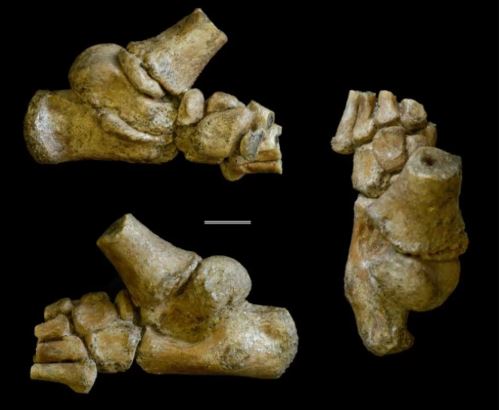
The 3.32 million-year-old foot from an Australopithecus afarensis toddler shown in different angles. Credit: Jeremy DeSilva & Cody Prang[/caption]

A complete 3-million-year-old skeleton

Discovered in 2002 by Zeresenay Alemseged, a professor of organismal biology and anatomy at the University of Chicago, the foot is about the size of a modern human’s thumb. Astonishingly, it is part of an almost complete skeleton of a young female Australopithecus afarensis living 3.32 million years ago in the Dikika region of Ethiopia. “This is the most complete foot of an ancient juvenile ever discovered,” Desilva says. “For the first time, we have an amazing window into what walking was like for a two-and-a-half-year-old, more than 3 million years ago.”

 “On the cusp of being human”

Alemseged is a world leader in palaeontology, specialising in the study of human origins and our evolution. He contributed to the study as a senior author. “Placed at a critical time and the cusp of being human, Australopithecus afarensis was more derived than Ardipithecus (a facultative biped) but not yet an obligate strider like Homo erectus. The Dikika foot adds to the wealth of knowledge on the mosaic nature of hominin skeletal evolution” explains Alemseged. The fossil record shows that these ancient ancestors were adept at walking upright. Desilva adds: “Walking on two legs is a hallmark of being human. But, walking poorly in a landscape full of predators is a recipe for extinction.” [caption id="attachment_8792" align="aligncenter" width="230"] The child’s foot (bottom) compared with the fossil remains of an adult Australopithecus foot (top). Credit: Jeremy DeSilva & Cody Prang[/caption]

A relative of the Lucy fossil?

The fossil of the toddler’s foot is not only the same species as the famous Lucy fossil, but was also found in the same vicinity in Ethiopia. Unsurprisingly, this led to it being erroneously called ‘Lucy’s baby’ by the popular press – despite this toddler having been around 200,000 years before Lucy.

What we know about the toddler’s lifestyle

With a remarkably preserved anatomy, the fossil foot has given the research time invaluable insight into the daily lifestyle of this toddler. After an examination into how the foot developed and what this tells us about human evolution, it can even start to tell the story of how our ancestors survived. At just two and a half years of age, this Dikika child was already walking on two legs. However, findings also suggest that she was still spending time in the trees, foraging for food while clinging to her mother. “If you were living in Africa 3 million years ago without fire, without structures, and without any means of defence, you’d better be able get up in a tree when the sun goes down,” adds DeSilva. Accordingly, the base of the big toe and the skeletal structure surrounding it suggests that vulnerable children spent more time in the trees than their adult carers. “These findings are critical for understanding the dietary and ecological adaptation of these species and are consistent with our previous research on other parts of the skeleton especially, the shoulder blade,” Alemseged notes.]]>

Categories
Editorial

How did 'dazzle painting' affect World War One military tactics?

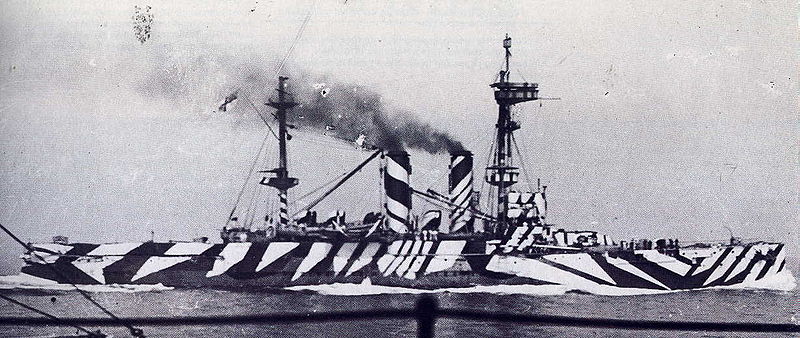
German U-boats: A looming challenge As a Royal Navy volunteer, Norman Wilkinson was all too aware of the threat from Germany’s U-boats. The Kaiser had declared a no-holds-barred approach to submarine warfare on January 31st 1917 and, desperate to bring an end to such a costly and gruesome war, he ordered torpedoes on any ship entering the warzone. Unbridled horror ensued: on April 17th 1917, the HMHS Lanfranc, a hospital ship with wounded German soldiers, was torpedoed by Imperial U-boats. 40 died, including 18 Germans. Maritime camouflage became one of the big questions being passed around the British Royal Navy offices. On a ship’s journey, it moves through changing light and visibility. If a camouflage was to work, it would need to evolve every second. What worked on land simply wouldn’t work at sea. As imaginative ideas from artists and inventors arose, they were discussed, trialled and ultimately vetoed. Thomas Edison’s idea, to adorn a vessel with trees to make it look like an island, was actually put into practice on the S.S. Ockenfels. It made it to New York harbour before the winds got the better of the disguise.

Hidden in plain sight

Artist-turned-Royal-Navy-volunteer Wilkinson took a different approach. Rather than hide the boat, he’d distort it. Reflecting on his idea, he said: “Since it was impossible to paint a ship so that she could not be seen by a submarine, the extreme opposite was the answer – in other words, to paint her, not for low visibility, but in such a way as to break up her form and thus confuse a submarine officer as to the course on which she was heading.” A U-boat gunner would need to hit the target from between 300 and 1900 metres away. He had under 30 seconds to pick out the ship through his periscope before he would be spotted, thus revealing the submarine’s location. Terribly expensive and often slow, torpedoes were in limited supply: a typical U-boat would only carry 12. For the gunner, getting it right first time was imperative. The visibility of a British ship may have been its vulnerability; but the gunner’s weakness was his reliance on his own guesswork during that 30-second window. Spotting this, Wilkinson realised that ‘dazzling’ the gunner was the only way to compromise his estimation. In that split moment, he’d have to decide: should he risk shooting a precious torpedo when he couldn’t be certain where the ship was heading? With this theory in place, Wilkinson started to design. He used broad strokes of intense colours in geometric shapes to blur the vessel’s shape, size and direction. For example, a curve on the side of the ship could conjure up a phantom wave; making the ship seem smaller. Bold patterns on the stern or bow could create an optical illusion, turning the ship around in the eye of the gunner and his low-down viewpoint. [caption id="attachment_8786" align="aligncenter" width="500"] HMS London in May 1918. Credit: British Royal Navy[/caption] Consciously or not, Wilkinson’s newly militarised creativity reflected the overwhelming strides being made in contemporary art.

What was happening in the art world?

As an artist, Wilkinson would have been aware of the truly ground-breaking movements occurring in art during the First World War. Consumed by nihilism, many international artists had begun to express their anguish at a humanity hell-bent on tearing itself apart. In 1915, one artist, the Russian Kazimir Malevich, painted a simple black square on a canvas. Representing the end of everything, the omnipresence of death, and a bleak hopelessness, Black Square remains one of the most influential artworks of the 20th Century. Malevich’s Black Square was part of the artist’s Suprematist movement: a bold visual language of abstract geometric shapes and stark colours. The first ever Suprematist exhibition was held in 1915, showing 35 of Malevich’s seemingly random arrangements of shapes and colours. Despite the sparse conversation around the relationship between Suprematism and dazzle painting, the influence is clear. [caption id="attachment_8785" align="aligncenter" width="500"] Supremus 58 by Kazimir Malevich. Credit: Russian Museum[/caption] More frequently discussed is the impact Cubism may have had on dazzle painting. Picasso, a leading artist of the Cubist movement that first gained traction in 1907, claimed inspiration for the new military technique. Whether Cubism, Suprematism or something else, Wilkinson was functioning in an art world obsessed with randomised geometric shapes and a gripping use of colour. His subconscious would have been overflowing with an aesthetic intended to confuse.

Dazzle painting gets the royal approval

By late October, Wilkinson’s idea had come to fruition. King George V was sent to inspect the ‘Dazzle Section,’ a new division of the British merchant naval service. At first, the King was presented with a small model of a ship. Rather than the classic battleship grey, it had been painted with a joyous palette of contrasting colours. Looking through a periscope about 10 feet from the tiny model, he was asked to guess the ship’s course. As an ex-Naval officer, he knew what he was doing. “South by west,” he answered. Had he been a gunner, he’d have wasted one of 12 precious torpedoes on that guess. The dazzle-painted ship had actually been heading east by southeast. The king was first confounded, and then convinced.

Dazzle artists at work

The Royal Academy of Arts offered four unused studios as dazzle-painting headquarters. Wilkinson’s team of 19 was made up of 5 artists, 3 model makers and 11 female art students who hand-painted the technical plans. To become predictable was to become defunct; so each design was unique and tailored to individual ships. Within a year, 2,300 British ships were painted with dazzle. By the end of the war, that number would grow to 4,000. [caption id="attachment_8787" align="aligncenter" width="500"] A Dazzled Merchantman by Charles Pears. A Merchant vessel at sea during choppy weather conditions. The ship is painted in a dazzle camouflage scheme, which incoporates shades of blue, pale green, mauve and also black and white. Credit: Imperial War Museum[/caption]

Did dazzle painting work?

Whether or not dazzle painting worked is up for debate. In the first three months of 1918, 72% of dazzled British ships that were attacked were sunk or damaged. In the second quarter, though, this dropped to 60%; compared to the 68% of non-dazzled ships. Dazzled ships in America fared better: of 1,256, only 18 were sunk. The conversation continues to this day. In 2011, the University of Bristol released research concluding that dazzle painting can certainly disrupt a person’s perception of the speed of a moving target. In truth, though, it didn’t matter whether dazzle painting worked. Insurance companies thought it did, so they lowered the premiums on painted boats. Morale on dazzled ships was higher, making deployment of the strategy a no-brainer. Despite being met with general derision in the press, dazzle ended up having a distinct effect on the identity of wartime Britons. Its distinctive visuals appeared on fashion items, cars and even high street windows. People attended ‘dazzle balls,’ where they would dress up in dazzle-inspired costumes and raise money for the war effort. Its military effect may be debatable but one thing is certain: a creative injection into a flailing war can have a morale boost at sea and at home.]]>

Categories
Breaking News

Not Western after all: veterinary science originates from Mongolia

Max Planck Institute for the Science of Human History. A team of scholars, led by William Taylor of the Institute, have analysed ancient horse remains from a Mongolian pastoral culture called the Deer Stone-Khirigsuur Culture. Crucially. their findings challenge the traditional view that veterinary care is a Western science.

Who were the people of the Deer Stone-Khirigsuur Culture?

This pastoral culture roamed the steppes of Mongolia and the eastern parts of Eurasia between 1300 and 700 BC. The nomadic tribe carved beautiful standing stones, known as deer stones, and created burial mounds, or khirigsuurs, across the Mongolian Steppe. As peaceful horsemen, they have been linked to some of the oldest evidence for nomadic herding and the keeping of domestic livestock in that part of the world. [caption id="attachment_8781" align="aligncenter" width="500"] Horses congregate near a deer stone site in Bayankhongor, in central Mongolia’s Khangai mountains.
Credit: William Taylor[/caption] They were the first peoples in eastern Eurasia to utilise horses as livestock, and it has been suggested that they were among the first to ride the animals. At roughly the same time as their inhabitancy, bronze and metal mouthpieces for riding spread throughout the region. These would have given riders more nuanced control over the animals, enabling them to use them for new purposes – including warfare. However, using metal to control horses also saw the rise of new oral issues, including painful interactions with a vestigial tooth that develops in some animals, known as a ‘wolf tooth’. A common problem among the horses, ‘wolf tooth’ would have been alleviated by the use of blunt metal instruments. The practice remains in a similar form today. This dentistry care would have allowed the early riders to control their horses, and further use them to advance their own society. Near each deer stone and khirigsuur, stone mounds symbolise the ritual burials of domestic horses. To contextualise the scale of this culture, the number of horses buried can run up into the hundreds, or even thousands. [caption id="attachment_8782" align="aligncenter" width="500"] A depiction of the classic Mongolian style of deer stone. Credit: Kyarrakun, via Wikimedia Commons[/caption]

“Oldest known practitioners of vet care”

A careful study of the skeletal remains found in these burials has exposed never-before-known information about early veterinary dental procedures. The Deer-Stone Khirigsuur people would have removed any baby teeth causing pain in young horses – making them the world’s oldest known practitioners of veterinary dental care. Throughout the study, Taylor worked closely with colleagues from the National Museum of Mongolia. Jamsranjav Bayarsaikhan and Tumurbaatar Tuvshinjargal were able to provide him with deeper insight about the development of horseback riding and how a horse-based pastoral economy facilitates scientific advancement. “We may think of veterinary care as kind of a Western science,” Taylor comments. “But herders in Mongolia today practice relatively sophisticated procedures using very simple equipment. This results of our study show that a careful understanding of horse anatomy and a tradition of care was first developed, not in the sedentary civilizations of China or the Mediterranean, but centuries earlier, among the nomadic people whose livelihood depended on the well-being of their horses.”

Connecting East and West

Nicole Boivin, Director of the Department of Archaeology at the Max Planck Institute for the Science of Human History, concludes: “In many ways, the movements of horses and horse-mounted peoples during the first millennium BCE reshaped the cultural and biological landscapes of Eurasia. “Dr. Taylor’s study shows that veterinary dentistry – developed by Inner Asian herders – may have been a key factor that helped to stimulate the spread of people, ideas, and organisms between East and West.” The research has been published in full here.]]>

Categories
Breaking News

Chewing the fat: gossip culture in early Neolithic food halls

PloS One demonstrates that specialised food production buildings were commonplace in the world’s earliest agricultural villages. The study shows how these buildings played a key role in maintaining and enhancing community cohesion. [caption id="attachment_8777" align="aligncenter" width="500"] View of the early Neolithic communal structure at Beidha, Jordan. Credit: Prof. Cheryl Makarewicz[/caption]

Food production encourages an organised society

Prof. Cheryl Makarewicz of Kiel University and Prof. Bill Finlayson from the University of Reading have posited that the advent of food production sparked profound changes in the ways humans organised their societies. The team undertook excavations at the Pre-Pottery Neolithic B settlement of Beidha, not far from the UNESCO World Heritage site of Petra in Jordan. The very architectural fabric of early farming villages helped to shape human interaction, which was crucial during a period when farming and animal herding were in their first incarnations. Professor Makarewicz comments: “These buildings provided a focal point for the community, a place where everyday mundane activities such as preparing food and making tools could have been undertaken by several people simultaneously.” [caption id="attachment_8778" align="aligncenter" width="377"] The Monastery, Petra, Jordan. Credit: Berthold Werner[/caption]

A place to cook, a place to chat

On top of their immediate functions, these spaces became a platform for conversation and the exchange of ideas. She continues: “These spaces were also important in that they provided a place where community members could drop by and have a chat with their neighbours. “This informal, but highly regular activity may have been all the more important in this context of increasingly large and settled populations. Community members knew information was being passed along and there was a central place to catch up on the news.”

A platform for philosophy?

The buildings have even been linked to the first hints of control and ownership in human society. “What we are also seeing here at Beidha is a really interesting example of how societies deal with managing new issues of how to access and control ownership of plant and animal resources, which might have become more contested within these increasingly populous settlements.”

The early social influence of architecture

“Also interesting is that people at Beidha dealt with these new social tensions very differently from their contemporaries to the west across the Jordan Valley,” Makarewicz adds. The research suggests that in southern Jordan, community daily practice occurred in non-residential buildings, which maintained and strengthened social structures. Conversely, nearby communities would use buildings like this for occasional, dramatic ritual practices. The researchers conclude: “There is a long history of using special-purpose architecture in the south of Jordan to structure the community, and this way of using the built environment for more than just shelter goes right back to the start of the Neolithic here. The continuation of this practice illustrates a strongly local continuity in pathways through the Neolithic revolution.”]]>

Categories
Breaking News

Secrets of the Neanderthals: collaborative, intelligent hunters

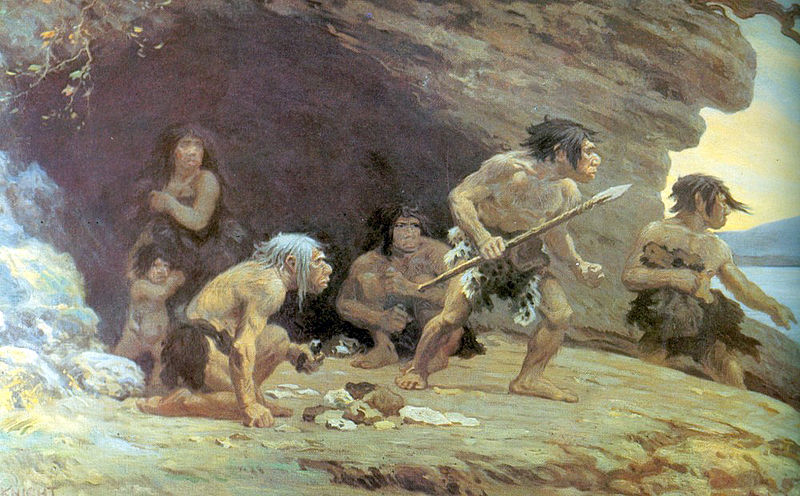
they, and not humans, created the first cave paintings. Now, with an analysis of prehistoric animal remains from Germany, we can deduce that Neanderthals were capable of sophisticated and collaborative hunting strategies. [caption id="attachment_8773" align="aligncenter" width="500"] Credit: Le Moustier Neanderthals by Charles R Knight, 1920[/caption]

120,000-year-old secrets

Cut marks on the bones of two deer from 120,000 years ago provide the earliest evidence that weapons were used to stalk and kill prey. The findings, published in Nature Ecology and Evolution, used microscopic imaging and ballistics experiments to confirm that at least one of the blows was delivered at low velocity with a wooden spear. Sabine Gaudzinski-Windheuser, a researcher at Johannes Gutenberg-University Mainz, Germany has commented: “This suggests that Neanderthals approached animals very closely and thrust, not threw, their spears at the animals, most likely from an underhand angle.” “Such a confrontational way of hunting required careful planning and concealment, and close cooperation between individual hunters,” she continues.

A brief history of the Neanderthals

Neanderthals occupied areas in Europe from around 300,000 years ago. They died out 30,000 years ago, when they were overtaken by humans. For a long time, it was considered that Neanderthals simply lacked the intelligence to compete with humans, but evidence such as this new study has turned that argument on its head. For instance, it was thought that Neanderthals lacked symbolic culture; but as we now know, they were creating cave paintings 20,000 years before humans arrived in Europe. Similarly, they buried their dead in a ritual fashion, proving a symbolic culture in itself. New Historian has previously published a study on the differences between the Neanderthals and humans, which you can read here. [caption id="attachment_8774" align="aligncenter" width="500"] A model an adult Neanderthal male head and shoulders on display in the Hall of Human Origins in the Smithsonian Museum of Natural History in Washington, D.C. Credit: Tim Evanson[/caption]

Neanderthals: cleverer than we might have thought

Hominins, which include both early human species as well as our own, are likely to have hunted with weapons more than 500,000 years ago. 300-400,000 year old wooden staves have been found in England and Germany, and are the oldest known spear-type implements that could have been used to kill prey. However, with no physical evidence that they were indeed used for hunting, scientists have speculated. This new finding removes any doubt: these were hunting tools. “As far as spear use is concerned, We now finally have the ‘crime scene’ fitting to the proverbial ‘smoking gun’,” Gaudzinski-Windheuser says. Excavations from nearby sites have provided us with tens of thousands of bones from huntable animals such as deer, horses and bovids. Thousands of stone artefacts also found nearby help to paint the picture of a flourishing Neanderthal forest lifestyle between 135,000 and 115,000 years ago. Despite having been discovered around 20 years ago, these deer bones have now been examined with new technologies. They have allowed us to tell which injuries were fatal, the kind of weapon used and what kind of distance there was between the hunter and his prey. Annemieke Milks, a researcher at the Institute of Archaeology at University College London writes in Nature Ecology and Evolution: “the ballistics work is experimental archaeology at its best”.]]>

Categories
Editorial

The Irish Fright of 1688: racism, rumours and the reign of fake news

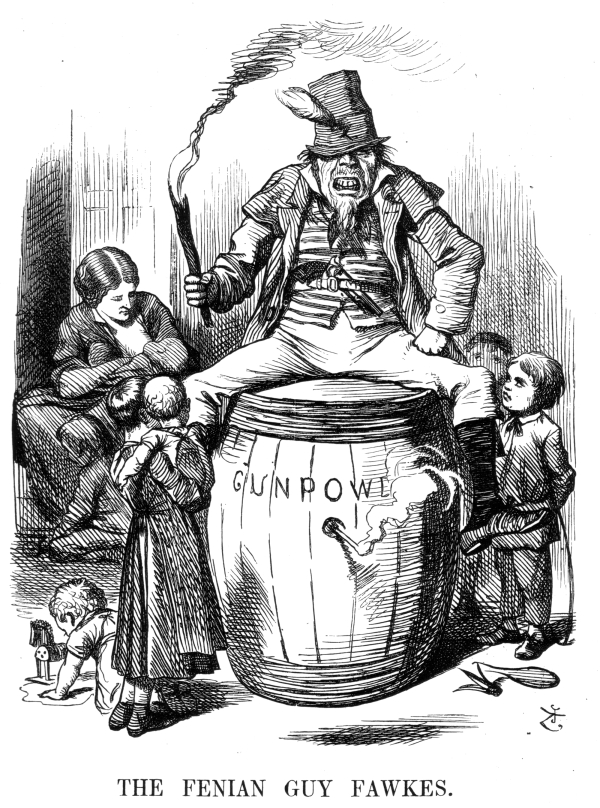
here). Often, outbreaks occur in small, tight-knit groups, due to the intensity of collective thinking. But if common thought is scaled up, hysteria can still occur. The Irish Fright of 1688 is a solemn reminder that when a prejudiced ideal is held by an entire country, fear can hypnotise the human mind into insanity. All it needs is a catalyst: political instability. [caption id="attachment_8768" align="aligncenter" width="600"] Anti-Irish propaganda continued for centuries: this cartoon is from ”Punch” magazine, published in December 1867. Credit: Wikimedia Commons[/caption]

The 17th Century Englishman’s understanding of the Irish

The trope of the ‘wild Irishman’ had been a firm narrative of the British Empire for centuries. Negative stereotypes appear as far back as 1190, with the Norman chronicler Giraldus Cambrensis justifying the Norman invasion of Ireland. He penned Topographia Hibernica, or Topography of Ireland, which played a lasting role in shaping English colonial attitudes towards the Irish. More than just poor and uncultured, the Irish were painted as unholy. In The Anglo-Irish Experience, 1680-1730: Religion, Identity and Patriotism, historian DW Hayton says: “the native Irish were called ‘a brutal race that Israel’s God ne’er knew’”. Conditioned by a racist misconception of the Irishman, the English people had a well-established fear. With political instability nibbling at their heels, they were primed for acts of mob mentality.

Political instability rocks England

When King James II took the throne after the death of the ‘Merry Monarch’ Charles II, his policies of religious tolerance were met with opposition from the political powers. Troubled by the new King’s Catholicism and his close ties with France, they were increasingly outspoken about the king’s unsuitability for the throne. Prior to the birth of James II’s son on 10th June 1688, the heir presumptive had been his 26-year-old daughter Mary, a Protestant married to William of Orange.  This change in the line of succession meant that the establishment of a Roman Catholic dynasty seemed ever more likely. In private, Tories and Whigs worked together to bring William of Orange to England to perhaps quell any danger of rising Catholic influence.

Irish soldiers come to Portsmouth

On his ascension to the throne, James had inherited an army in Ireland. It was made up of 8,238 men; majority Protestant. Over the next three years, the army would welcome some Catholic soldiers and grow to have almost 9,000 men. Due to the looming threat of an expected invasion by William of Orange, the English Army needed support from Irish troops. When 2,820 men were sent to Portsmouth in September 1688, the townspeople were suspicious. Fear began to spread. A few weeks after the Irish soldiers arrived, a newspaper reported that people were making “great complaints of the rude Irish who have caused many families to leave that place, having committed many robberies.” Rather than robberies, the true fear of the local people was that Irish or Catholic forces were in a fine position to launch an anti-Protestant uprising. In fact, just a few years earlier, the House of Lords had announced that there was a “horrid and treasonable Plot and Conspiracy, contrived and carried on by those of the Popish Religion in [Ireland], for massacring the English, and subverting the Protestant Religion, and the ancient established Government of that Kingdom.” As the Glorious Revolution to overthrow James II took hold, the Irish troops were ordered to go north to fight in the Battle of Reading on 9th December 1688. After a sorry defeat, some Irish troops were sent back to Portsmouth; some to Uxbridge, just west of London.

The Irish Fright grips England

One account from 1746 quotes Bishop Gilbert Burnet: “Country Fellows, arriving about Midnight at Westminster caused a sudden Uproar by Reporting that the Irish, in desperate Rage, were advancing to London, and putting all before them to Fire and Sword.” Other news writers passed similar comment, immediately igniting enough panic for 100,000 men to mobilise. Contemporary accounts tell us that men were discharging firearms and beating drums rapidly. Women were able to contribute more significantly to the din by beating pots and pans. False reports flew about the country. Allegedly, Uxbridge had been ransacked by the Irish. The House of Lords even had an emergency meeting at 3am in Whitehall to dissect the situation. Rather than subsiding due to lack of evidence, the Irish Fright snowballed. The following day, hysterical reports that the Irish were attacking Kent and Norfolk caused people to mobilise. People living in Kingston-upon-Thames started to cut down trees to barricade themselves against the ‘wild Irishman’. Madness swept northwards. By 15th December, Yorkshire succumbed to the Fright; believing that both the Lancastrians and the Irish were coming to burn their towns to the ground. Three days later, the Fright reached remote parts of England and Wales. On 18th December, a local mob shot and killed a supposed Irishman. As it turned out, he was an exciseman; someone they might have been happy to see the back of anyway. Significantly, the reports feeding from one town to the next talked about “8 or 9,000 Bloody Irish,” despite only 2,820 men having been stationed in Portsmouth originally. Hayton comments: “This panic was the climax to a decade of Whig propaganda, seeking to terrify the English public with the traditional nightmare of bloodthirsty Irish papists. That the programme worked so well proved the persistence in England of the popular reputation of the Irishman as a cruel savage, though it did require a political crisis to realise its full potential.”

The fallout of the Fright

Contemporary accounts tell us that at least 19 counties were swept up into the Irish Fright. All displayed a similar narrative: an onslaught of bloodthirsty Irishmen were said to have massacred the inhabitants of towns only around a day’s journey away. The panic burned brightly for a day or two before subsiding. Although the exciseman was the only casualty, innocent Catholics were targeted. A diarist noted: “[Protestant mobs] made most miserable of all the papists’ [Catholics’] houses they came near; for, under pretence of seeking for arms, they did many thousands of pounds worth of hurt, cutting down rich hangings, breaking through walls, pulling in pieces of excellent ceilings … then they secured all the papists they could get, intending to carry them all away to prison.” [caption id="attachment_8769" align="aligncenter" width="600"] Anti-Irish propaganda from ”Punch” magazine, published in May 1882. Credit: Wikimedia Commons[/caption] For all of its insanity, the Irish Fright was not a standalone, freak occurrence. Historians agree that it bore a striking resemblance to the French Great Fear of 1789, which followed the fall of the Bastille. In both uprisings, false rumours of massacres caused men and women to take up arms. Concerns about a collapsing regime, coupled with the cold realisation that no central authority could protect the people, resulted in a volatile civilian situation. With its echoes throughout history pointing towards a continuing relevance, the Irish Fright is a startling reminder of the power of a racist narrative in times of political instability.]]>
Categories
Breaking News

Sweden has been brewing beer since the Iron Age

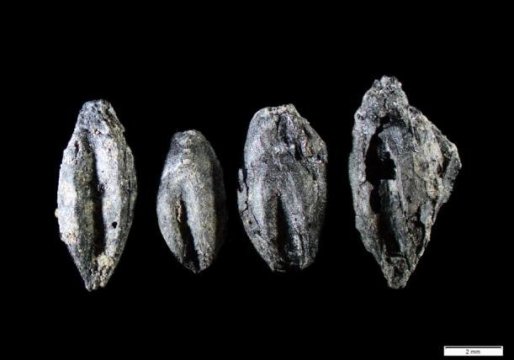
Carbonized germinated grains found at Uppåkra, Sweden.
Credit: Mikael Larsson[/caption] “We found carbonised malt in an area with low-temperature ovens located in a separate part of the settlement. The findings are from the 400-600s, making them one of the earliest evidence of beer brewing in Sweden,” says Mikael Larsson, a specialist in archaeobotany, the archaeology of human-plant interactions.

Beer: a hazy history

The brewing, consumption and distribution of beer was an important aspect of many ancient societies across the world. By way of example, beer was produced in Mesopotamia as far back as 4000 BCE. There have been suggestions that Mesopotamians could have been drinking beer in 10,000 BCE, but there is little evidence to back this up. We do know, though, that beer was drunk in Northern China 9,000 years ago. [caption id="attachment_8765" align="aligncenter" width="640"] Beer has played an important role in society for at least 10,000 years. Credit: Pixabay[/caption] But for the Nordic countries, evidence of early beer consumption is scarce, as there are no written sources from before the Middle Ages in this region. Knowledge of beer production has been, so far, dependent on botanical evidence. Existing findings are limited, though early traces of malt for beer brewing have been discovered in two other places in the Nordics. One is in Denmark from 100 CE and one is in Eketorp on Öland from around 500 CE. “We often find cereal grains on archaeological sites, but very rarely from contexts that testify as to how they were processed. These germinated grains found around a low-temperature oven indicate that they were used to become malt for brewing beer,” says Larsson.

A centre of political & religious power

Uppåkra, where the grains were discovered, is the largest known Iron Age settlement in southern Scandinavia. It served as a densely populated political and religious centre of power for more than 1000 years, from the 100s BCE to the 1 000s CE. Many imported and luxury items have been discovered at Uppåkra. Jewellery and glass bowls found on the sites indicate that the location was a rich, bustling trading centre – one that would likely play host to Scandinavia’s oldest brewery.

Scandinavia’s oldest brewery

Making beer is a two-stage process. Before the actual brewing, the malting process must be executed. Grains are soaked in water, which will allow the grain to germinate. While that’s happening, enzymatic activities convert both proteins and starches of the train into fermentable sugars. When enough sugar has been formed, the germinated grain is dried in an oven with hot air. It was this oven that was discovered and studied in Uppåkra, Sweden. Larsson explains: “Because the investigated oven and carbonised grain was situated in an area on the site with several similar ovens, but absent of remains to indicate a living quarter, it is likely that large-scale production of malt was allocated to a specific area on the settlement, intended for feasting and/or trading.”]]>

Categories
Breaking News

‘King Arthur’ inscriptions prove multiculturalism of 7th Century Cornwall

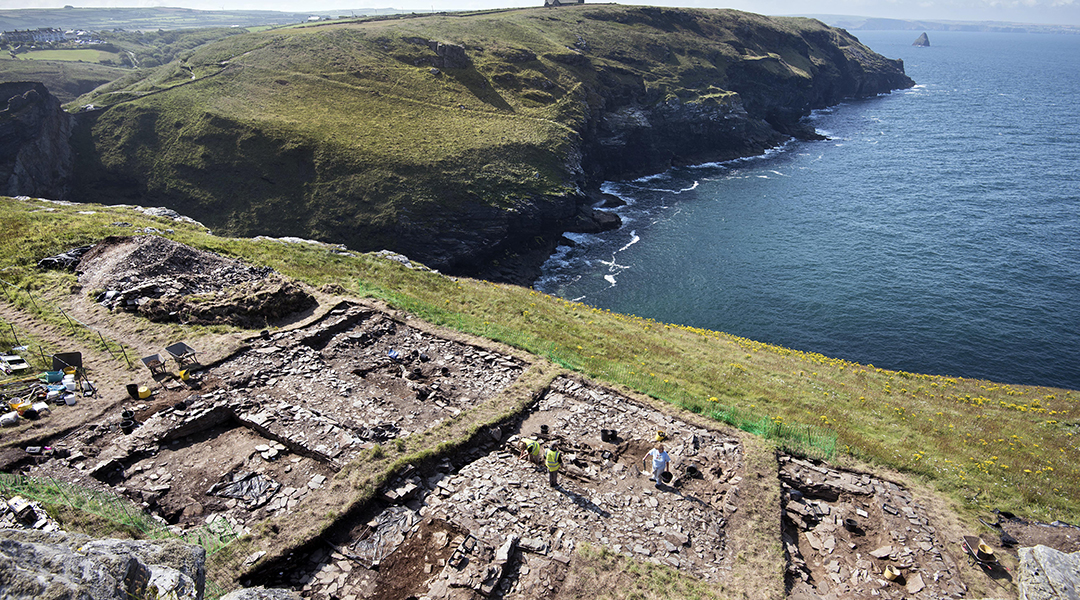
A court on the coast? The craggy Cornish coastline might not seem like an obvious choice for the location of a royal court. Nonetheless, English Heritage, which manages Tintagel Castle, says the find “lends further weight to the theory that Tintagel was a royal site with a literate Christian culture, and a network of connections stretching from Atlantic Europe to the eastern Mediterranean.” [caption id="attachment_8761" align="aligncenter" width="500"] Ancient writing inscribed in slate was discovered during an ambitious excavation at Tintagel Castle last summer. English Heritage has revealed the find ahead of it going on display at the Cornish castle. Credit: English Heritage / Emily Whitfield-Wicks[/caption]

Multiculturalism inspires early literacy

Measuring two feet long, the slate windowsill displays Latin and Greek inscriptions alongside Christian symbols. Roman and Celtic names ‘Tito’ and ‘Budic’ are legible, hinting at a thriving multicultural community in this part of Cornwall. The Latin words ‘fili’ (son) and ‘viri duo’ (two men) are also written. [caption id="attachment_8760" align="aligncenter" width="500"] Specialist digital imaging was created by Dr Tom Goskar to show the detail of the inscription. English Heritage has worked with a panel of experts to decipher the cryptic message from the past. Credit: English Heritage /Tom Goskar[/caption] It is believed that the scribe was practicing their handwriting while gazing out to sea. The decorative script can be likened to the illuminated Gospel manuscripts of the age, meaning that whoever wrote this would have been familiar with those texts. English Heritage Curator Win Scutt comments: “It’s incredible to think that 1300 years ago, on this dramatic Cornish cliff-top, someone was practising their writing, using Latin phrases and Christian symbols. We can’t know for sure who made these marks or why, but what we can say is that 7th Century Tintagel had professional scribes who were familiar with the techniques of writing manuscripts –– and that in itself is very exciting.” Writing from the early Middle Ages is rarely legible, but these words and symbols are clear enough to indicate that the person was familiar with both informal and formal scripts. Scutt continues: “Our ongoing research has already revealed the extent of Tintagel’s buildings and the richness of the lifestyle enjoyed here. This latest find goes one step further to show that we have a literate, Christian community, with strong connections from Atlantic Europe to the Mediterranean. Writing was a privileged pursuit, undertaken by specialist scribes attached to the Church or wealthy households. The discovery of this stone supports the idea that Tintagel was an important, thriving trade port, and a high-status settlement which could have been the seat of Cornish kings.” University of London’s Michelle Brown will decipher the inscription with the assistance of textual expert Oliver Padel. She considers the style of the writing to be as significant as the chosen words: “The survival of writing from this period is rare and this is a very important find, especially in terms of the continuity of a literate Christian tradition in post-Roman Cornwall. The lettering style and language used, as well as Christian symbols exhibiting Mediterranean influence and contacts, all reveal precious clues to the culture of those who lived at Tintagel in the 7th century.”

Deep research planned

The windowsill is not the first example of medieval writing to be unearthed at Tintagel Castle. In 1998, research revealed a stone inscribed with several words, including the Celtic name ‘Artognou’. Like the Artognou stone before it, this new windowsill is scheduled to undergo deep analysis. High resolution scanning is planned, which is likely to reveal just how the marks were engraved.

“We can’t ignore legends”

The legend of King Arthur was first brought to attention in the 12th Century by Geoffrey of Monmouth’s The History of the Kings of Britain. The debate over King Arthur’s existence continues; though Scutt considers the legend itself to have profound importance. “We can’t ignore legends,” he says. “This castle was built by Richard, Earl of Cornwall purely because of the Arthurian legend. There was no other reason for the castle to be here. These excavations will enable us to learn more about the older site, and we hope in turn they will encourage people to visit it.” For now, the stone will go on display at Tintagel Castle in Cornwall, UK.]]>

Categories
Editorial

“The strangest leader west of North Korea”: the personality cult of Turkmenbashi

Turkmenbashi rises to power Turkmenistan had operated under Russian control for more than a quarter of a century when it became part of the Soviet Union in 1924; so when Communism fell, the country found itself independent for the first time in 100 years. When it came to appointing a new leader, Saparmurat Niyazov was the obvious choice. Having operated as the Communist Party’s puppet governor since 1985, he was already considered by many to be the country’s ruler. Still, an election took place. On 21st June 1992, the Turkmenistani presidential election saw Niyazov chosen as the country’s first elected president. He was the sole candidate.

A post-Soviet cultural vacuum

One of his first acts was to declare himself Türkmenbaşy, or Turkmenbashi. Shortly afterwards, a plebiscite extended his term to 2002. Allegedly, it was to enable him to oversee a decade-long development plan. The proposal achieved a 99.9% approval rate in the vote. However, before the term was complete, Parliament declared him ‘President for Life’. It was no coincidence that parliamentary elections had been held just a few weeks earlier, in which the president had chosen all the candidates.

Extreme mismanagement of the economy

The gas-rich state allowed Turkmenbashi to indulge himself at the expense of a downtrodden population. His National Democratic Party managed the economy disastrously; meaning that 35% of the population lived below the poverty line. The average income, in fact, was less than £30 a month. Housing and fuel were cheap; but healthcare and education were sparse. This didn’t stop him from commissioning Central Asia’s largest mosque, the Spirit of Turkmenbashi, at a reported cost of £60m. On top of the hardships of widespread poverty, the ubiquitous image of the leader became inescapable. And yet, criticising the money lavished on this and other presidential projects – such as eccentric horse race tracks – would be committing the offence of ‘parricide’. In the national criminal code, this was defined as ‘questioning the policy of the president’.

Bizarre policies

Daily life in Turkmenistan became increasingly eccentric. He declared July 10th a public holiday to honour melons. April 27th was Horse Day. As time went on, allegedly drug-fuelled paranoia came to define the President-for-Life’s policies. The arts fell victim to Turkmenbashi’s whims: ballet, circuses and opera were all banned.

An ego goes berserk

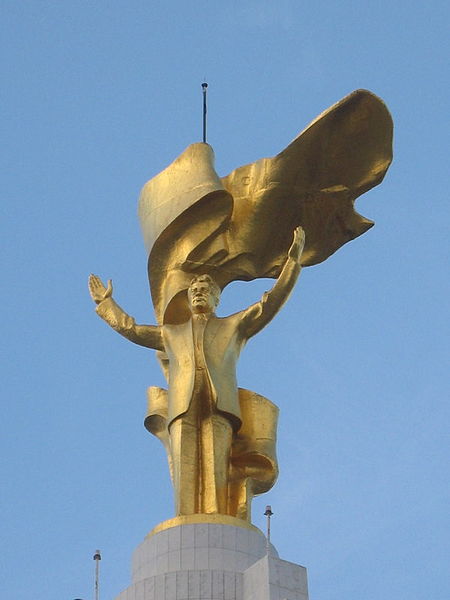
Many of Turkmenistan’s new laws reflected an uncontrollable ego. When he gave up smoking in 1997, so too did his populace (in public places, at least). Doctors took an oath not to Hippocrates, but to Turkmenbashi. The month of January was renamed Turkmenbashi; and a 250 ft gold statue of Turkmenbashi constantly rotated to face the sun. Streets, cities schools, and even the airport were all renamed Turkmenbashi, making the country increasingly difficult to navigate. When a meteorite landed in Turkmenistan in 1998, its given name surprised no one. [caption id="attachment_8752" align="aligncenter" width="450"] Credit: Martijn Munneke via Wikimedia Commons[/caption]

Turkmenbashi, the author

And yet, for all of his self-aggrandising moves, there are few that compete with his book. Like Chairman Mao and Colonel Gaddafi before him, Turkmenbashi penned a philosophical treatise known as Ruhnama, which is Persian for ‘Book of the Soul’. To celebrate finishing it in September 2001, he renamed the month ‘Ruhnama’. A combination of poetry, moral guidelines and revisionist history, it became compulsory reading in all schools. Indeed, an entire day of the schoolchild’s week was spent on Ruhnama. Memorisation was required to graduate, get a state job or receive a driver’s license. Its effect was not limited to the mortal lives of the people. The book lay next to the Quran in mosques, and it was to be kissed by all worshippers on entering the building. Shortly before his death, Turkmenbashi even suggested that reading the Ruhnama was a requirement for entry into heaven. Without much competition (all Soviet-era books were banned), Turkmenbashi awarded himself the Magtymguly International Prize, an accolade honouring the best pro-Turkmen poetry.

Repressing opposition politics

The edict of Ruhnama was so strictly enforced that when former chief mullah Nasurallah Ibadullah resisted, he was punished with a 23-year prison sentence. But of course, extreme punishments became characteristic of Turkmenbashi’s rule. Some were welcomed by certain pockets of society: he would execute Turkmen gangsters and display their dead bodies on national television. Other punishments were more political. In 2002, the country’s former foreign minister, Boris Shikmuradov, wrote an open letter accusing Turkmenbashi of staging an attack on his car so that he could enforce harsh laws. He wrote: “I intend to hand myself in to the National Security Ministry in the hope my arrest will stop the massive arrests and torture of innocent people… I write this while I am free. I can only assume what will happen to me in the near future… We have several times witnessed how people were physically and psychologically tortured.” Shikmuradov was arrested in December that year, confessed to his crimes on national television and was jailed for life. After that, the number of political prisoners in the country rocketed to an estimated 20,000. Many were forced to watch as their relatives were beaten. [caption id="attachment_8753" align="aligncenter" width="334"] Turkmenbashi walks with Vladimir Putin in 2000. Credit: kremlin.ru via Wikimedia Commons[/caption]

The strangest leader west of Pyongyang?

On 21 December 2006, Turkmenbashi died of a heart attack. Since then, his successor has been busy dismantling a personality cult that permeated every aspect of Turkmenistan’s society. As political author Daniel Kalder writes, “Soon Niyazov will be reduced to a footnote of history, a joke to all except the unfortunate five million Turkmens obliged to live under his rule.”]]>

Categories
Editorial

Colour symbolism in Viking culture: what we know so far

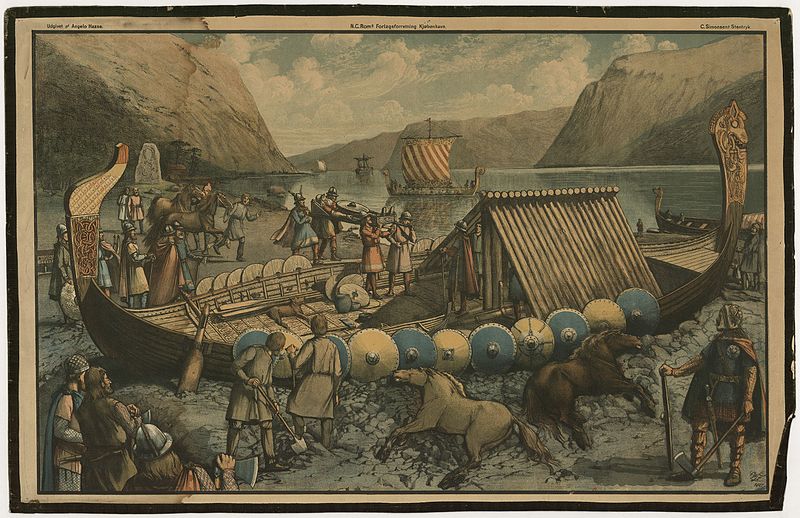
The pigments of pillage Regarding the Vikings, research has been relatively sparse. We know they used bold colours to be seen from a distance, and they would produce these colour pigments from numerous sources, including ochre and charcoal. These would have been blended together along with a binding agent (such as milk products, egg, or linseed oil), to allow the colour to adhere to the material. Now, after the publication of a new chemical analysis on Viking objects, we know more about the Viking use of colour than ever before. [caption id="attachment_8744" align="aligncenter" width="500"] En vikingehøvdings højsætning (“The burial of a Viking jarl”), Carl Schmidt, 1888. Credit: Wikimedia Commons[/caption]

No sailing under false colours

With the help of specialist teams of chemists, archaeologists have been able to study colour used in the Viking Age. Chemical analyses of pigments from objects have allowed them to stipulate what could have been the Vikings’ symbolic colour palette. Co-author of the paper and conservator from the National Museum of Denmark, Line Bregnhøi, says that the Viking Age was probably more visually vibrant that we may have first assumed. She says: “When we’ve previously excavated finds from the Viking Age among others, we weren’t so interested in colours. Partly because we didn’t have the techniques to study pigments, but also because we assumed that the colours appeared more or less as they were found.” [caption id="attachment_8743" align="aligncenter" width="440"] The study includes a selection of colours that are likely to have been used by the Vikings. Credit: National Museum of Denmark / Roberto Fortuna[/caption]

Authenticity first

However, she has now worked with colleague Lars Holten, director of the Centre for Historical and Archaeological Research and Communication, to create the colour palette used in the reconstructed version of The Royal Hall, Denmark’s largest Viking building. In the reconstruction, which sits at the Centre for Historical and Archaeological Research and Communication in Denmark, the team has worked with the same type of paint that would have been used by those in the upper echelons of Viking society. The Royal Hall has been decorated with linseed oil paint, as it would have been the most durable binding agent available to Viking painters. For authenticity’s sake, the hall has not been entirely covered in paint, as sheer expense means that this would have been unlikely.  

A study in scarlet

As has been true throughout the history of paint, some colours were rarer and thus more expensive than others. Imbued with symbolism, they indicated a separate social standing. Lars Holten comments: “We know that the symbolism of colour is enormously important in all cultures. Red, white, and black are some of the most common and have similar symbolism among numerous cultures.” Henriette Syrach Lyngstrøm, an archaeologist from the University of Copenhagen’s Saxo Institute, says: “it’s an important study because it presents the chemical analyses that form the basis for the very subjective ideas that archaeologist have on Viking Age colour.” Although not involved in the new study herself, she says it’s one of the most essential reports we have on the Viking’s use of colour. She continues: “On the rare occasion that we excavate a piece of painted wood, the colour looks nothing like the original. Here, chemists and conservators analyse the pigments and help us to further our interpretations.”]]>