Categories
Breaking News

Bone Could Link Transition From Fish to Tetrapods

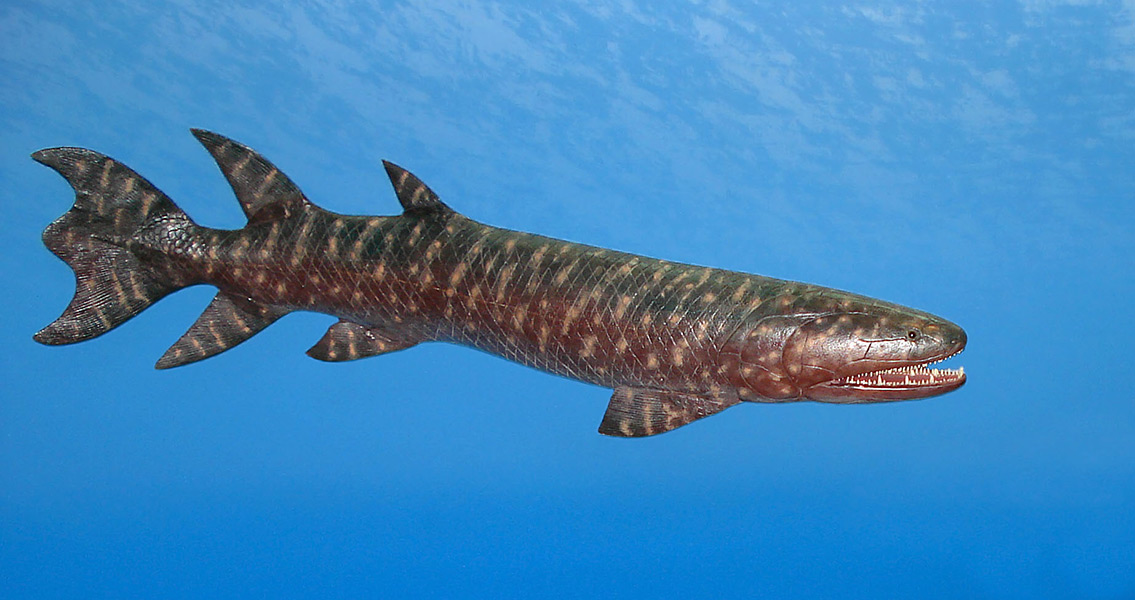
Prehistoric Wildlife notes. Later, however, it was established that it was a fish, though its anatomy and habitat in shallow waters were both factors linked to the later emergence of tetrapods. Land dwelling vertebrate animals originated around 390 to 360 million years ago, when some fish species that had lungs moved into shallow waters before eventually crawling onto land. In fact, all four-limbed vertebrates up to and including humans, along with lobe-finned fish, belong to the class of Sarcopterygii. Initially, this class only included lobe-finned fish but after scientists discovered that these fish were the ancestors of every four-legged animal, the class was expanded to include them as well. Image courtesy of Wikimedia Commons user: Dr. Gunter Bechly]]>

Categories
Breaking News

Earliest Georgian Script Found in 2,700-Year-Old Temple

New Historian “Most of the languages in the surroundings that I’m aware of used cuneiform script, which is significantly different in every way to that (the newly discovered script).” He added, however, that there are a number of possibilities as to what the script may be, but the current images available of it were insufficient to say anything with any degree of certainty. Image courtesy of Wikimedia Commons user: rocketfall]]>

Categories
Breaking News

Evidence of Leukemia Found in 7,000-Year-Old Skeleton

Categories
Breaking News

Large Aztec Tzompantli Unearthed in Mexico City

top 10 list of structures made using human bones, in which the top spot is occupied by a tower made from human skulls. The tower, made from the skulls of Serbian rebels against the Ottoman empire, was the brainchild of one general Hurshid Pasha, who built the 15-foot tower from 952 skulls, near the city of Nis. Commenting on the Mexico City find, one of the researchers working on the dig, Raul Barrera, told the AP that there are a lot more skulls in deeper layers in the ground, so the initial number of 35 is expected to swell considerably as excavations continue. This will take time, however, because the house above the site is considered to be historically valuable, so the archaeologists often have to work in narrow wells some six feet under the floor of the house, suspended on a wooden platform, lying face down. It seems that these efforts have paid off, since there is not much doubt that this is indeed the main tzompantli of the Templo Mayor Aztec. A year ago, scientists from the National Institute of Anthropology and History uncovered another partial tzompantli in Mexico City, under a stretch of a new underground extension currently under construction. Four skulls were discovered there, Gizmodo reports, one of them, interestingly, a dog skull. Animal skulls were put on skulls racks extremely rarely, with the Aztecs obviously believing that human heads were more awe inspiring. ]]>

Categories
Breaking News

Black Rock Canyon Pterosaur Myth Debunked

Antiquity. The composition, they write, is typical of Fremont art, which often depicts human shapes with elongated bodies and round heads that are surrounded by “attendants”, smaller images of animals such as cats, dogs, badgers, bears, and birds. Commenting on the news, one biologist who had seen the painting himself, Phil Senter from Fayetteville State University, told Live Science that what Bahn and Le Quellec had found was in line with his own view of the image, that it was clearly a collection of several images rather than one “pterodactyl”. Another scientist, world rock art professor Benjamin Smith, noted that dinosaurs only rose to fame in the nineteenth century, when palaeontology gained traction. It is difficult to imagine that a culture as ancient as the Fremont would have known about pterodactyls, regardless of the fact that the region around Black Rock Canyon is rich in pterosaur fossils. For more information: “The death of a pterodactyl” Image courtesy of Wikimedia Commons user: Franko Fonseca]]>

Categories
Breaking News

Finger Bone Find Pushes Back Origins of Modern Human Hand

Homo habilis and Paranthropus boisei, the researchers say, but was more modern human-like than them. In fact, this species could be a “missing link” between Homo habilis and Homo sapiens. The bone was discovered in Olduvai Gorge, northern Tanzania, at a rich palaeontological site called Philip Tobias Korongo, or PTK, and, according to UPI, moves forward the point at which hominins climbed down the trees and evolved hands suitable for holding tools by as many as 400,000 years. In their paper, the researchers who discovered the bone note that there has been ongoing debate about the cause and effect relationship between the evolution of a hand capable of manipulating tools and the invention of these tools, a debate in which the discovery represents a valuable input. For one thing, it brings the evolution of the modern human-like hand closer to the oldest stone tools, discovered earlier this year in Kenya. Still, the tools predate the finger fossil by more than a million years, suggesting there could be even older fossils of modern human-like hands. The lead author of the study, Manuel Dominguez-Rodrigo from the Institute of Evolution in Africa, told New Scientist that the bone “belongs to somebody who’s not spending any time in the trees at all”. It is straighter than the phalangeal bones of tree-dwelling hominins who used their hands as modern-day primates do, to move in trees by hanging from branches and swinging between them. Speaking to the Christian Science Monitor, Dominguez-Rodrigo also said that this species was already capable of using tools and it was larger than its contemporaries. Based on the size of the fossil, the hominin it belonged to must have stood about five foot nine, which is quite a bit more than Homo habilis, (the first hominin who left Africa), who has been estimated to have stood at around three feet tall. The authors of the study note that the evolution of the hand has been a major driver for the evolution of humans, because the more capable of manipulating objects it became, the more capable hominins got at using increasingly sophisticated tools. However, recent discoveries, including this one, are revealing a much more complex hand evolution picture. For instance, the researchers write, the hand bones of some Pliocene australopiths have proven to be much more modern human-like than the bones of hominins from a more recent era, the Pleistocene. This suggests that hands capable of manipulating tools evolved before the tools were invented, feeding more evidence into the debate about the causal link between hand evolution and tool invention. For more information: “Earliest modern human-like hand bone from a new >1.84-million-year-old site at Olduvai in Tanzania” ]]>
Categories
Breaking News

500-Year-Old Figurehead Recovered from Baltic Shipwreck

Categories
Breaking News

China Cave Reveals Social Impact of Climate Change

“A Chinese cave links climate change, social impacts, and human adaptation over the last 500 years” Image courtesy of Wikimedia Commons user: Thomas Bresson]]>

Categories
Breaking News

50,000-Year-Old Bones Found in Altai

Categories
Breaking News

Spoken Language May Not Have Evolved Arbitrarily

“Iconicity can ground the creation of vocal symbols” ]]>