Categories
Breaking News

Research Shows “Lucy” Could Walk Upright and Swing Through Trees

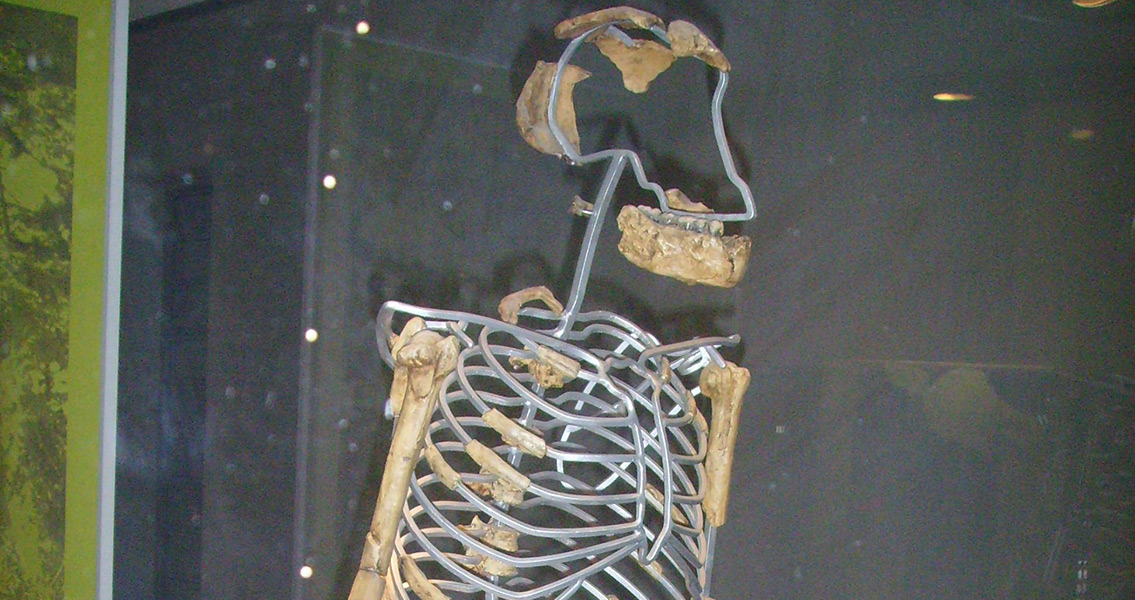
New Scientist. The debate may finally be settled based on the work completed by Christopher Ruff with Johns Hopkins University School of Medicine in Baltimore, Maryland, along with his colleagues. Using CT scans taken of Lucy’s skeleton, they studied the cross sections of both (left and right) upper arm bones along with the left thigh bone — the thigh bone from the right leg was never found. What the team discovered was that Lucy’s arm bones had thick walls, suggesting unusual strength. Bone strength is considered a “use it or lose it” characteristic directly related to an animal’s behavior and not inherited; meaning that at least some australopiths were at home on the ground and in trees. “It would not be present unless Lucy mechanically loaded her upper limbs more than most modern humans,” Ruff told New Scientist. “Ours is the best evidence to date that A. afarensis actually spent a significant portion of their time engaged in arboreal behaviour.” Over the course of a person’s life, bone structure changes depending on the way we use, or don’t use, our bodies. Human thigh bones typically have thicker walls due to all of our walking, our arm bones however, have relatively thin walls because we seldom use them to carry or lift our full body weight. Chimpanzees on the other hand develop arms with thick-walled bones because of their tree climbing. Previously, Ruff and his team discovered injuries to Lucy’s skeleton that indicated she may have died from a high fall, most likely from a tree. That study also suggested that Lucy spent a significant amount of time climbing trees, but it was far from conclusive. “I could fall out of a tree and present the same injuries as they suggest Lucy had,” Harcourt-Smith says in the article. The study has been published in the online journal PLOS One. ]]>
Categories
Breaking News

Long Discovered Mummified Legs Belonged to Queen Nefertari

Categories
Breaking News

Thousands of Animal Artifacts Entombed with Emperor

Categories
Breaking News

Bandicoot Fossils Show Marsupials were Ancient Survivors

Lemdubuoryctes aruensis however, the remarkably archaic new bandicoot fossil discovered by Alpin, didn’t live in a rainforest but on an expansive savannah plain stretching from Australia to New Guinea at the time of the last glacial maximum. “While retreating rainforests and spreading grasslands did provide a backdrop for ecosystem change 5-10 million years ago. The Australian fauna likely adapted via changing its distribution rather than undergoing wholesale extinction and replacement,” Michael Westerman, with La Trobe University in Australia, says in the article, adding, “This agrees with our results from DNA, which indicate that modern desert-living bandicoot groups pre-date the onset of aridity by as much as 40 million years.” These timeframes coincide with the proliferation of Eucalyptus woodlands in Australia’s interior. “Bandicoots, like other Australasian marsupials, probably occupied a range of different habitats over many millions of years. However, our study has further implications for future conservation. Arid zone bandicoots are amongst the most vulnerable mammals in Australasia today, with multiple species having gone extinct within the last 100 years. By demonstrating their profound evolutionary antiquity, we can thus serve to highlight how extremely urgent it is to protect these living fossils as part of Australia’s unique biodiversity”, Dr. Kear is quoted as saying in the Heritage Daily article. The study has been published in Scientific Reports. ]]>

Categories
Breaking News

Original Site of the Plymouth Colony Identified

Categories
Breaking News

Discovery Suggest Jordan’s Black Desert was Full of Life

Live Science. That was not always the case, however. “There are literally many thousands of Safaitic inscriptions and petroglyphs in the Jebel Qurma region, which suggests that people intensively used the area.” The petroglyphs (rock art) include renderings of lions, horses, gazelles and large birds – possibly ostriches. The writing found near the petroglyphs is mostly short texts of names. Several texts contain information on the activities of people, while a few hint of a conflict between the people of Jebel Qurma and the Nabataeans, the people responsible for building the ancient city of Petra. One such inscription reads: “I am on the lookout for the Nabataeans.” Other inscriptions describe the challenges and obstacles encountered by the residents of Jebel Qurma. “May there be strength against hunger,” one text reads, while another describes a man who was “distraught over his beloved.” Specialists are analyzing petroglyphs and texts to get a clearer understanding as to their meaning and the reason they were created. “The precise reason for producing rock art — inscriptions and/or representations — is still unclear and open to discussion. What was the message which the producers of the rock art tried to convey?” Akkermans asks in Live Science. In addition to the inscriptions and rock art, archaeologists discovered the remains of shelters, camps and tombs which were used by the people living in the area, who were likely nomadic. The team continues to look for additional evidence indicating what the environment may have been like in ancient times and how the landscape turned into the desolate region of today. “Our excavation at one site revealed masses of charcoal from the third century A.D., which appeared to represent several taxa [groups] of trees, which needed water year-round,” Akkermans says in the Live Science article. “Hence, the conditions in at least the third century A.D. may have been quite different from today. This is certainly something I wish to explore in the next field seasons, by coring for pollen.” The goal of the Jebel Qurma Archaeological Landscape Project is to study the extraordinary archaeological heritage in Jordan’s Black Desert. The project involves field surveys and excavations in the Jebel Qurma range east of the oasis of Azraq, close to the Jordan-Saudi border. The findings have been published in the American Journal of Archaeology. ]]>

Categories
Breaking News

Australia’s Oldest Bone Jewelry was Crafted 50,000 Years Ago

New Scientist: “I’ve met Indigenous Australians who remember their granddads wearing nose bones for special occasions,” adding, “In some groups, nose bones were only worn by elders, but in others, there were no restrictions, so all men and women could wear them to look more appealing.” The first humans to reach Australia would likely have brought the skills to craft bones from Africa where they were originally developed, and then adapted them to work with the bones of animals found in Australia. Kangaroo bones, which are strong, hard and easy to acquire, were easy replacements for ivory and horns. In Africa, humans have used bones as tools for more than a million years, however, the oldest recorded bone ornament on the continent is only around 15,000 years-old. It’s possible some of the bone artifacts which were older were mistakenly identified as tools as opposed to ornaments. This mistake in identification seems more probable than Australia being where bone jewelry was first developed. “Ancient bone technology discovered in Australia is important because it reshapes our understanding of the first inhabitants.” Langley says in New Scientist, “Findings of early bone tools and ornaments have been rare, leading to a long-held theory that Indigenous Australians initially lost the skills they brought from Africa.” “This shows that the first people in Australia were just as capable as those everywhere else of complex actions,” Ian Lilley from the University of Queensland is quoted as saying in the New Scientist article, “So whether this artefact was used as a nose bone or for sewing skins doesn’t really matter – it’s evidence of complicated behaviour.” To date, the oldest jewelry ever made by early humans are the 100,000-year-old shell beads discovered at sites in Africa as well as the Middle East, which look as if they had been strung together to create necklaces. Our cousins the Neanderthals appear to have beaten us to it, as they might have been creating jewelry around 80,000 years before early humans even made it to Europe. Eagle talons discovered at the Krapina Neanderthal site in modern-day Croatia date back 130,000 years and have features that suggest they may have been used in a bracelet or necklace. ]]>

Categories
Breaking News

Early Set of Dentures Constructed With Human Teeth

Categories
Breaking News

Researchers Discover Maya “Nesting” Pyramids

Guardian. The presence of the third structure suggests the Kukulkan pyramid was built in three separate stages. The first, innermost pyramid was constructed between the years 550 and 800. The middle pyramid, which was discovered in the 1930s, was built between the years 800 and 1000. The largest, final pyramid dates back to the years 1,050 to 1,300. Structures like El Castillo were constructed one on top of the other for a variety of reasons, including the arrival of new leaders or deterioration. The research team is hopeful the find will reveal information about the original Maya culture prior to influences from central Mexico populations. The Mesoamerican Maya civilization was notable for its hieroglyphic script, the only fully developed writing system within the pre-Columbian Americas, and also for its architecture, art, calendar, mathematics, and astronomy system. In 2015 archeologists discovered the pyramid was built on top of a cenote (sinkhole), common to the region and considered sacred by the Maya. The sinkhole under the temple is approximately 82 by 114 feet (25 by 35 meters) and could be up to 65 feet (20 meters) deep. Researchers also found that the pyramid sits on a 16 foot (4.9 meter) layer of limestone on top of the cenote. The discovery of the limestone layer, like the discovery of the third pyramid, was made using a new noninvasive technology involving the placement of electrodes in the area surrounding a structure and sending an electrical current into the ground. While the current is being emitted measurements to determine whether or not sub-surface elements are impeding or increasing the electrical potential are taken and then processed with software that creates three-dimensional maps of the subsurface area. A Mesoamerican step-pyramid, El Castillo dominates the center of the Chichen Itza complex. It was built by a pre-Columbian Maya civilization between the ninth and twelfth centuries CE. The pyramid functioned as a temple to the Yucatec Maya Feathered Serpent god Kukulkan, who was closely related to the Aztec god Quetzalcoatl. The National Institute of Anthropology and History has begun closing pyramids and monuments to the public in an effort to preserve the buildings, so while visitors can still walk around them, they can no longer climb or enter them. Climbing El Castillo was halted after a woman fell to her death in 2006. Today, it remains one of Mexico’s most recognized pre-Columbian structures. ]]>

Categories
Breaking News

Mesolithic Man Burial Site Studied in Ireland