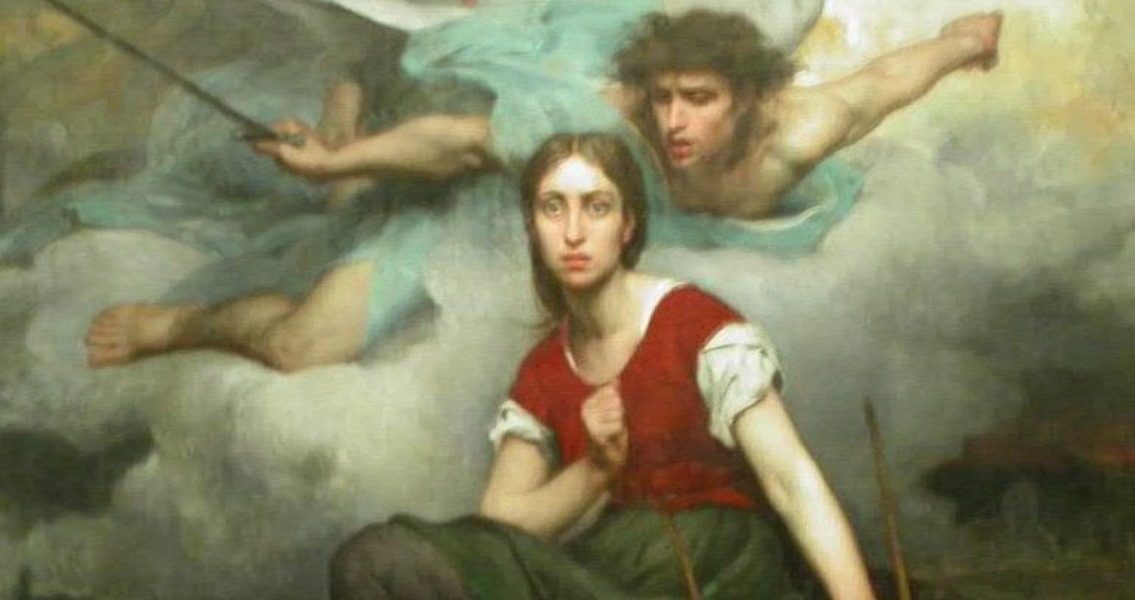
Live Science they initially came up with the hypothesis while they were examining documentation relating to Joan during her Trial of Condemnation, where she was tried for being a heretic and a witch, and ultimately sentenced to death. Joan of Arc, also called “The Maid of Orléans”, is a heroine in France for her role in the Hundred Years’ War. She has been canonized as a Catholic saint. Several aspects of the symptoms Joan had, which are detailed in the historical accounts, support the diagnosis, d’Orsi’s and Tinuper’s letter states. For example, the historical documents indicate that Joan reported seeing saints, like St. Margaret and St. Catherine, and hearing voices. These visual hallucinations (which only occurred occasionally) and auditory hallucinations are symptoms associated with this form of epilepsy, the team told Live Science. Additionally, sufferers of this type of epilepsy (40%) have seizures while asleep, another symptom Joan of Arc reported having. The frequency with which Joan heard voices, however, is not completely consistent with the proposed diagnosis, and other researchers point to the fact that patients with this form of epilepsy experience seizures infrequently. While diagnosing a medical condition in a person who lived during the 1400s isn’t easy, there may still be an opportunity to definitively answer the question; all that’s needed is a strand of Joan’s hair. It’s believed that Joan sealed her letters with red wax, imprinted with a fingerprint and a hair, to prove her identity. If historians can find even one of these letters, scientists may be able to test the DNA of the hair. To date, all efforts to find a letter sealed in this manner by Joan of Arc have been unsuccessful, but if such a discovery is ever made, scientist have identified the genes which are linked to this specific form of epilepsy, making DNA testing possible. ]]>


 Columbus, however, had no idea of the magnitude of his discovery. He was convinced he had landed in the far East; when his crew sighted Cuba he believed it to be China, and when they discovered the island of Hispaniola he believed he had landed on the coast of Japan.
He set sail back for Europe with his two remaining ships (the Santa Maria had been wrecked on a reef off of Hispaniola), loaded with gold, spices, and captured natives.
After hearing tales of the riches of the islands Columbus had discovered, Isabella and Ferdinand granted the funds and support for a second voyage west, hopeful that the fabled passage to Asia would be discovered.
Arriving at Hispaniola, Columbus found the settlers he had left behind at Navidad had all been killed. Columbus’ response was extreme, the indigenous population were enslaved into forced labour (despite Isabella being a firm critic of slavery) to build a colony for the Europeans and search for gold.
After further exploration of the Caribbean islands, Columbus set sail for Europe once again, his two brothers left in charge of the settlement on Hispaniola.
Columbus’ second voyage hadn’t been nearly as lucrative as anticipated, yet the Spanish monarchy eventually awarded the funds for a third, this time made up of six ships – three to search for the sea route to Asia, three to bring supplies and settlers to Hispaniola.
Plagued by poor weather, which slowed the ships’ progress, the beleaguered explorers eventually discovered the island of Trinidad, where they resupplied. There the expedition split, and Columbus personally led the ships searching for a passage to Asia.
Perhaps history’s greatest explorer, Columbus failed in his goal of finding a trans-Atlantic link between Europe and Asia. Nevertheless, his explorations shaped world history, and for the indigenous populations of the Americas, brought truly catastrophic repercussions.]]>