

Proceedings of the National Academy of Sciences. ]]>

PLOS ONE. If the notches on the raven bone were indeed made intentionally by a Neanderthal, it would suggest a much higher level of cognitive ability among our closest extinct evolutionary cousins than is typically assumed. Majkic and her team carried out a range of tests to determine whether two extra notches on the ZSK raven bone had been made by Neanderthals with the intention of making the final series of notches appear evenly spaced. Interestingly, these tests involved using modern day volunteers as a means of assessing the aesthetic intention behind the notches. The researchers carried out a multi-phase experiment involving turkey bones of a similar size to the raven bone unearthed in Crimea. Participants were asked to create evenly spaced notches in the bones, and these bones were then subjected to morphometric analysis. The analyses revealed that the equal spacing of the notches in the modern day test were comparable to those in the ZSK raven bone, even when they were adjusted for errors in human perception. For the researchers, this similarity is deeply significant. As they write in the abstract to their study: “This suggests that even if the production of the notches may have had a utilitarian reason the notches were made with the goal of producing a visually consistent pattern. This object represents the first instance of a bird bone from a Neanderthal site bearing modifications that cannot be explained as the result of butchery activities and for which a symbolic argument can be built on direct rather than circumstantial evidence.” Popular culture tends to portray Neanderthals as primitive when compared to modern humans. The reality however, is far more complicated. The idea of the brutish, uncultured Neanderthal is increasingly being challenged as new discoveries fuel debate over their cognition. Some scientists go as far as claiming Neanderthal cognition would have been comparable, perhaps even equal, to modern humans’. Others say that factors such as differences in cranial morphology and evidence of behaviour suggest vast differences between human and Neanderthal cognitive levels. Recent discoveries of altered bones at Neanderthal sites have been described by some as proof that Neanderthals had a taste for personal ornamentation. Earlier this year, a study claimed to have found evidence that Neanderthals used plant based medicine, pointing to a high level of intellectual development and awareness of their surroundings. Perhaps most unusually, a strange looking piece of limestone found at a site in Croatia was taken as an example of Neanderthals’ sense for aesthetics. The researchers who discovered the rock believe it could have served no practical function, and therefore may have been kept by a Neanderthal purely for the way it looked. Image courtesy of Francesco d’Errico]]>

Proceedings of the National Academy of Sciences, can be found here Image courtesy of Lior Weissbrod ]]>

The Fame, a Dutch merchant vessel lost in a storm in 1631. The ship, long known as the ‘Swash Channel Wreck’ after the location it was found, was discovered lodged in a sand and shingle bank outside Poole Harbour. The rudder of the wreck was raised in 2013 from the seabed after nearly ten years of investigation and excavation. Pulling the 28-foot rudder from the depths revealed a male face, complete with moustache, had been carved into it. The rudder has been placed on display for the public at Poole Museum after historians confirmed it belonged to The Fame. The timbers of the rudder were analyzed and historical records were studied in order to match the rudder with the ship says Dave Parham, a marine archaeologist from Bournemouth University. Parham said that while one can never be sure, everything from investigations into the rudder fits the theory that it belongs to The Fame. The timbers are the right age, according to the marine archaeologist, and the dates and names all match historical records. The likelihood that the ship had been traveling from the Netherlands to the Americas, using Poole as a port of call, is high. The discoveries add a human element to the wreck and provide a lens to view the history of Poole, according to Parham. Dr. Ian Friel, the historian who carried out the lion’s share of the research into the rudder, called the find “remarkable”. While there wasn’t any central shipwreck record dating back to the seventeenth century, Dr. Friel was able to discover local accounts attesting to how the wreck was considered a danger to shipping after it broke up and sank on a sandbank after dragging its anchor. The historian also surmised, according to the records he was able to find, that The Fame could have sailed without any cargo in its hold at the time of its watery demise. It would have set sail from Hoorn, a port near Amsterdam, in January of 1631, bound for the West Indies with around 45 people aboard. While the ship broke up on Hooks Sand in February 1631 after dragging its anchor in a storm, there were no fatalities when The Fame sank. According to Dr. Friel, this precluded the sunken ship from being legally considered a “wreck”. Despite this, there’s evidence that much of the ship’s contents, including its cannon, were looted. The wreck was originally discovered in 1990, when a dredger struck the ruins. It took two long years to raise the rudder of The Fame, which was brought up alongside the bowcastle of the ship in 2013. York Archaeological Trust then undertook a three-year conservation effort to dry and preserve the raised rudder before placing it on display at Poole Museum alongside other artifacts from the wreck. The rest of The Fame has since been covered in sand to protect it from the corrosive effects of seawater. ]]>

The death of megafauna Some scholars have suggested that humans started making irreversible changes to the planet as far back as ten thousand years ago. When humanity first started to spread across the globe spectacular megafauna inhabited the continents, from Wooly Mammoths in the Northern Hemisphere to giant kangaroos in Australia. Many of these creatures are now extinct, with scientists debating intensely whether this was the result of human activity – such as hunting or competition for food, the drastic climate change at the end of the Ice Age; or a mixture of both. If these mass extinctions were driven by humans, it would signify a massive, permanent change to the planet’s ecosystems. Ecosystem Makers Humanity’s influence has not necessarily been just destructive. There is an increasing number of scientists and archaeologists who argue that two of the planet’s most awe-inspiring ecosystems: the Amazon rainforest and the Sahara Desert, could have been created by human activity. Fertile land found radiating from the remains of ancient settlements in recent years has led some archaeologists to claim that for millennia a massive civilisation once inhabited the Amazon, enriching the soil to allow the rainforest to grow. Earlier this year, a new study looked at the distribution of various tree species to add further support to the idea the Amazon was shaped by human hand thousands of years ago. Earlier this year, a research study claimed humans may have played a role in turning the Sahara from green, fertile and dotted with lakes 10,000 years ago to the desert it is today. The research suggests that the arrival of pastoralism to the Sahara could have upset the region’s ecosystem, cleared vegetation leading to an increased albedo and drastic reduction in rainfall. The theory is a relatively new one, but the team behind it are continuing their search for more evidence to support it. The Little Ice Age A 1677 painting by Abraham Hondius depicts ice skaters on London’s River Thames. To any modern Londoner, such a sight seems unthinkable. The seventeenth century was characterised by plummeting temperatures on a global scale however, which some historians label the Little Ice Age. A number of explanations have been offered for this prolonged period of unusually low temperatures, from increased volcanic activity blocking the sun’s radiation to changing ocean current flows. Some have even suggested a shift in the earth’s orbital cycle could have caused the freeze. Another argument posits a human explanation. Specifically, some scientists claim that the massive population loss in the Americas following the arrival of Europeans led to a huge decline in agriculture and process of reforestation substantial enough to change the oxygen/carbon ratio in the atmosphere and generate a cooling effect. Killing the Aral Sea As recently as the 1970s the Aral Sea was the fourth largest lake in the world, yet only 10% of it now remains, leaving a desert in its place. Situated between Kazakhstan and Uzbekistan, the Aral Sea’s disappearance took less than forty years. In the 1960s irrigation projects by the Soviet Union saw the two main rivers feeding the lake diverted. The consequences have been terrifying. The climate in the area has changed massively due to a huge reduction in rainfall. Fishing communities have been devastated by lost livelihoods. Toxic gases rise from the exposed seabeds, leading to dangerous levels of pollution in the area. Ecosystems that once flourished in the Aral Sea are now all but extinct. Meanwhile, dust storms caused by the dried up land have caused nearby glaciers to melt much faster, in turn leading to massive reductions in the amount of drinking water. Radiation The 1950 date chosen by the Working Group on the Anthropocene is heavily tied in with the proliferation of nuclear weapons and power. Although atomic bombs were being tested in the USA in the 1940s, with the first two used in anger against Japan in 1945, it was in the 1950s that nuclear weapons went global. The nuclear arms race saw more and more countries testing weapons of mass destruction, while nuclear power stations also sprung up around the globe to meet a growing energy demand. These saw radioactive elements flung across the planet, having an immeasurable impact on the environment. There are of course countless other examples which could be mentioned, all of which point to the impact mankind has had on the planet. Some are debatable, some speculative, others, such as the drying of the Aral Sea, impossible to deny. Whether one believes we live in the Anthropocene or not, mankind has undoubtedly left a dramatic mark on the delicate ecosystems and environment of the planet. ]]>

National Post, adding, “It is difficult, perhaps even impossible, to find proof of one ordinary person from thousands of years ago.” However, based on finds from hundreds of archaeological digs, Avni believes archaeologists can accurately reconstruct Jesus’ life from the Church of the Nativity, the site revered as his birthplace, to the Church of the Holy Sepulchre, where he is believed to have been buried after the Crucifixion. Professor of Christian archaeology, Eugenio Alliata, explained to the National Post that the artifacts corroborate the biblical accounts of Jesus and his life, putting his existence into context. “We have not found any evidence of the person of Jesus, but we have found lots of things about what happened at the time he lived, such as the population and the material culture that grew because of him,” Eugenio Alliata, a professor of Christian archaeology at the Franciscan biblical school in Jerusalem, is quoted as saying. Image courtesy of MENAHEM KAHANA/AFP/Getty Images ]]>
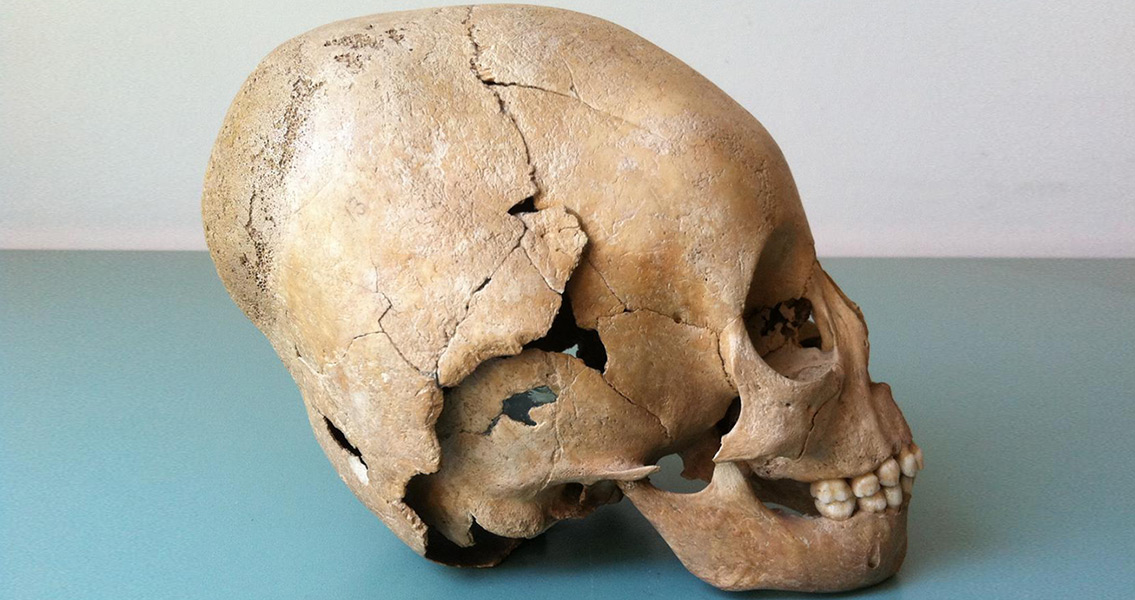
PLOS ONE, the new study from the University of Cambridge looks at fifth century gravesite remains in the Roman frontier of Pannonia (in what is now Hungary) to reveal how ordinary people might have dealt with the arrival of the Huns. One remarkable discovery points to the Huns recruiting from the Roman frontiers. Biochemical analyses of teeth and bones suggest some farmers gave up their homesteads on the edge of the Roman Empire to become roaming herdsmen like the Huns. This raises the possibility that some of these farmers may have taken up arms and fought for the Hun tribes. The cultural exchange between Huns and farmers was far from a one way process, however. Nitrogen and carbon isotopes in remains can allow researchers to distinguish between agricultural and pastoral diets. Based on this, the team found a significant dietary shift in some sets of remains, suggesting that some Huns gave up on their nomadic lifestyle and elected to settle into an agricultural one. According to lead researcher Dr Susanne Hakenbeck, the Huns may have introduced farmers to ways of life some found appealing, but they also learnt from and occasionally settled among the locals. “We know from contemporary accounts that this was a time when treaties between tribes and Romans were forged and fractured, loyalties sworn and broken. The lifestyle shifts we see in the skeletons may reflect that turmoil,” said Hakenbeck, in a press release. “However, while written accounts of the last century of the Roman Empire focus on convulsions of violence, our new data appear to show some degree of cooperation and coexistence of people living in the frontier zone. Far from being a clash of cultures, alternating between lifestyles may have been an insurance policy in unstable political times.” Hakenbeck’s team analysed the carbon, nitrogen, strontium and oxygen isotopes of bones and teeth from the fifth century graves in Hungary. Those were then compared with sites in Germany known to have been home to typical farmer communities, and sites in Siberia and Mongolia known to have been home to nomadic herders. Unlike the other sites, Pannonia showed signs of both nomadic and agricultural lifestyles, as well as individuals that switched between the lifestyles during their life times. “The exchange of subsistence strategies is evidence for a way of life we don’t see anywhere else in Europe at this time,” said Hakenbeck. The results paint a picture of the Hun incursions markedly different to those offered by Roman authors from the period. As Hakenbeck explained: “While Roman authors considered them incomprehensibly uncivilised and barely human, it seems many citizens at the edge of Rome’s empire were drawn to the Hun lifestyle, just as some nomads took to a more settled way of life” . Image courtesy of Susan Hakenbeck ]]>